Caraway says its cookware is tested against more than 600 PFAS compounds and more than 20 heavy metals. A ceramic pan at a big-box store rarely gets that kind of testing, or at least never says so. That gap is a real part of why a Caraway set costs what it does.
But it is not the whole story. And it does not mean the pan itself outlasts a cheaper one.
Caraway's premium traces to three things its own CEO names on record.
Independent PFAS and heavy-metal testing. A large patent portfolio. And the retail expansion that comes with a direct-to-consumer brand moving into big-box stores.
None of that is a claim about the pan lasting longer, though. Caraway's 1-year warranty ties Our Place's Always Pan 2.0 for the shortest coating coverage among the ceramic pans we checked. And it excludes the exact heat-caused damage owners report most often.
So which is it? Are you paying for something real, or just for design and packaging? Both, depending on which slice of the price you're asking about. If you're weighing Caraway against nonstick brands more broadly, our nonstick cookware buying guide covers the buying decision axis by axis.
Where the money says it goes#
Caraway's founder and CEO, Jordan Nathan, has been very direct about this in interviews. Asked where the money goes, he names product development first.
"Our biggest investment is still product," he told Retail TouchPoints. "We have a really active innovation pipeline built out to 2030."
Caraway's own third-party testing claim sits at the center of that pitch: Caraway says its testing covers more than 600 PFAS compounds and more than 20 heavy metals.
"Anyone can put the words non-toxic on a label," Nathan said, "but backing them with testing, design and access is much harder to copy." The brand also says it holds more than 400 patents issued or pending.
That's a cost center. It has nothing to do with how the pan cooks.
Nathan also pushes back on the idea that the premium is just marketing spend. "We've never believed growth comes from simply spending more money on advertising," he said.
He frames it as product design and education instead. That's the company describing its own goals, not an outside audit, so treat it as a claim, not proof.
It does line up with a real cost, though. Caraway started as a direct-to-consumer brand in 2019, grew its wholesale footprint from Crate & Barrel into Target, The Container Store, Costco, Macy's, Dillard's, and Amazon, and, as of July 2026, added more than 500 Walmart stores.
Store shelves cost money in a different way than a website does. "In retail, you have a few seconds to capture someone's attention," Nathan said. Packaging matters more there.
News reports also say tariffs on imported cookware pushed Caraway's costs up. That's a fourth layer, and it has nothing to do with the coating.
Add all of that to the price, which stays discounted all year instead of on sale for a short time, and the 12-piece Cookware Set starts to look less like pure markup. It looks more like testing, patents, and retail overhead.
That's a fair reason for the higher price. Whether the pan lasts longer is a separate question.
What the premium doesn't buy#
Here's where the math gets less flattering. Caraway's warranty covers defects for one year. It does not cover "non-stick deterioration, discoloration, warping, or metal separation due to high heat, prolonged heat exposure."
Owners on Amazon report coating problems anywhere from one month to about a year of normal use. The warranty period and the failure period mostly overlap. But the warranty does not cover the part that actually fails.
Compare that to the rest of the ceramic pans. Our Place's Always Pan 2.0 also carries a 1-year warranty, per Consumer Reports' own data. So Caraway isn't the only short one; it ties for shortest.
GreenPan's standard Thermolon coating carries a 2-year warranty. Its named premium lines (Barcelona, Copenhagen, Craft, Padova, Premiere, Venice Pro, Featherweights) stretch that to 5 years. Scanpan's Stratanium and Stratanium+ lines, and HexClad's cookware, both carry a limited lifetime warranty against defects.
But "lifetime" has limits. HexClad's own warranty terms also leave out damage from too much heat, the same failure Caraway's warranty leaves out.
So the honest read isn't "Caraway's warranty is bad and everyone else's is great." It's that ceramic warranties fall into two groups: about 1 year on one side, 2 to 5 years or lifetime on the other.
Even the longer-warranty brands often skip the single most common cause of failure. Caraway's window is short enough that it almost fully overlaps with reported failures. A 5-year or lifetime window at least outlasts most failures, even without covering how they happen.
The decision that actually matters#
Forget "is Caraway worth it" as one yes-or-no question. Ask this instead: how often do you actually replace a nonstick pan?
If you replace nonstick pans every 1 to 2 years regardless of brand, a cheaper ceramic set gives you the same practical protection as Caraway's warranty, for a fraction of the price. The testing Caraway discloses and the design premium are real.
But neither one makes the pan last longer than a budget set over that same time. If you want a warranty that spans several years instead, GreenPan or HexClad buy more time on paper, even with the same heat-damage gap working against them.
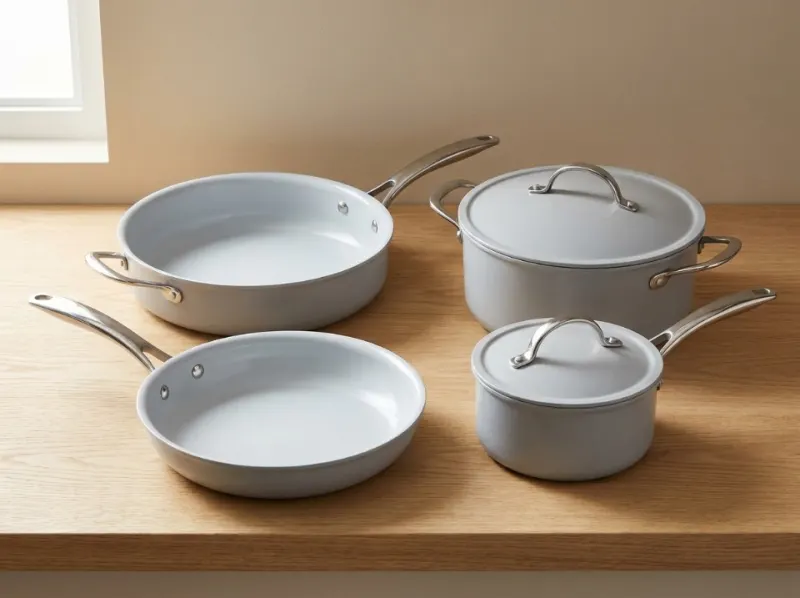
What the premium clearly buys, no matter which camp you're in: a PFAS-free claim backed by independent third-party testing, plus a heavy-metal-free claim that is Caraway's own stated assertion. A coating that covers both the outside and the inside of the pan. You can look up any brand's PFAS status in our cookware safety checker to see whether it is bare metal, PTFE, or something safer.

And matching storage pieces that solve a real cabinet problem, if you've ever tried to stack four mismatched pan lids. If none of that matters and you just want food to release cleanly, our deeper look at whether Caraway is worth it covers durability in more detail than this price breakdown does.

The Verdict on Why Caraway Costs So Much#
Caraway's price is not an accident and it is not pure markup, either. A real chunk of it funds independently verified non-toxic testing, a large patent portfolio, and the retail growth that gets the brand onto more shelves. That's a real cost, even if unaudited, not just a design tax.
What it is not is a longer warranty or a coating proven to outlast cheaper ceramic pans. If you specifically want independently tested non-toxic proof and a design you're happy to pay for, the Caraway Ceramic Cookware Set earns its price.
If you expect that price to buy meaningfully longer coating life than a budget ceramic pan, the sourced warranty terms say otherwise.