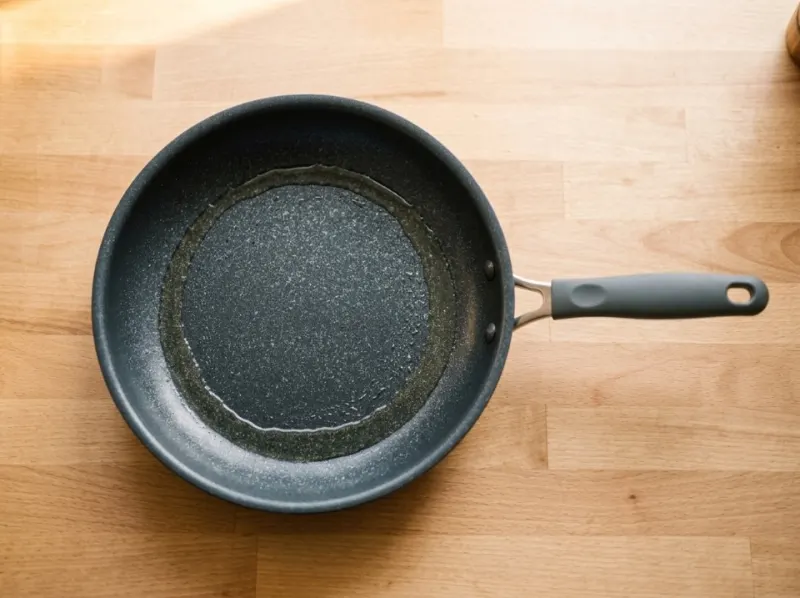
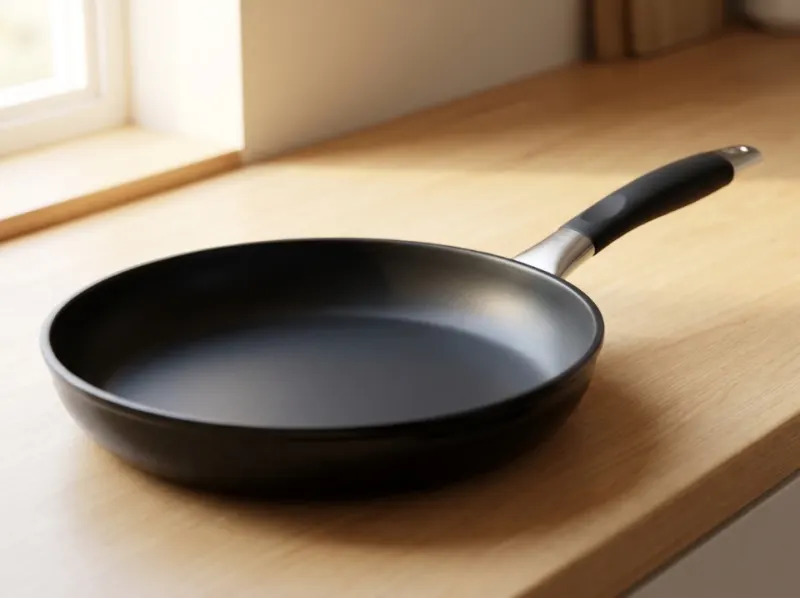
More heat stops an egg from sticking. It works on a stainless skillet. It wrecks a nonstick coating a little more every time you do it.
The fix depends on the pan. On bare stainless, egg protein bonds to the steel, and Cuisinart's fix is to preheat until a drop of water beads and rolls, then add the oil. Treat a nonstick pan that suddenly grabs eggs as a worn coating, not bad technique. Give new cast iron or carbon steel extra oil while its seasoning builds, and cook on medium-low once the egg lands.
Why do my eggs stick to the pan one morning and release clean the next? The pan sitting on your burner right now decides the answer.
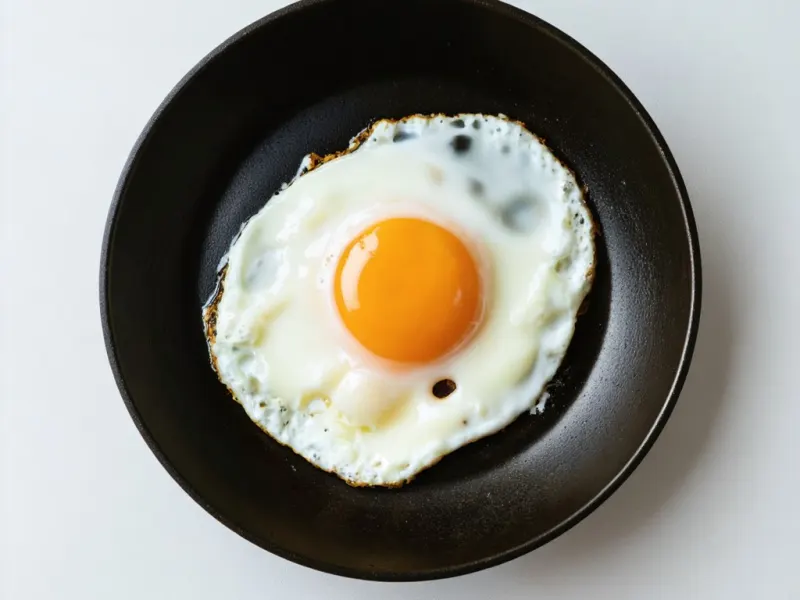
Why Eggs Grab Bare Steel#
Egg white is mostly water and protein. A peer-reviewed study on egg white protein and bare stainless steel surfaces (Hagiwara et al., Food Control, 2015) found that raising the surface temperature increases protein adhesion.
Heat denatures the protein. The denatured molecules then bond onto the metal through chemical links. The study tested stainless steel only, so it explains stainless sticking, not coated or seasoned pans.
Stainless Steel: Preheat Until Water Beads#
Stainless steel offers no coating to fall back on. Cuisinart's own care manual for its stainless cookware lays out a fixed order. Heat the empty pan for about two minutes over medium-low, then test it with a few drops of water.
Water that beads and dances across the surface, instead of hissing flat, is the readiness signal Cuisinart's manual names.
Add oil only once the water passes that test. Let it heat, then add the egg. Cuisinart's sequence runs pan, then oil, then food, in that order, every time.
Skipping the water test, and guessing at "medium-high enough," is how stainless earns its reputation as the hardest material to cook eggs on.
Nonstick: When the Coating Is the Problem#
KitchenAid's own care guidance says never preheat nonstick cookware empty, not even on low heat.
Start the oil or egg in the pan before the burner goes on. Raise the heat only after a minute or two.

GreenPan's own support page confirms the coating wears down on its own schedule. That is a natural reduction in release over time, and overheating speeds it up. Zwilling's manual for its Ceraforce ceramic line goes further: extreme heat makes the coating properties diminish, and the manual sets an explicit heat ceiling to prevent it.
A peer-reviewed materials-science study (Alaboodi, Sivasankaran, and Ammar) heat-tested six nonstick pans, three PTFE and three ceramic. No scratches or metal utensils were involved, isolating heat on its own as the variable.
Every pan showed the same pattern: the coating-metal bond measurably weakened as temperature rose. The study recommends staying under 482°F, and under 45 minutes of continuous heat, to limit it.
Ceramic coatings do not keep up with PTFE here. Owners report ceramic losing release anywhere from a few months to about a year and a half. Owners of PTFE pans commonly report about a year to 4-5 years of service under the same careful heat habits.
Cast Iron and Carbon Steel: Seasoning Takes Months#
Seasoning is the only thing standing between bare iron and a stuck egg, and it does not arrive on day one. Lodge's own care page says every cook adds another layer, building toward a genuinely nonstick surface over time.
Uneven at first, Lodge says, which it calls expected rather than a defect.
Field Company puts it more bluntly. Cast iron is not truly nonstick until it has been used for a few months, building up dozens of interlocking layers.
Both brands recommend extra oil for lean, delicate foods cooked early in a pan's life, before that buildup finishes. Eggs are exactly that kind of food.
A rough, brand-new modern casting makes the wait worse. Adam Ragusea's side-by-side test found a fresh, pebbly budget pan released food noticeably worse than an already-smooth antique pan and a mirror-polished premium pan, all cooked with matched heat and oil.
PapaMau, a second individual tester, cooked French omelets and frozen dumplings without sticking on a brand-new, unpolished Lodge Chef Collection pan, using deliberate heat and fat control. Technique narrows the gap even before seasoning catches up.
How Much Fat, and Why Spray Backfires#
Heat and fat are not two separate checklist items. They substitute for each other. One home cook's own test, across roughly 30 eggs on carbon steel, cast iron, and stainless pans, found that at gentler heat, between 120 and 160°C, more oil is what stopped the sticking.
At higher heat, close to the point where dropped water beads dance across the pan instead of evaporating, the egg released almost instantly with barely any oil. That same test even released one egg with none at all. Its own starting point for oil amount:
- About one teaspoon for an 8-inch pan
- About two teaspoons for a 10-inch pan
- About three teaspoons for a 12-inch pan
Cooking spray breaks this trade quietly. It is oil plus an emulsifier, usually soy lecithin, plus a propellant.
That emulsifier burns at a lower temperature than butter or oil. The residue bonds specifically to nonstick coatings. It does not bond onto bare metal the same way, which is why the same can behaves differently pan to pan.
A faint amber film that meets slight resistance from a fingernail is spray residue, not a dead coating. Grey or silver patches, or actual flaking, is the real failure.
A baking soda paste left to sit, up to 24 hours for heavy buildup, then worked in with a non-abrasive sponge, restores release most of the time. Spray residue that looks like a dying coating is a separate problem from the coating actually dying.
Heat and Movement Once the Egg Is In#
Egg protein does not need a scorching pan to set. A food-chemistry course text, hosted on LibreTexts, puts the white's coagulation point between 140°F and 149°F.
The yolk sets between 144°F and 158°F.
Dropping to medium-low the moment the egg lands still clears that threshold with margin to spare.
How much you move the egg from there depends on the style, not one universal rule. J. Kenji Lopez-Alt and Adam Ragusea, two independent food-science-minded cooks, describe the same three-way split:
- Scrambled eggs want near-constant motion. Lopez-Alt stirs the whole time over relatively low heat, for a tender, creamy curd.
- A fried egg is left alone. Lopez-Alt lets it sit without basting, and Ragusea waits until the inner ring of white just starts to set before the one flip.
- An omelet does both in sequence. Ragusea stirs continuously while the mixture is still liquid, then lets it set and folds it once it firms up.
When Replacing the Pan Is the Fix#
A pan only becomes the real problem under specific, checkable signs.
Visible bare metal showing through the coating is one. Food sticking despite correct oil and heat is another. Coating flaking into the food itself is the third.
If you have fixed heat and fixed fat, and eggs still tear on the surface, no technique reverses a coating that has crossed from worn to dead. A nonstick pan that stopped releasing describes that same failure.
Pan size is the other real exception. Everything sticks to stainless below the water-bead threshold, but even a correctly heated 12-inch pan spreads a single egg too thin.
The edges dry out before the center sets. An 8-inch omelette pan built for one or two eggs avoids that, regardless of technique. If stainless and cast iron both feel like the wrong fit for your routine, the material selector quiz narrows that down fast, including carbon steel, which shares cast iron's seasoning timeline.
If a worn coating is the actual problem, the Zwilling Madura Plus 8-Inch Nonstick Fry Pan is sized for exactly this job. Its 8-inch diameter keeps a single egg collected instead of spread thin.
The manufacturer lists it as compatible with gas, electric, glass, halogen, and induction cooktops. Ceraforce Titanium, Zwilling's titanium-reinforced ceramic coating, is listed oven safe to 302°F.
We would treat this pan the way the nonstick section above describes: no empty preheat, moderate heat, and a shorter, faster-wearing lifespan than PTFE. If you want to know exactly what is in a given coating, our PFAS safety checker gives a sourced verdict by brand and line.
The Zwilling Madura Plus earns its spot once technique and seasoning have both had their chance. Get the pan-specific fix first.