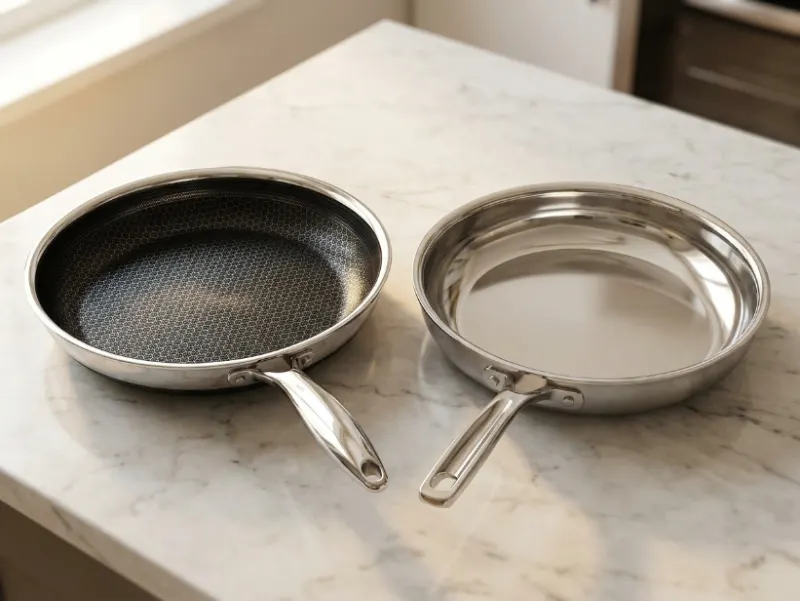
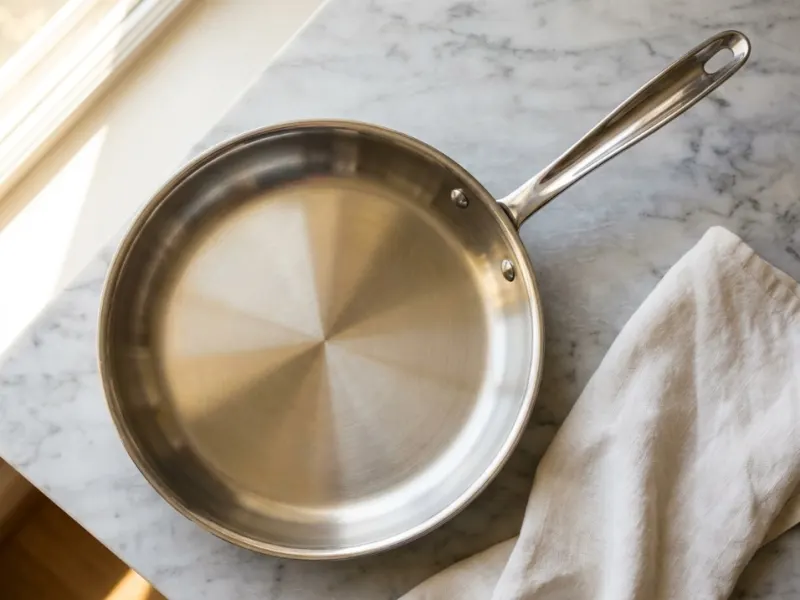
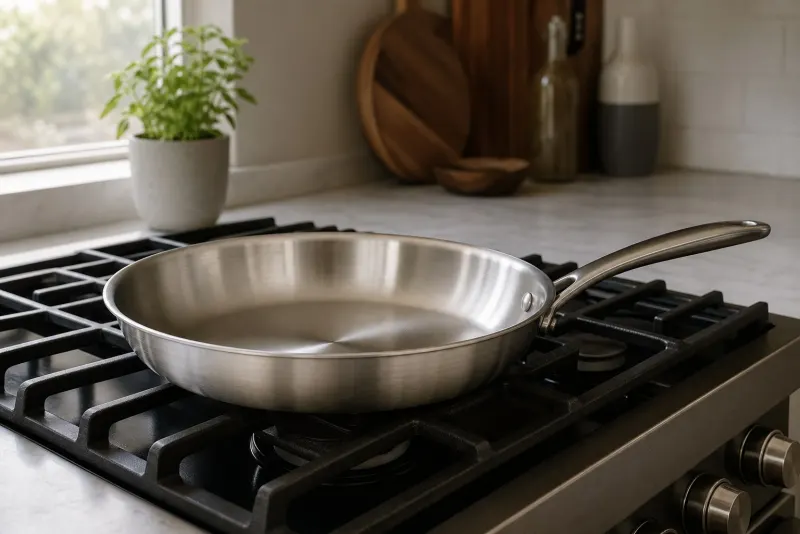
An All-Clad buyer on r/madeinusa paid the brand's stainless-tier premium expecting a pan built in Pennsylvania. What showed up instead was a box stamped "Made in China," "much to my surprise," they wrote.
All-Clad's answer comes down to two factories. The brand's bonded stainless lines, D3, D5, Copper Core and G5 Graphite Core, are made at All-Clad's own Canonsburg, Pennsylvania factory. Both of All-Clad's current nonstick lines, HA1 Hard Anodized and NS Pro Ceramic, are made in China instead. Which one you buy decides which claim actually applies to your pan.
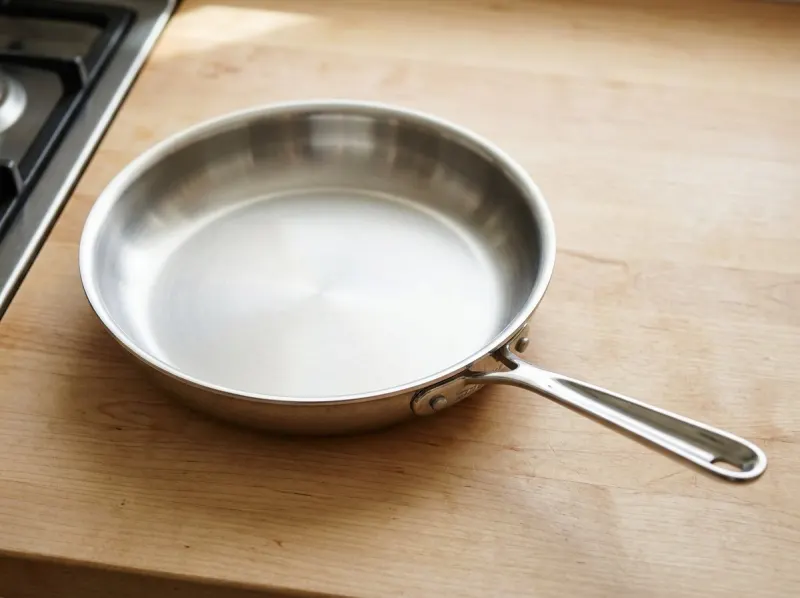
Every Current All-Clad Line, by Origin#
All-Clad sells six lines right now. Each one's own product page states a "Made in" field directly. Laid out side by side, the split is a clean two-factory line, not a scattered case-by-case mess:
| Line | Made in | Source field quoted |
|---|---|---|
| D3 Stainless | United States | "Made in the USA with global components in our Pennsylvania Factory since 1971." |
| D5 Stainless | United States | "Made in: United States" |
| Copper Core | United States | "Made in: United States" |
| G5 Graphite Core | United States | "Made in: United States" |
| HA1 Hard Anodized Nonstick | China | "Designed in Canonsburg, PA - USA, Made in China" |
| NS Pro Ceramic Nonstick | China | "Designed in Canonsburg, PA - USA, Made in China" |
What "Made in the USA with Global Components" Actually Means#
The FTC sets a high bar for an unqualified claim. "All or virtually all" of a product's assembly, processing and materials have to be American, with "no -- or negligible -- foreign content." All-Clad's stainless lines do not make that unqualified claim. Their own product pages say "Made in the USA with global components in our Pennsylvania Factory since 1971." The FTC has a name for that kind of statement: a qualified claim, one that "describes the extent, amount or type of a product's domestic content."
That distinction maps onto Canonsburg itself. All-Clad's customer-service FAQ page states that the "fully bonded cookware and bakeware are bonded, engineered, & assembled in the USA," built with "US and imported materials." Every D3, D5, Copper Core and G5 pan fits that same description.
Nothing about that wording is misleading. It is a qualified claim doing exactly what the FTC standard describes. The nonstick lines carry a different, equally truthful qualified claim: the same FAQ states that the "impact-bonded & hard-anodized non-stick cookware, and non-stick bakeware" are "sourced from our global factories," which for HA1 and NS Pro Ceramic means made in China. All-Clad's about-us and materials pages scope the USA claim the same narrow way, naming the bonded stainless collections specifically.
The reader's mistake is treating a per-product qualified claim as a brand-level promise. "All-Clad" on a box or a listing title is not the claim; the line's own spec-table field is. Skip that field and the stainless side's qualified wording reads like an unqualified brand-wide guarantee All-Clad never made.
The per-line spec-table field discloses the origin already. Marketing and resale listings tend to shorten six lines into one brand name, which is where the surprise comes from.
The Bonded Stainless Lines Are Made in the USA#
All-Clad D3 Stainless, the brand's benchmark tri-ply line, anchors that claim. The table above shows the same field, worded almost the same way, across every bonded stainless line All-Clad currently sells.
Every bonded line has run through the same Canonsburg, Pennsylvania factory since the company's founding. The origin claim on one bonded stainless product page holds for the rest of that side of the catalog.
Origin is one axis of the larger stainless buying decision. Our stainless steel cookware guide covers construction, induction compatibility, and maintenance. Our review of whether All-Clad's price is worth it breaks down what that Pennsylvania-made premium actually buys, once the warranty terms and cost-per-year math get checked against a budget tri-ply pan.
Both Current Nonstick Lines Are Made in China#
All-Clad HA1 Hard Anodized Nonstick and All-Clad NS Pro Ceramic Nonstick, All-Clad's PTFE-free nonstick line, both carry the same "Made in" field on their own product pages. That field is quoted in full in the table above.

The brand name on the box does not settle it. The country-of-origin field on that exact model's product page does.
The two lines also differ on paper. NS Pro Ceramic Nonstick carries only a 1-Year Limited Warranty. HA1 carries a Limited Lifetime Warranty instead. That is a difference in coverage length, not a claim about how long either coating lasts.
Both that warranty gap and the coating wear pictured above describe the nonstick lines only. The D3 Stainless on this page's product card is a bonded stainless piece with no nonstick coating to wear.
Our All-Clad nonstick safety deep dive covers what the PTFE and ceramic coatings themselves are made of, separate from the origin question here. The PFAS safety checker is the faster route if a specific pan's coating chemistry is the actual question.
Who Owns All-Clad, and Why the Factory Stayed#
All-Clad was founded in 1971 by John Ulam, a metallurgist credited with more than 75 patents. All-Clad is now owned by Groupe SEB, and Groupe SEB's own corporate materials still describe Canonsburg, Pennsylvania as All-Clad's manufacturing base. None of that ownership history changes the per-line answer above; it just explains why the bonded stainless lines are still made in the same factory the founder opened.
The Decision That Actually Matters#
If American manufacturing is the reason you are buying All-Clad, buy from the bonded stainless side and accept two things: a stainless cooking surface, and a price of roughly three to four times as much as a Tramontina Tri-Ply Clad of the same size (based on July 2026 Amazon and Home Depot listing prices) for the same fully-clad construction type. What that premium buys is the Pennsylvania factory, handle finishing, and a lifetime warranty; no independent cooking-performance comparison exists, so do not expect the food to tell you which pan it came from. A buyer whose only reason is cooking performance should start with the budget tri-ply and read our All-Clad vs. Tramontina comparison.
Still deciding stainless versus nonstick itself? Try our material selector quiz first.
If you want All-Clad nonstick, origin should leave your reasoning entirely: both lines are made in China, per All-Clad's own product pages. Decide between HA1 and NS Pro Ceramic on coating type and warranty term, and judge the price the way you would judge any imported nonstick pan.
How to Check a Specific Pan Before You Buy#
Every current All-Clad product page lists a "Made in" field in its own spec table. That field is the fastest way to settle the question for the exact piece in front of you, not the brand as a whole. Packaging and printed disclosures can vary by piece and by year. The manufacturer's own spec-table field for that exact SKU is the check worth trusting.
Before buying anywhere other than All-Clad's own site, pull up that exact model's spec-table field first. A retailer or resale listing does not have to carry that field. When it is missing, its absence is not evidence either way.
If you are shopping the bonded stainless side of the lineup, All-Clad D3 Stainless is the line the Pennsylvania claim was built around. It is the one worth checking first against the origin table above.