You already know an 8-quart stock pot is the popular pick. What the capacity number alone won't tell you is whether the pot heats the way its own listing implies, and that question sent us digging through the same brand's catalog to find out.
Most home kitchens land on 8 quarts. That number is the easy part of this decision.
The harder part, the part we kept running into while comparing listings, is confirming the pot is actually built the way its description suggests. An aluminum core needs to run the full height of the walls, not sit as a disc bolted only to the bottom.
Get the quart number right and the construction wrong, and you've bought the wrong pot at the right size. We dug into Tramontina's own product pages, put the Clad and Base lines side by side, and found a naming pattern worth flagging before you buy either one.
What Size Stock Pot Do You Need? Start With the Construction#
We searched Tramontina's catalog for an 8-quart or 12-quart stock pot. More than one option wears nearly identical marketing language.
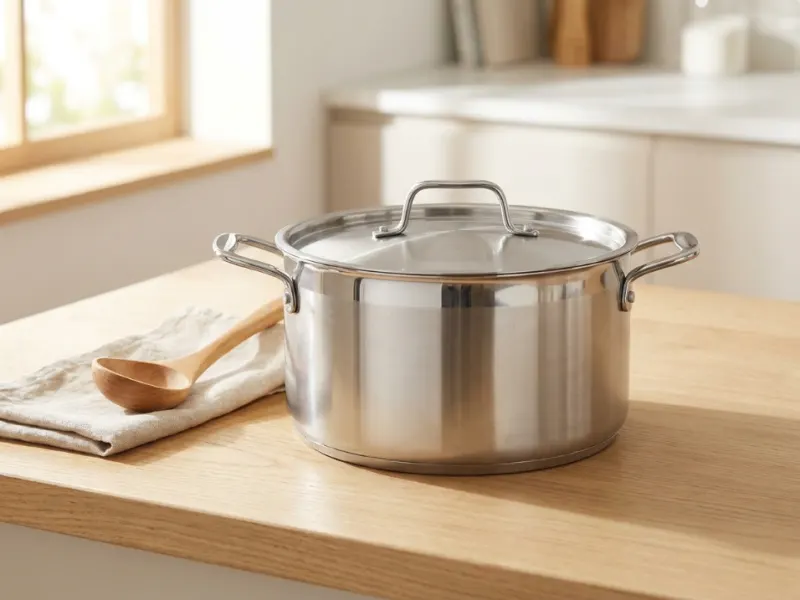
Tramontina's Tri-Ply Clad line, the construction behind the Tramontina Gourmet Tri-Ply Clad 8-Quart Stock Pot, runs an aluminum core and a magnetic stainless layer from the base straight through the walls. Tramontina's own product page says the build "heats from all sides," reaching well past just the bottom.
Tramontina's Tri-Ply Base line, sold in a 12-quart size and sometimes listed under the name "Prima," describes itself almost the same way. Its listing promises "tri-ply base construction to ensure even heat distribution." Read quickly, that sounds like the same engineering.
It isn't. This version's aluminum core sits only at the bottom, the same disc-bottom approach most budget stockpots use. Its own listing describes the base construction, not the sidewalls.
This isn't a hypothetical mix-up we're inventing. One verified buyer of Tramontina's 12-quart stock pots described choosing between the "Gourmet" and "Prima" listings as frustrating. Amazon's displayed dimensions for the two pots didn't clearly separate them.
Same brand. Same rough capacity. A shopper who genuinely couldn't tell which construction they were ordering.
The two lines even ship with different lids. The Clad line's 8-quart pot uses glass; the Base/Prima 12-quart pot uses stainless steel. That swap isn't cosmetic, and it changes how hot you can run the pot in the oven. If you're still weighing construction and material tradeoffs across brands, our material selector quiz matches your cooking habits to the right build in about 30 seconds.
Pick the Capacity by the Task#
Most sizing charts ask how many people you're feeding and hand back a number. We think that skips the part that actually decides whether 8 quarts holds up: what you're cooking, and how much room the pot needs to do it without a boil-over. We went looking for a real number instead of a guess.
Barilla's own cooking instructions put a real number on this. Their guidance calls for at least one quart of water per quarter pound of pasta, and describes the typical procedure for a box of pasta as bringing 6 to 8 quarts to a boil.
That range exists for a reason. Starchy pasta water foams as it nears a rolling boil, and a pot filled too close to the rim sends that foam straight over the edge.
An 8-quart pot holds Barilla's own 6-to-8-quart range directly, with room left before the rim. A 6-quart Dutch oven doesn't have that same room: its total capacity already sits at the low end of that range before a single cup of water goes past halfway.
That's the concrete test for outgrowing the Dutch oven. Not a vague sense that you cook a lot. One specific task, pasta night, that the numbers say a smaller pot can't comfortably fit.
The same logic scales up. Once you're working with a whole chicken carcass and enough water to keep it submerged through a multi-hour simmer, 12 quarts becomes the practical next step.
Tramontina's own catalog carries a 12-quart option (the Base/Prima line from the naming trap above) right alongside the 8-quart Clad pot. That tells you the jump from 8 to 12 quarts is common, not an unusual upgrade reserved for serious cooks.
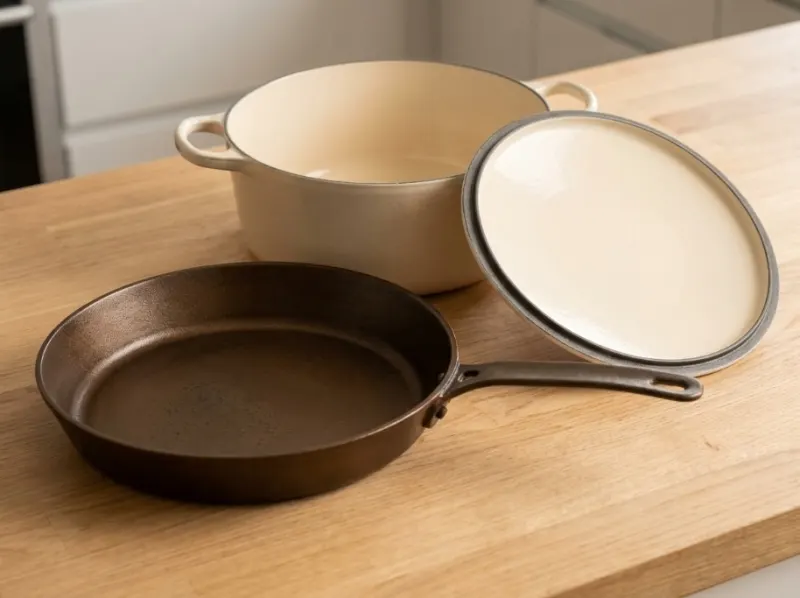
Skip both of those tasks most weeks, and the Dutch oven already in your cabinet keeps doing the job. A stock pot only earns its shelf space by covering what that Dutch oven's volume can't reach.
The Oven-Safe Rating Has a Catch#
Once you've settled on 8 quarts and confirmed the Clad construction, we'd flag one more number worth checking before you plan to finish anything in the oven with the lid on.
The Tramontina Gourmet Tri-Ply Clad 8-Quart Stock Pot is oven-safe to 500°F without its lid attached. Put the glass lid on, and that ceiling drops to 350°F.

The pot body handles the higher number. The lid is what holds you back. Plan to finish a braise or a pot of beans in the oven with the lid on, and 350°F is the figure that actually applies, not the 500°F headline the listing leads with.
That split comes straight from the lid material, not a flaw specific to this pot. Tramontina's own Tri-Ply Base/Prima line, built with a stainless steel lid instead of glass, carries a flat 500°F rating with no lid exception anywhere in its listing. For the exact oven limits on other brands and lines, our oven-safe temperature lookup lists the body, handle, and lid limits side by side.
Glass lids run cooler limits across the category. It's worth checking which material you're actually getting before you plan an oven finish around the higher number. If a long braise is the actual job, our Dutch oven vs stock pot comparison breaks down why the lid, not the pot body, decides whether a stock pot can stand in for a Dutch oven.
The full-wall cladding that makes the Clad line heat evenly also makes it heavier in hand than a disc-bottom pot at the same capacity, simply because more aluminum runs through more of the pot. That extra weight buys the even heating.
Common to fully clad construction generally, it's the trade-off that comes with it, not a defect unique to this line.
Our Pick for Most Kitchens#
For pasta night on a weekly basis and soup or stock a few times a month, we'd point to the Tramontina Gourmet Tri-Ply Clad 8-Quart Stock Pot. It matches both halves of this decision at once: the right capacity for the task, and construction that actually delivers what its description promises.
The base-to-rim cladding is what separates it from the disc-bottom pots crowding the same price range, including some carrying Tramontina's own name. It's induction-compatible and dishwasher-safe too, which matters more day to day than any spec sheet suggests.
Planning oven work with the lid on? Keep that 350°F ceiling in mind rather than the pot's higher unlidded number.
Before buying at 8 quarts or stepping up to 12, measure your largest burner and your tallest cabinet shelf. Read the construction line on whatever listing you're comparing, not just the capacity. Those two checks catch the specific mismatch this article covers, one the capacity number by itself does not.
If you're deciding between a full cookware set and buying pieces individually, a stock pot is worth buying on its own terms, the same way Tramontina's tri-ply skillets hold their own against premium sets piece for piece. Get the construction and the capacity right, and the pot earns its space instead of collecting dust behind the Dutch oven you already own.