You're comparing T-fal and Cuisinart nonstick sets, and the more familiar name feels like the safer bet. We checked what's actually under each line's coating and its body, digging through both brands' own spec pages, disclosure pages, and owner reports on Amazon, and that assumption stops holding up.
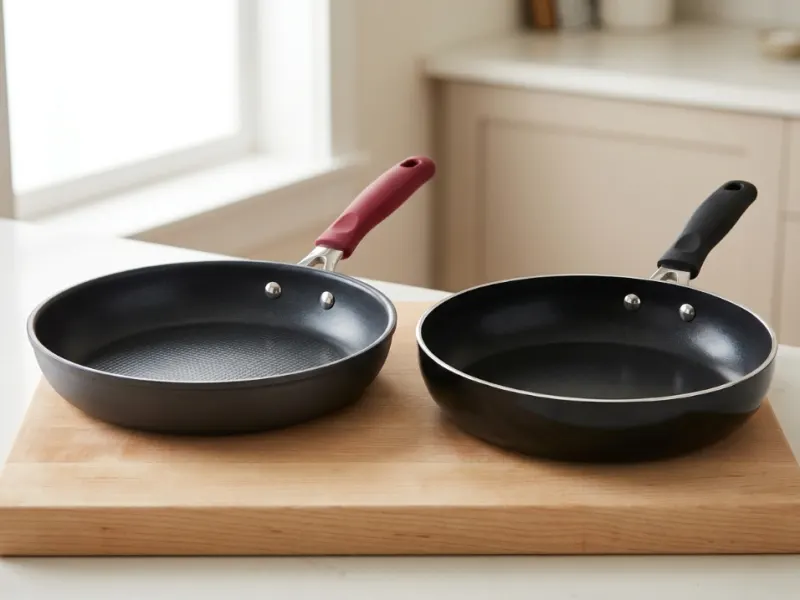
T-fal's Ultimate line uses a genuinely hard-anodized aluminum body. Cuisinart's comparably priced Advantage line uses standard, non-anodized aluminum instead.
Our nonstick cookware buying guide covers that same body-versus-coating distinction across the wider nonstick category.
That construction difference, not brand history, is what actually separates these two sets. It buys a higher oven-safe ceiling, better resistance to warping under heat, and a body that keeps the coating heating evenly for longer.
The brand with the longer résumé isn't the one with the sturdier pan here. There's a second mislabeling hiding in the fine print, too: neither brand's marketing name for its coating tells you what's actually on the pan.
What "Ceramic Nonstick" Actually Means on the Box#
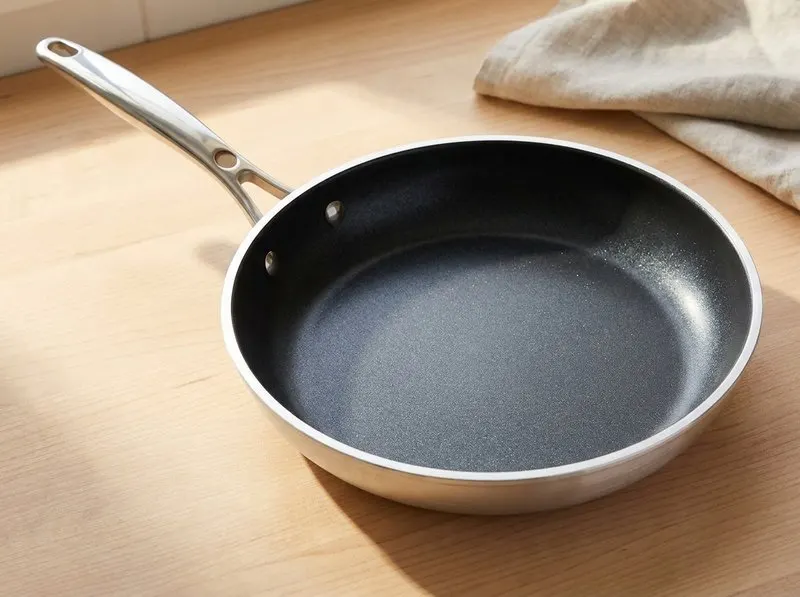
T-fal's own retail listing for the Ultimate Hard Anodized set calls the coating "Ceramic Nonstick." Check T-fal's own PFAS disclosure commitments page, though, and the chemistry it discloses for this exact line is titanium-reinforced PTFE. That's not a ceramic sol-gel coating at all.
"Titanium-reinforced" and similar phrases like "triple-layer professional grade" are marketing terms. They describe a reinforced PTFE formulation, not a different base chemistry. It's the same category of coating as plain PTFE, just with particles mixed in for scratch resistance.
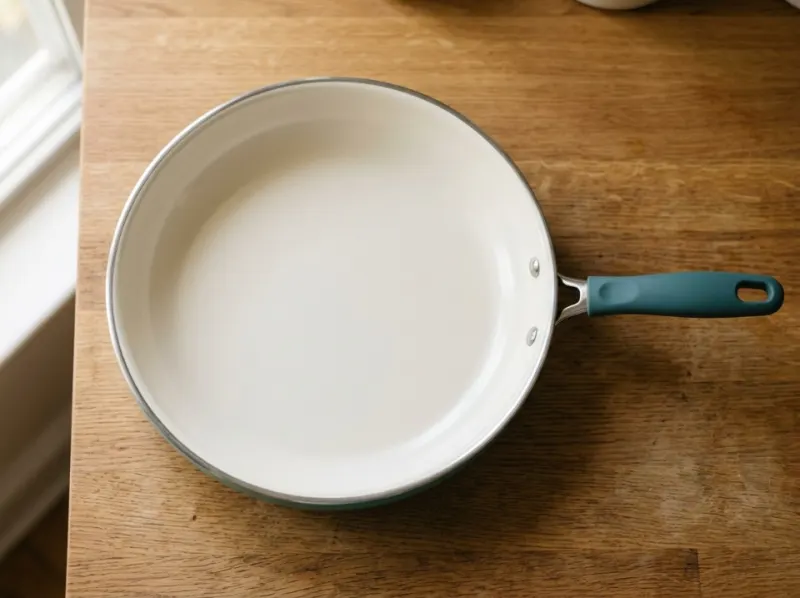
Cuisinart's Advantage line takes the opposite approach. Its own product page never names a coating chemistry at all. Cuisinart's pricier Chef's Classic line brands its coating "PURELYCERAMIC" by name; the Advantage listing just says "premium nonstick surface" and stops there.
If coating transparency matters to you, that's worth knowing before you buy. You won't find the answer on the box either way. We track which lines actually disclose their composition in our PFAS safety checker, rather than taking the name on the label at face value.
Neither naming choice makes either pan more or less safe to cook on day to day. T-fal's own commitments page confirms this Ultimate line is PFOA-free, and PTFE cookware from major manufacturers has been PFOA-free since 2015 under the EPA's PFOA Stewardship Program, which addresses the health concern that used to matter most with nonstick coatings.
What the naming confusion tells you is simpler: the word on the box describes marketing, not chemistry. Check the brand's own disclosure page, not the label, if you want to know what's actually on the pan.
The Body Underneath: Hard-Anodized vs. Pure Aluminum#
This is where the real difference lives. T-fal's Ultimate line is hard-anodized aluminum. An electrical process hardens the surface of the metal. That makes the body much more resistant to warping under heat than plain stamped aluminum.
Cuisinart's Advantage line, by its own product description, uses a pure aluminum core instead. No anodizing step is mentioned anywhere on the page.
That gap matters most on a glass-top or electric coil stove. Those surfaces need full, flat contact to heat evenly. A pan that warps even slightly gets a hot ring around a cooler center.
That means uneven cooking, and over time, uneven wear on the coating above the hot spots. Gas matters less here. The grates hold the pan up at several points, even if the base isn't perfectly flat.
The construction gap shows up in the oven-safe ceiling, too, though it's worth a caution here: T-fal's own retail listings for "Ultimate Hard Anodized" 12-piece sets don't all agree with each other. This specific 12-piece Black set is independently confirmed by two retailer listings as broiler safe to 600°F, while other color and piece-count variants under the same collection name top out at 400°F. Cuisinart's Advantage line, by contrast, is consistently rated to 350°F across its own listing.
Check the exact listing behind whichever T-fal Ultimate set you're buying. The collection name alone doesn't guarantee the rating. Either way, both sets clear a home oven's typical range; the gap matters most if you finish dishes under the broiler.
None of this makes the Cuisinart a bad pan, though. A standard aluminum body is genuinely lighter than a hard-anodized one of the same size. Some cooks like that for daily use. It's a real trade-off: less weight for less warp resistance.
For a deeper look at what "hard anodized" and "nonstick" each actually describe, since they're independent specs rather than competing categories, our hard anodized vs nonstick breakdown covers the mechanism in more detail. Still deciding between construction types generally, rather than these two specific sets? Our material selector tool walks through the tradeoffs by cooking style.
Where T-fal Wins#

T-fal's Ultimate line wins on the fundamentals: the hard-anodized body, a higher heat ceiling than Cuisinart's Advantage, and one genuinely useful feature.

The Thermo-Spot indicator changes color when the pan reaches cooking temperature.
It's built to stop you from overheating an empty pan. It won't magically extend coating life on its own. But it removes one of the most common ways a nonstick coating gets damaged too soon.
Owner reports on T-fal's PTFE coatings span a wide range. One owner reported a coating failing in about 10 months. Two other long-term owners each reported 3 to 5 years, with careful, hand-washed, medium-heat use.
That spread says less about T-fal and more about how much care and heat habits matter, no matter the brand or price.
Where Cuisinart Gets Something Right#

The Advantage line's real advantage is weight. A pure aluminum body is lighter to lift and maneuver than a hard-anodized one. That matters if you're cooking one-handed while managing a pan on the stove, or if wrist strength is a consideration in your kitchen.
Cuisinart's own product description leans on this directly: the aluminum core heats quickly and evenly. For everyday, lower-heat cooking, that's a fair claim. A lighter pan heats up faster for the same burner output.
What you give up for that lighter feel: the warp resistance, the higher heat ceiling, and any clarity on which coating chemistry you're actually cooking on.
If you cook mostly on gas, where the grates make base flatness less critical, and you don't need to finish dishes above 350°F, that trade genuinely makes sense for some kitchens. It's an honest trade, not a lesser pan across every dimension.
T-fal vs Cuisinart: The Decision That Actually Matters#
Skip the brand comparison. Ask two questions instead.
First: does your stove need flat, even contact to cook well? If you're on glass-top, electric coil, or you regularly finish dishes above 350°F in the oven, the hard-anodized body on T-fal's Ultimate line is doing real work for you. It isn't marketing.
Second: does coating transparency matter to you, or is a familiar name enough? Neither brand's retail label tells you the truth about coating chemistry at a glance. T-fal calls a titanium-reinforced PTFE coating "ceramic." Cuisinart's Advantage line doesn't name a chemistry at all.
Check the brand's own disclosure page before you check the box art.
If you cook mostly on gas, want the lighter pan, and don't need the higher oven ceiling, Cuisinart's Advantage line is a reasonable, honestly-traded-off choice. We wouldn't call it the sturdier pan, but it isn't pretending to be, either.
For a broader look at whether T-fal holds up as a brand beyond just this comparison, our full T-fal review covers that ground. And if coating lifespan and replacement timing is what's actually driving your decision, our nonstick pan lifespan breakdown has the fuller range of owner data behind the numbers above.
Neither set is confirmed induction-compatible right now. T-fal's is verified not compatible; it has no magnetic base layer. Cuisinart's own materials don't settle the question either way. If induction matters in your kitchen, run the magnet test on the exact set before you buy.