This guide draws on every stainless steel review and cleaning breakdown already published here, distilled into the choices that actually decide whether a pan holds its shape for decades or warps within one year.
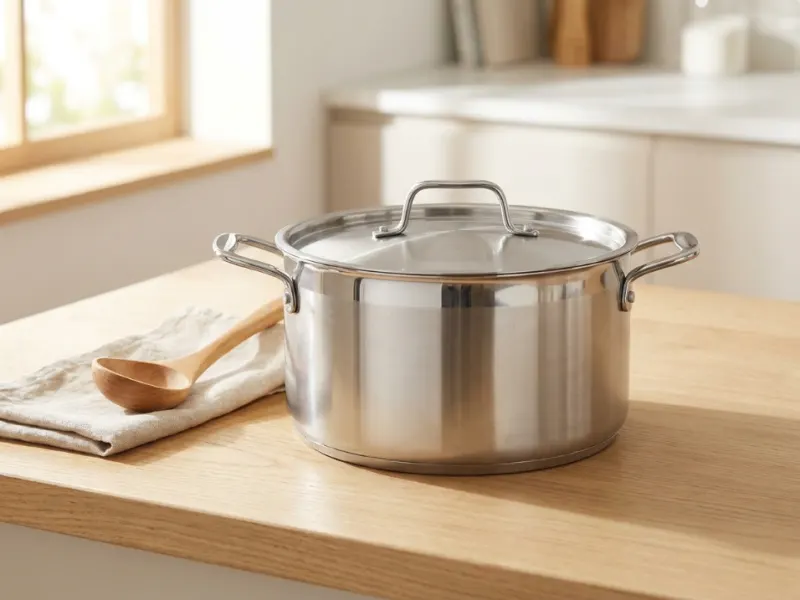
Stainless steel cookware is a bare-metal pan. Most of it is built by bonding a fast-conducting core, usually aluminum, between layers of chromium-nickel steel. That construction is why it heats quickly and never carries a coating that can wear off.
A stainless pan earns its place for one job: high-heat searing, pan sauces, and anything acidic. Those are jobs a coated pan either can't do or won't survive for long.
One failure kept surfacing that no box ever discloses: a "stainless" set marketed as induction-ready can still fail on its smaller pans, because only the base disc carries the magnetic layer. The Induction Compatibility section further down shows the two-second check that exposes it.
Whether a pan is genuinely fully clad, aluminum running from the base to the rim, or only disc-bottom, aluminum bonded to the base alone, decides more of the cooking experience than the brand name on the box.
Which side of that split a pan lands on outweighs ply count entirely, and it outweighs whatever the word "clad" says on the listing too.
Delicate egg release, or fish that can't survive being flipped hard, just isn't a job for bare stainless. A dedicated nonstick pan does that part better.
That verdict doesn't shift by brand name, and it doesn't shift by price tier either.
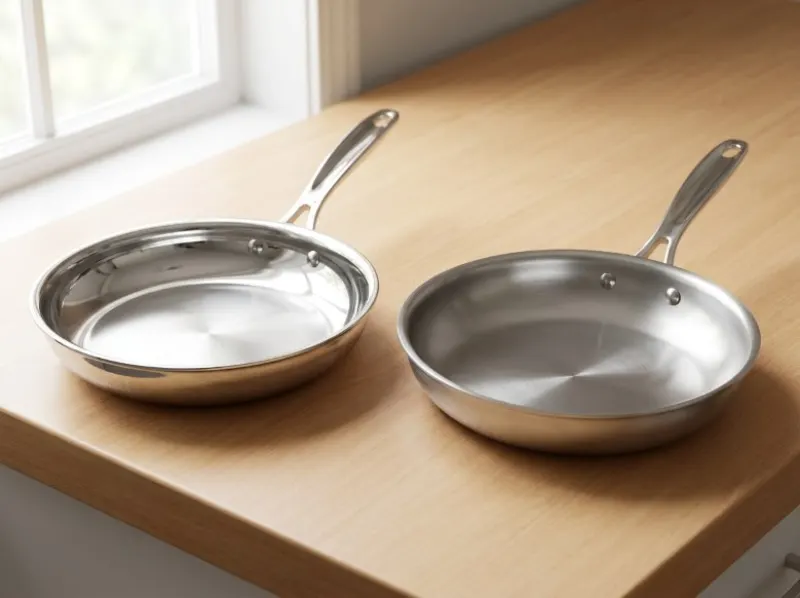
Nearly every stainless set advertises itself as induction-ready, fully clad, or dishwasher safe, and that holds up only in the limited sense printed on the packaging. What the box leaves out is usually the part a buyer actually needs to know.
A "clad" set might mean the aluminum runs the full height of the pan. It might just as easily mean a disc bonded only to the base. An induction-ready claim usually means a magnetic layer exists somewhere in the base. It rarely says whether that layer covers the whole cooking surface.
How Stainless Steel Cookware Actually Works#
We went looking for why some stainless pans heat evenly for decades while others warp within months. The answer turned out to be construction, not brand loyalty.
Stainless steel on its own is a poor conductor. Per NIST reference data, aluminum moves heat about 16 times faster than stainless steel: 237 watts per meter-kelvin versus 14.9. Copper moves it roughly 27 times faster. That gap is why makers bond a conductive core into the pan instead of selling raw steel alone.
A 3-ply pan sandwiches one aluminum core between two stainless layers. The interior layer gives you a food-safe cooking surface. The exterior layer adds durability, and when it uses 430 ferritic stainless, induction compatibility. A 5-ply pan adds two more alternating layers on top of that same idea.
Here is the part that surprises most shoppers. Whether the aluminum sits as one thick layer or splits across several thinner ones, it moves heat the same way, as long as the total mass matches. Layer count is a manufacturing detail. It is not a performance ceiling.
The word "clad" describes how far that aluminum core extends, not how many layers exist. A fully-clad pan runs the core from the base all the way up the sidewalls. A disc-bottom pan bonds aluminum only to the base. The sidewalls stay bare, slow-heating stainless, and the seam at the disc's edge is where thermal stress concentrates every time the pan heats and cools.
Stainless is not naturally nonstick, and the reason is structural, not a missing feature. The metal has no applied coating engineered for food release.
What it has instead is a thin, self-healing chromium oxide layer. That layer forms on contact with air and regenerates on its own if scratched. It protects the metal from corrosion, but it does nothing to keep food from sticking.
That same absence of a coating changes the PFAS conversation entirely. Stainless has no coating to make a PFAS-free claim about in the first place, which is a different kind of safety question than ceramic nonstick faces.
No coating is not an unconditional safety upgrade, though. A 2013 peer-reviewed Journal of Agricultural and Food Chemistry study found stainless cookware does leach measurable nickel and chromium. If you want to know what a given coating is made of, our PFAS safety checker shows each line's verdict with the maker's own wording behind it.
Leaching is highest in a brand-new pan during long, acidic simmers, then drops roughly 65% for nickel and 35% for chromium by the third cook. A quick sauté is not the scenario that study is describing. A long-simmered acidic sauce, or a known nickel sensitivity, is where it actually matters.
The Buying Decision, By Axis#
Which stainless pan heats evenly, works on your cooktop, or is worth the premium price isn't one question. It's several. They don't all point to the same brand.
Construction: Fully-Clad vs. Disc-Bottom#
Layer count on a listing tells you nothing about how a pan cooks. What you actually feel in the kitchen is this: a disc-bottom pan browns food only where the disc sits underneath and reduces a sauce unevenly against its cooler, uncovered walls, while a fully-clad pan sears and reduces the same way all the way up the sidewall. That gap rarely shows up in the collection name, so it's worth confirming before you buy rather than trusting a "clad" label on its own.
Check the listing's own construction wording, or look at the rim: a genuinely fully-clad pan shows the layered sandwich running the full height of the sidewall, not just at the base.
Our 3-ply vs. 5-ply cookware breakdown covers why total aluminum mass, not layer count, controls heat distribution. Calphalon stainless steel reviews is the clearest single-brand case study: the same brand sells a disc-bottom Classic line and a fully-clad Brushed 3-Ply line side by side, so the construction gap is visible without comparing across companies.
Our Cooks cookware review and Tramontina vs. Calphalon comparison both cover how to confirm construction from the listing itself, before a collection name misleads you. Our All-Clad vs. Cuisinart comparison is a direct case of that gap: a fully-clad Copper Core against Cuisinart's disc-bottom Chef's Classic Stainless at a fraction of the price.
Why Food Sticks: Technique, Not a Manufacturing Flaw#
Bare stainless has no engineered release layer. Food sticks by design until the pan reaches the right temperature, not because of a manufacturing flaw.
Tramontina's budget-tier care sheet and All-Clad's premium-tier care page state the identical restriction: preheat on low-to-medium heat, confirm readiness with a water-drop test, then add oil and food in that order. A crust forms and releases on its own; forcing an early flip just tears it off.
Our why everything sticks to a stainless pan guide walks through the water test step by step. Even a hybrid surface marketed to skip the technique runs into the same wall. Our HexClad vs. All-Clad comparison found four independent Amazon reviewers, plus a corroborated Reddit thread, describing dry eggs sticking to HexClad's ridged hybrid surface, despite the buyers following the manufacturer's instructions exactly.
Induction Compatibility: the Magnet Test That Actually Matters#
Induction compatibility depends on whether a pan's exterior is ferromagnetic, commonly 430 ferritic stainless, across the full base. It has nothing to do with the word "stainless" on the box.
A genuinely fully-clad pan passes by default, since its magnetic exterior covers the whole cooking surface. A disc-bottom pan's magnetic layer may exist only inside that base disc. Contact can end up partial, not full-surface, and a smaller pan in the same set is usually where that gap shows up first.
Here is the two-second test. Drag a refrigerator magnet from a pan's rim to its center. A strong, even pull the whole way confirms full-surface contact. A pull that grabs at the edge and goes weak toward the middle means the disc is a ring, not a full base.

Our hard anodized vs. stainless steel comparison covers why stainless wins this test by default, against a material that needs an added disc just to qualify. Our induction compatibility checker gives a sourced verdict per pan.
Maintenance: Cleaning, Discoloration, and What Actually Damages the Pan#
Nearly everything that discolors a stainless pan is cosmetic, not damage. Rainbow heat tint, brown polymerized-oil residue, chalky white mineral spots: all three sit on top of the same self-healing chromium oxide layer that protects the metal underneath. The one real exception is pitting from prolonged salt exposure, which feels like small craters under a fingernail rather than a smooth mark.
An oxalic-acid cleanser dissolves the cosmetic tints quickly, and shouldn't sit on the surface any longer than the label's brief contact window, since extended contact risks etching the metal itself. Metal utensils leave only shallow cosmetic scratches, since the alloy is solid all the way through with no separate layer for a blade to cut into.
Stainless is genuinely dishwasher-safe in the corrosion sense, since there's no coating to degrade, but hand washing preserves the shine and finish better than repeated dishwasher cycles do.
Our stainless steel pan discoloration guide covers what each color actually means. How to clean a burnt stainless pan splits the job into lifting stuck food first, then treating whatever tint remains. Bar Keeper's Friend on stainless steel and is Bar Keeper's Friend toxic cover the oxalic-acid cleanser most owners reach for, and how to use it without over-treating the surface. Can you use metal utensils on stainless steel covers the chromium-oxide science behind why those scratches stay cosmetic.
Value: Is the Premium Brand Worth It?#
A premium brand's price mostly buys handle comfort, edge finishing, and manufacturing continuity. It does not buy a documented cooking advantage over a budget pan using the same fully-clad physics.
Consumer Reports independently lab-tested Tramontina's budget-tier Tri-Ply Clad stainless steel and rated it Excellent for cooking evenness, food release, and handle temperature, with no Poor or Fair score anywhere in the results. A comparable fully-clad premium line, at a meaningfully higher price, uses the identical bonding physics, and the price gap tracks handle finishing and warranty coverage rather than a documented cooking-performance difference.
Construction quality, not brand name, is what should decide the spend. A "fully-clad" label alone does not guarantee no early warping, either: one fully-clad tri-ply line has multiple independent owner reports of early bottom warping despite the aluminum core running base to rim.
Our is All-Clad worth the price piece checks the warranty terms and the lab data behind that verdict. All-Clad vs. Tramontina shows exactly where the price gap does, and doesn't, show up on the plate. Our where is All-Clad made guide shows which lines are still made in Pennsylvania and which two nonstick lines are made in China.
How long does stainless steel cookware really last covers why construction shifts the odds of early warping rather than eliminating it. Kitchen Charm cookware is the case where the construction is genuinely solid, but the direct-sales markup, not the steel, is what you're really paying for.
Where to Go From Here#
Work backward from whatever question actually brought you here, not a brand name. Here's where we'd send you for each one:
- Deciding between fully-clad and disc-bottom before you buy anything: 3-ply vs. 5-ply cookware.
- A single brand selling both construction types side by side: Calphalon stainless steel reviews.
- Whether a budget set matches premium construction: Cooks cookware reviews and Tramontina vs. Calphalon.
- Why food sticks, and the fix that actually works: why everything sticks to a stainless pan.
- A hybrid surface that promises to skip the technique: HexClad vs. All-Clad.
- Comparing stainless against a different material entirely: hard anodized vs. stainless steel or ceramic vs. stainless steel.
- Confirming your cooktop compatibility before you buy: our induction compatibility checker.
- Rainbow tints, brown stains, or white spots after cooking: stainless steel pan discoloration.
- A pan with food actually burnt onto it: how to clean a burnt stainless steel pan.
- The cleanser most owners reach for, and whether it's safe: Bar Keeper's Friend on stainless steel and is Bar Keeper's Friend toxic.
- Whether metal utensils will ruin the pan: can you use metal utensils on stainless steel.
- Whether All-Clad's price is earned: is All-Clad worth the price and All-Clad vs. Tramontina.
- How long a pan should realistically last, and when to stop troubleshooting a warp: how long does stainless steel cookware really last.
- A demo-sale set with a price that doesn't match the pitch: Kitchen Charm cookware.
Common Pitfalls Before You Buy#
These five mistakes cut across the whole category rather than any one brand, and each one costs you money or cooking performance, regardless of which stainless set you're eyeing.
Running cold water over a pan straight off the burner. That thermal shock stresses the metal far more than a normal heat-and-cool cooking cycle, and it's a documented contributor to early warping, on top of whatever construction type the pan already uses.
Let the pan cool on the stove for a few minutes before it goes anywhere near the sink.
Trusting "surgical steel" language from a demo pitch or a listing. The actual ASTM surgical-implant standard governs a specific molybdenum-added alloy, not the plain T-304 (also labeled 18/8 or 18/10) steel most stainless cookware, budget or premium, is actually made from.
Check the base of the pan for the real grade stamp, not the sales language used to sell it.
Assuming a "waterless cooking" demo depends on proprietary brand technology. The mechanism is a tight-fitting lid plus low heat holding in the food's own moisture, a property of the lid and the heat setting, not a metal treatment unique to any one brand.
Any pot with a lid that actually seals can do the same thing.
Assuming a higher-nickel grade number like 18/10 cooks better than 18/0. That number changes pitting resistance and shine, not heat distribution, which comes entirely from the aluminum core described above.
Judge cooking performance by the construction, not the grade stamp.
Replacing an entire set because one piece failed. Tramontina, All-Clad, and Duxtop all back delamination and defect claims with a lifetime warranty on the original line. A single warped or delaminated pan is a warranty claim, not a reason to replace the whole set.
Check the warranty on the specific piece before buying a full replacement set.
Start With the Job, Not the Brand Name#
Confirm what the pan needs to do first: high-heat searing and pan sauces, or a job stainless was never built for.
After that, the axis that decides your purchase is whichever trade-off you're least willing to accept. Fully-clad construction over disc-bottom. Confirmed induction contact rather than a badge. The preheat habit that stops sticking.
A construction-quality check instead of a brand premium. Our induction compatibility checker can confirm whether the pan suits your cooktop.
The word "stainless" printed on the label, and the price tag next to it, settle none of that on their own. Everything above is grouped by the specific question you walked in with, instead of one flat "best stainless steel cookware" list.