Why does a splash of wine reduce to a glaze in one pan, but barely thicken in another on the same burner?
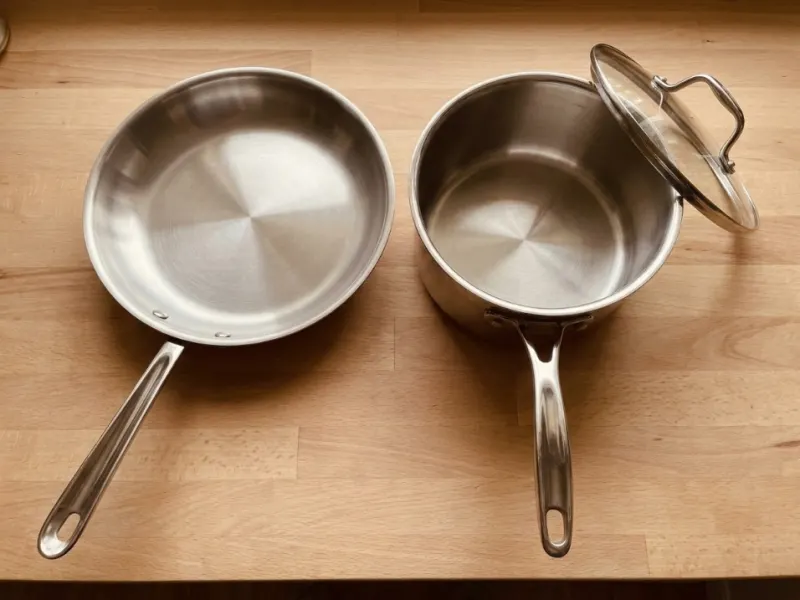
The difference between a saucepan and a skillet is wall height, and that one measurement decides the job. A skillet runs wide and shallow, roughly five times wider than its walls are deep, so exposed liquid evaporates fast, which suits searing, sautéing, and reducing pan sauces. A saucepan runs tall and narrow, barely wider than it is tall, so liquid stays put and heat holds steady, which suits simmering soups, grains, and stocks.
Grab the wrong one, and you spend the whole cook fighting the pan's shape.
Skillet vs Saucepan: Wide and Shallow vs Tall and Narrow#
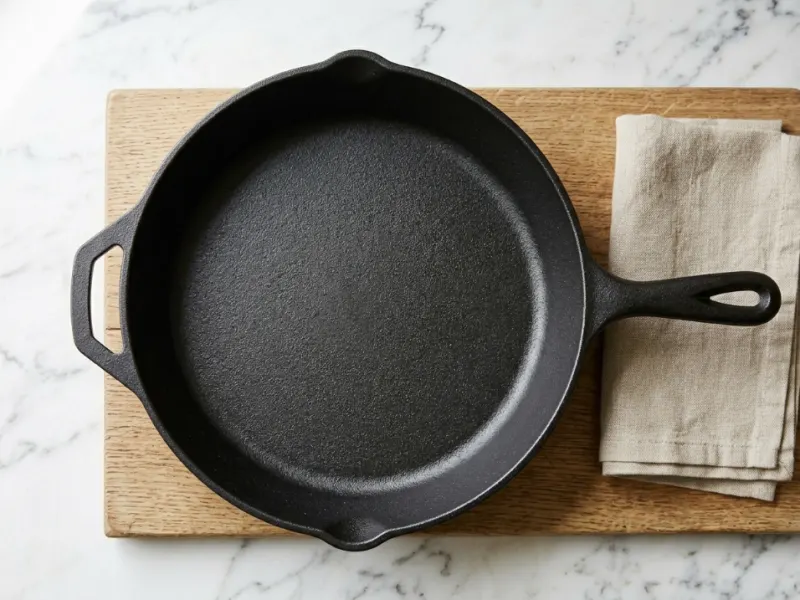
The gap between these two shapes shows up on real spec sheets. The Stargazer 10.5-inch cast iron skillet lists a cooking depth of 2.0 inches on its own manufacturer page. That is a rim diameter a little over five times its wall depth (10.5 divided by 2.0). The Zwilling Spirit 3-Ply 3-Qt Sauce Pan runs the opposite way: 5.98 inches tall against a 7.87-inch upper diameter, barely wider than it is tall.
Evaporation rate tracks the surface area of liquid exposed to open air. More exposed surface means faster evaporation. A skillet's wide, shallow basin keeps a large liquid surface open to the room.
A saucepan's tall, narrow column exposes a fraction of that surface at the same volume. Its lid, standard on most saucepans and rare on skillets, compounds the effect; a fitted lid traps the steam that would otherwise carry heat and moisture away.
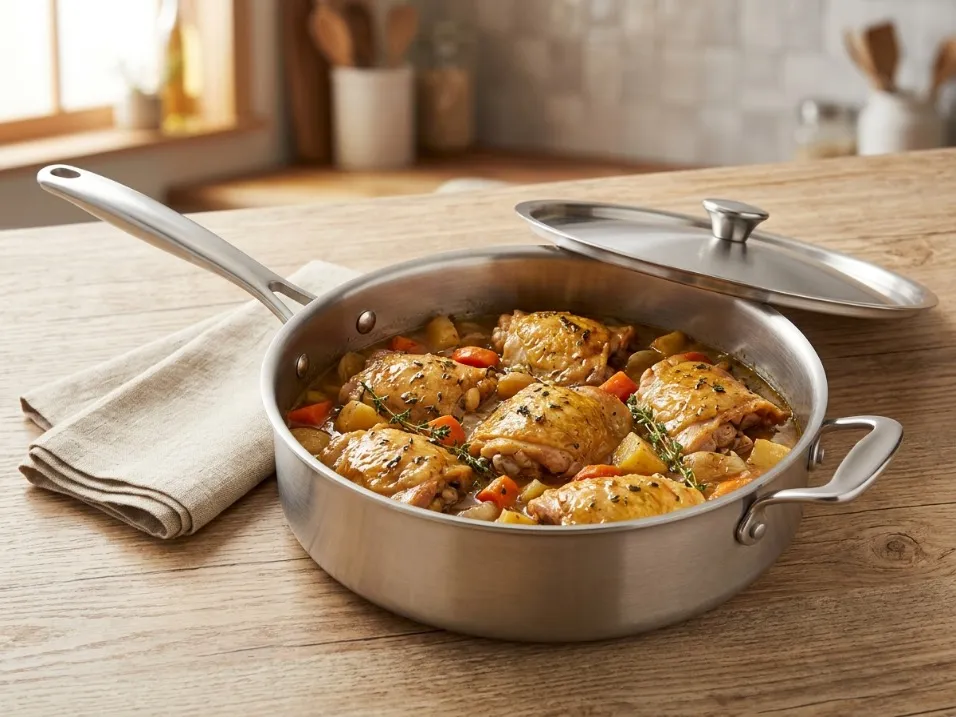
A saute pan sits between the two shapes on purpose. Its walls run straighter and taller than a skillet's flared sides, but shorter than a true saucepan. That middle geometry evaporates liquid slower than a skillet but faster than a saucepan. It still will not hold a simmering stock as efficiently as a tall saucepan, and it will not brown as fast as a wide-open skillet.
Sizes Come in Inches and Quarts#
Skillets and saucepans are measured in different units entirely, and that reflects the job each shape does. Tramontina's Signature Tri-Ply Clad Fry Pan line ships in 8, 10, and 12-inch sizes, measured rim to rim. Misen's Stainless Steel Skillet line ships in 6, 8, 10, and 12-inch sizes on the same inches-across logic.
Saucepans are sized by volume instead. Tramontina's Signature Tri-Ply Clad Covered Sauce Pan ships in 1.5, 2, 3, and 4-quart capacities. Zwilling's Spirit 3-Ply Sauce Pan line ships in 1, 2, 3, and 4-quart sizes.
A tall, narrow shape makes volume the number that matters. A wide, flat shape makes diameter the number that matters. Neither unit converts directly to the other. Comparing a "10-inch" skillet to a "3-quart" saucepan means comparing two different kinds of measurement, not two sizes on the same scale.
Clad Walls and Riveted Handles#
Construction quality also splits inside the saucepan shelf. Tramontina sells a fully-clad Signature saucepan and a base-only Tempo saucepan. The Signature Tri-Ply Clad Covered Sauce Pan runs an aluminum core between two layers of stainless steel the full height of the pan, base to rim.
The disc-bottom Tempo Tri-Ply Base Stainless Steel Covered Saucepan confines that same aluminum core to the base disc only. It carries nearly identical "tri-ply" branding anyway. Check the specific line name, not just the word "tri-ply," before buying a saucepan.
Handle attachment differs by brand too. Tramontina's own product pages state the stainless steel handle is "securely riveted" on both the Signature skillet and the Signature saucepan. The disc-bottom Tempo saucepan separately states a "precision-cast, riveted" handle.
Misen's own skillet page and Zwilling's own saucepan page do not use the word riveted anywhere. Misen describes an "ergonomic, stay-cool handle," and Zwilling describes "ergonomic, v-shaped handles," with no attachment method stated on either page.
A riveted-handle claim is accurate for Tramontina specifically, not something to assume for every stainless pan on the shelf.
An induction compatibility check is worth running before buying either shape. A fully-clad pan's magnetic outer layer is what determines whether it heats on an induction cooktop.
The Tramontina Signature Tri-Ply Clad 12-Inch Skillet carries this fully-clad, riveted-handle construction on the skillet side of this comparison. It is built to the same clad tier Tramontina also sells in a saucepan under its own brand.
Can One Stand In for the Other#
Neither shape substitutes well for the other past a narrow range of jobs. A saucepan can stand in for a skillet at low, moist-heat tasks, like warming a sauce. It cannot stand in for searing or sautéing.
Its tall walls trap steam close to the food. That moisture has to clear before the surface can climb past boiling; Maillard browning needs temperatures above 280°F, and liquid water tops out at 212°F. That gap is why a crowded, steamy saucepan browns far slower than an open skillet.

A skillet can stand in for a saucepan only at very small liquid volumes, like a single-serving pan sauce. It is the wrong tool for anything that needs real depth. Its shallow walls let liquid evaporate faster than a saucepan's taller sides allow, the same geometry that makes it the better tool for a reduction in the first place.
Which One to Buy First#
If you sear, buy the skillet first. If you simmer grains and soups, buy the saucepan first. That split also fits a first kitchen.
A skillet is the highest-utility shape for the widest range of everyday cooking. A saucepan earns its spot once sauces, grains, or small-batch soups become a regular habit, not an occasional one.

Tramontina's Signature skillet line ships in 8, 10, and 12-inch sizes; first-kitchen guidance favors the 10-inch for small kitchens, where a 12-inch can overhang small burners and crowd storage.
A close relative, the saucier, swaps the saucepan's sharp base corner for a curved one. Our saucier vs saucepan breakdown covers when that curve is worth the extra cost, and how many pans you actually need depends on how often you cook.
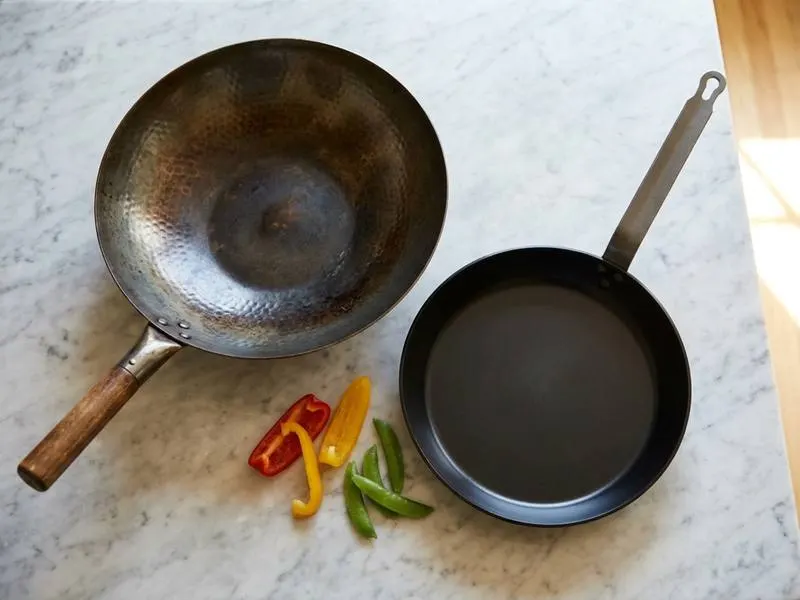
The wok vs skillet comparison covers where a skillet's open geometry runs out of room for high-heat tossing.