Which pan actually earns a spot on your stovetop: the saucier, the saucepan, or the saute pan sitting three shelves over at the store? The material selector quiz can help narrow this down based on how you actually cook.
We compared manufacturer specs for a Misen saucier, a Zwilling saucepan, and a Cook N Home saute pan side by side, and traced each pan's wall geometry back to what actually happens when a whisk moves through it.
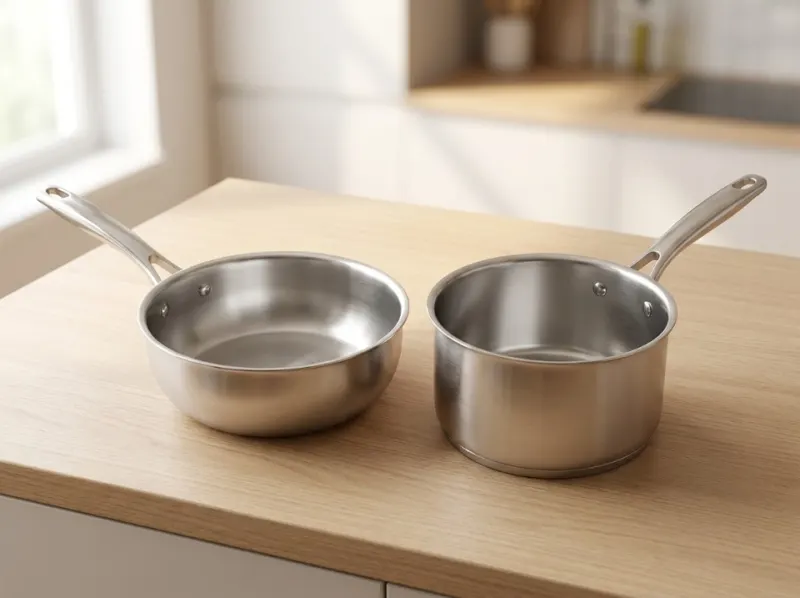
The corner decides everything. A saucepan's wall meets its base at a sharp right angle; a saucier's wall curves continuously, with no corner at all. Whisking-heavy jobs, risotto, pastry cream, hollandaise, earn back the saucier's higher price, while hands-off jobs like boiling or simmering don't need the curve. Neither pan browns food, that's the saute pan's separate job.
Most buying guides stop at saucier versus saucepan. They never explain why the saute pan doesn't belong in that same choice at all.
It solves a different problem entirely. Lumping it in is how kitchens end up with three pans that overlap instead of three that cover distinct jobs.
The Corner Is the Entire Difference#
A right angle where a saucepan's wall meets its base is a spot a curved whisking motion can't fully reach. A whisk moving in a circle traces a curve. A curve cannot fold itself into a 90-degree turn.
Whatever settles into that corner, egg proteins thickening a custard, starch releasing from rice in a risotto, butter solids in a beurre blanc, sits still against a hot wall while everything else keeps moving. Sitting still next to direct heat is exactly how a sauce scorches in one spot.

A saucier removes the corner entirely with a continuous curved wall. The same motion that missed a dead zone in a saucepan now covers the whole interior on every pass.
This is the same shape-driven physics that decides skillet versus saucepan. Wall geometry, not material or brand, decides which jobs a pan handles well.
That comparison swaps a skillet's wide, shallow evaporation for tall, straight walls that hold liquid. Here, the saucier swaps a saucepan's straight wall for a curve that removes the one spot a whisk can't reach. None of this makes a saucepan's corner a design flaw; it's simply irrelevant for hands-off jobs.
Boiling water, cooking pasta, poaching eggs, reheating leftovers, none of it leaves anything sitting still long enough in a corner to scorch. A straight wall also holds slightly more usable volume near the rim at the same stated capacity, since no inward curve eats into that space.
When the Saucier Earns Its Price Over a Saucepan#
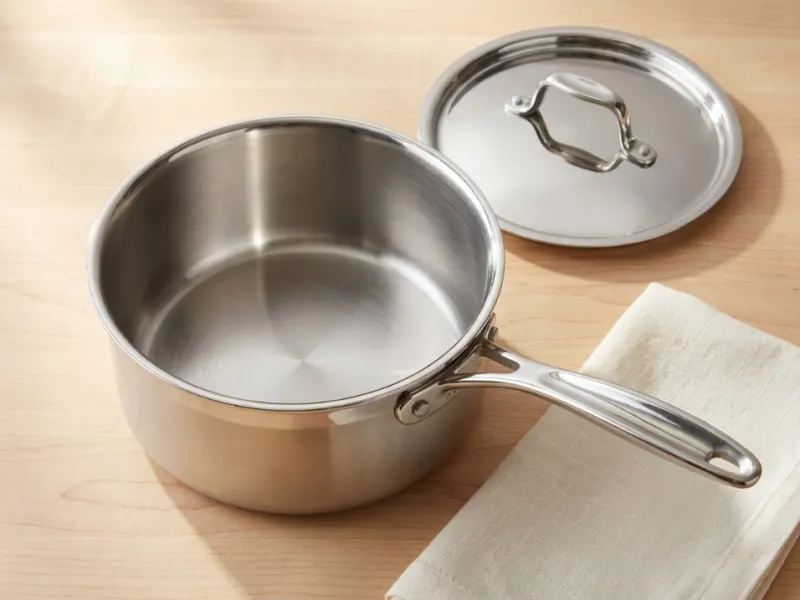
At matched 3-quart capacity, a genuine saucier like the Misen 5-Ply Stainless Steel Saucier runs roughly 40% more than a comparable straight-walled saucepan such as the Zwilling Spirit 3-Ply 3-Qt Sauce Pan. Part of that gap is construction, not shape alone.
Running the price gap against ply count is what showed us how much of it is construction, not the curve alone: the Misen is a 5-ply build against the Zwilling's tri-ply, so part of what you're paying for is two extra cladding layers. Curious what those extra layers actually buy you? Our 3-ply vs 5-ply breakdown covers it.

That premium only pays off if your cooking actually uses the curve. Risotto that needs constant stirring from the pot's edge inward. Pastry cream that scorches the second it sits still. Hollandaise that can split in seconds once heat concentrates in one spot.
These are where a saucier changes the outcome. If your stovetop routine is mostly simmering stock or boiling pasta water, you're paying the curve premium for a corner you were never going to use.
If you are deciding whether the saucier earns its space, our guide to how many pans you need can help you prioritize the shapes you use.
Where the Saute Pan Actually Fits#
A saute pan isn't a rounder saucepan, and it isn't a smaller Dutch oven. It's a wide, flat-bottomed vessel built to brown a large surface area before the pan goes into a braise.

Neither the saucier nor the saucepan is shaped to do that job well; both are built around a small footprint and a corner or curve meant for liquid, not a wide surface meant for contact with meat or vegetables. We already worked through when a saute pan earns cabinet space over a plain frying pan: its straight walls trade a skillet's easy tossing motion for the ability to hold volume and reduce a sauce in the same vessel you browned in.
That's a browning decision, not a whisking decision. Which is exactly why folding the saute pan into a saucier-versus-saucepan choice doesn't make sense.
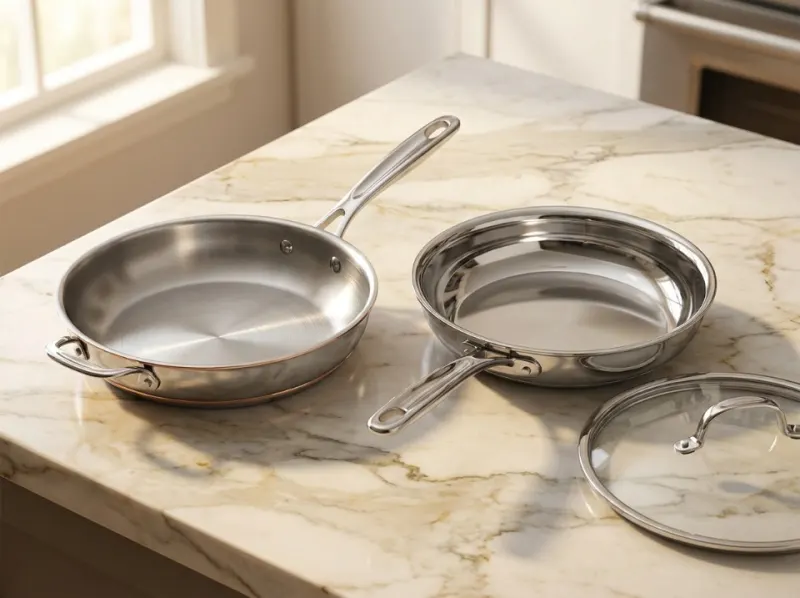
Buying a Cook N Home 4-Quart Tri-Ply Saute Pan does not replace either pan above it. It replaces a skillet for one specific step: getting color on meat or vegetables before liquid goes in and the lid comes down.
The Decision Framework#
Skip the "which looks nicer in the cabinet" question. What decides this is how often your stovetop routine puts a whisk against a hot wall. Looks don't factor into it at all.
If you're asking this question at all, you likely already own a saucepan, the near-mandatory workhorse behind most weeknight boiling, poaching, and simmering. The real decision in front of you is whether the saucier earns a second spot next to it.
It does the moment your whisking work has actually cost you a scorched sauce more than once, custard, risotto, hollandaise, anything that demands constant motion against a hot wall. If that's never happened, the saucepan you already own keeps covering the job, and the curve is a premium you don't need yet. The saute pan solves a browning problem neither of the other two touches, so its case stands entirely on its own, independent of whether a saucier ever earns a spot in the same kitchen.
Owning all three isn't excess if your cooking genuinely spans whisking sauces, simmering stock, and browning before a braise. Adding a saucier or a saute pan before you've hit a real limitation in your saucepan is how a drawer fills up with pans that see daylight twice a year.
The corner is small. What it decides isn't. Buy for the job you actually cook, not for whichever pan looks the most impressive sitting on the stove.