Both a roasting pan and a dutch oven get pulled out for the biggest meal of the year. Only one of them can actually fit a whole turkey.
A dutch oven wins almost every week. It handles braising, stewing, frying, and bread, and it is stovetop-safe at any price tier. A roasting pan wins exactly one job: fitting a whole turkey or an oversized roast. Even the largest oval dutch ovens do not have the footprint for that unless the bird is spatchcocked first.
That capacity gap settles the purchase. Stovetop safety and moisture control never even get a turn.
Most comparison articles skip straight past it. We went through Reddit's cookware threads, hands-on comparison videos, and owner reports on both tools to find out what actually decides a roasting pan vs dutch oven purchase.
The honest answer: this is a capacity question wearing a performance-comparison disguise.
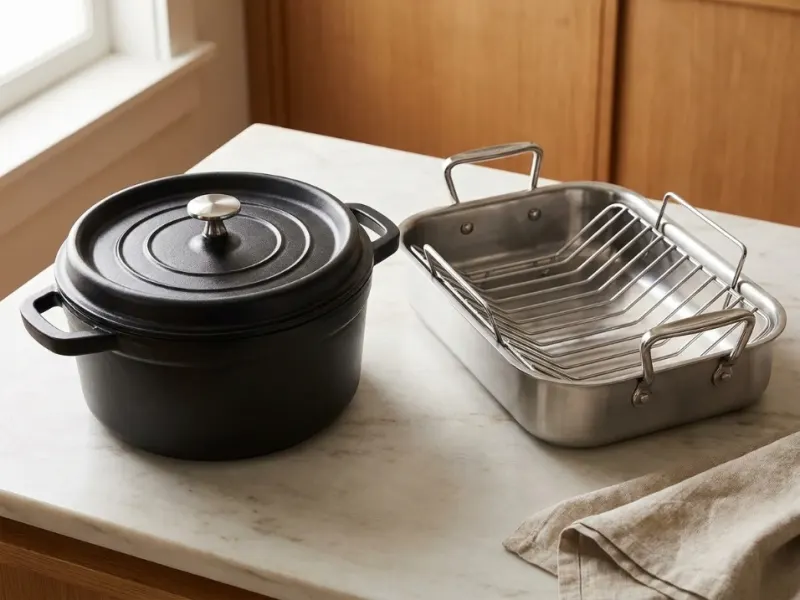
The Staub Cast Iron Round Cocotte and a stainless roasting pan like the Cuisinart MultiClad Pro Roasting Pan are the two products we focused on here. They represent each category at its most common configuration.
A 4-quart enameled cast iron dutch oven. A tri-ply stainless roasting pan with a rack.
Roasting Pan vs Dutch Oven: The Capacity Question#
Reddit's r/Cooking and r/castiron communities consistently put most kitchens in the 5.5 to 6-quart range for an everyday dutch oven.
Step up to around 7.25 quarts, the size Le Creuset itself rates for 7 to 8 servings, and you add room for a whole chicken plus vegetables. That is a batch-cooking size rather than an everyday one.
Even the biggest oval dutch ovens still fall short of a roasting pan's footprint. Le Creuset sells a 15.5-quart oval, rated for 9 or more servings on its own product listing, and even that size does not solve the turkey problem on its own.
Cooking sources and owner communities consistently report that a whole large turkey still needs to be spatchcocked or broken down first. Otherwise no dutch oven, oval or otherwise, has a real chance of closing its lid.
A rack-equipped roasting pan skips that problem entirely. It is sized by footprint, not volume.
The Cuisinart MultiClad Pro Roasting Pan runs 16 inches, and Cuisinart's own listing says its roasting pans are "designed to hold turkeys, chickens, and large roasts," with room underneath for vegetables to catch the drippings.
If the thing on your counter is a full-size turkey, this comparison resolves itself immediately. Moisture retention and browning do not even enter the conversation. A dutch oven simply will not close over it.
The Staub Cast Iron Round Cocotte featured here runs 4 quarts. That sits well below even the 7.25-quart batch-cooking size.
It is a genuinely useful everyday size for braises and weeknight cooking. It is not the pot to reach for when the job is a spatchcocked turkey or a whole chicken with vegetables.

Stovetop Safety Is the Differentiator Nobody Mentions#
Here is where the two tools split in a way most comparisons skip. A dutch oven is stovetop-safe by default, at any price tier, because its base is solid cast iron with nothing coated on top of it.
Sear a roast. Braise it in the oven. Set the same pot back on a burner and reduce the liquid into a sauce.
One vessel, start to finish.

A roasting pan's stovetop capability depends entirely on what it is made of. The Cuisinart MultiClad Pro Roasting Pan is fully-clad tri-ply stainless, per Cuisinart's own product listing, with riveted handles and a solid stainless rack.
A bare stainless surface like that has no applied coating to protect at all, which removes one specific concern, coating breakdown, that a non-stick roaster has to account for. It is still worth checking the specific product's own rating rather than assuming construction alone settles it.
A non-stick-coated roaster is a different story. PTFE coatings begin releasing fumes at temperatures as low as 500°F, according to NCBI research on polymer fume fever. Human symptoms generally do not start until 662°F, and full degradation does not begin until 752°F, both well past normal cooking use.
Non-stick coated roasting pans are generally discouraged from stovetop use, since the coating faces direct high heat it isn't built for. That means pouring drippings into a separate saucepan before gravy happens, an extra dish and an extra step a dutch oven never requires.
Check the manufacturer's rating before you assume any roasting pan can go on a burner. Construction tier alone does not settle it, and it is not a safe default the way it is with cast iron.
If you are ever unsure whether a specific pan or rack can handle those temperatures, the oven-safe temperature lookup covers it by brand and material.
How Often Either One Actually Leaves the Cabinet#
Per gummysearch.com's aggregation of Reddit threads across r/Cooking, r/BuyItForLife, r/Sourdough, r/cookware, and r/AskCulinary, dutch ovens showed up as a constant buy-it-for-life topic.
Dutch ovens from Lodge, Le Creuset, and Staub all turned up repeatedly with strong ratings. Roasting pans essentially did not appear in those same threads at all.
That pattern matches how the two tools actually get used. A dutch oven earns a weekly spot in the rotation: soups, stews, braises, the occasional loaf of bread.
A roasting pan comes out a handful of times a year for most households, usually clustered around the holidays. The rest of the time it takes up an awkward chunk of cabinet space that does not stack or nest well.
One workaround worth knowing: one baker, Foodgeek, tested this directly in a side-by-side sourdough comparison. They used an oblong roasting pan's lid on its own as a stand-in for a large loaf too long to fit a round dutch oven.
It loses the tight, self-basting lid seal of an enameled cocotte. The extra footprint fits a shape a round dutch oven physically cannot.
If You Can Only Buy One#
For most kitchens, the dutch oven is the stronger first purchase. It covers braising, stewing, frying, and small to medium roasting.
It is stovetop-safe at any price tier, which a roasting pan is not by default.
The Staub Cast Iron Round Cocotte earns its spot here on two strengths. Its metal lid knob has no phenolic temperature ceiling to track. Its self-basting lid uses interior spikes to condense moisture and drip it back over the food.
Per gummysearch.com's aggregation of the same Reddit threads, owners commonly cite this feature, plus a tighter lid seal and a black interior that hides scorch marks, as their reasons for choosing Staub over Le Creuset.
That black interior has a small tradeoff of its own. It also makes browning and fond harder to judge by eye than a lighter interior would.
This 4-quart size is the everyday, weeknight pick, not the one-dutch-oven-fits-everything answer. If your default roast runs bigger than that, a whole chicken with vegetables or more, look at the 5.5 to 6-quart range most kitchens settle on instead, sized up from there if you regularly cook for a crowd. The category verdict here is dutch oven vs roasting pan, not a claim that this specific size covers every job in that category.
If a whole turkey or a cut too large for anything else you own is forcing the issue, choose a heavy stainless or tri-ply model instead of a thin aluminized or non-stick one, like the Cuisinart MultiClad Pro Roasting Pan. Both will hold the bird and a rack. The tri-ply's advantage shows up after the bird comes out, in the gravy step covered above.
Readers deciding on dutch oven size specifically should see our breakdown of what size dutch oven to buy. Anyone wondering whether their dutch oven can handle a glass-top or electric range should check dutch oven electric stove compatibility.
For a different everyday substitute question, pressure cooker vs dutch oven covers the speed tradeoff this article does not. Run the cookware cost calculator before you decide which tier actually makes sense for how often you will use either one.