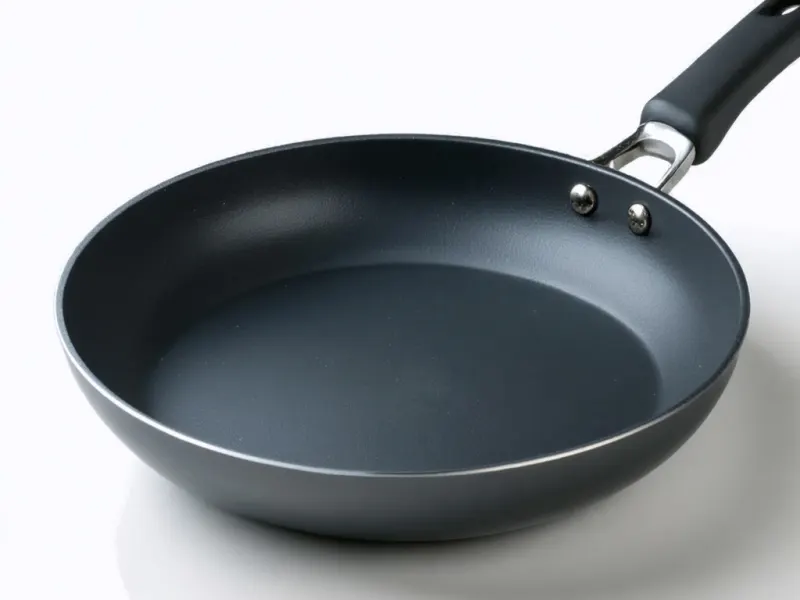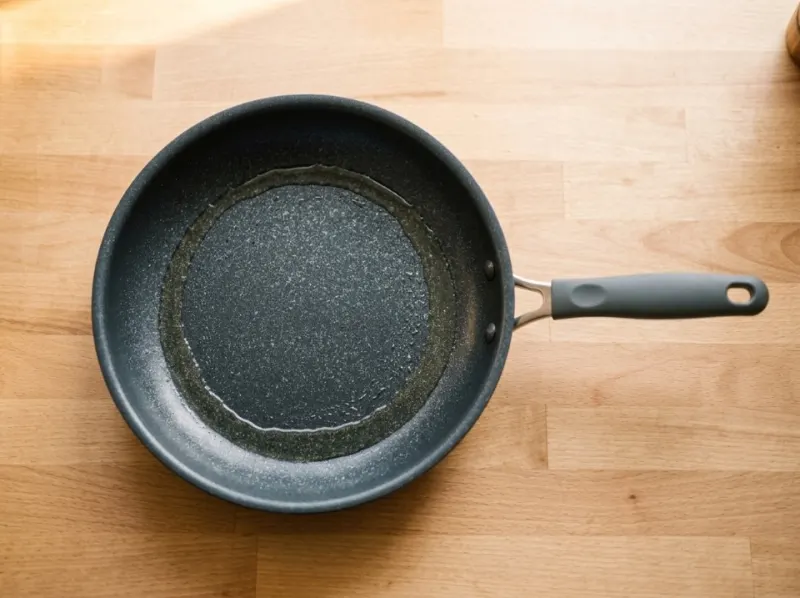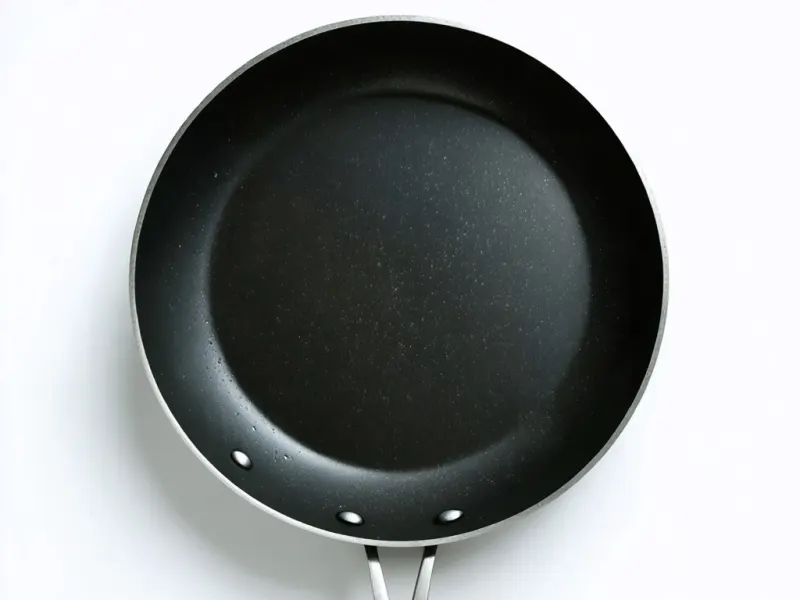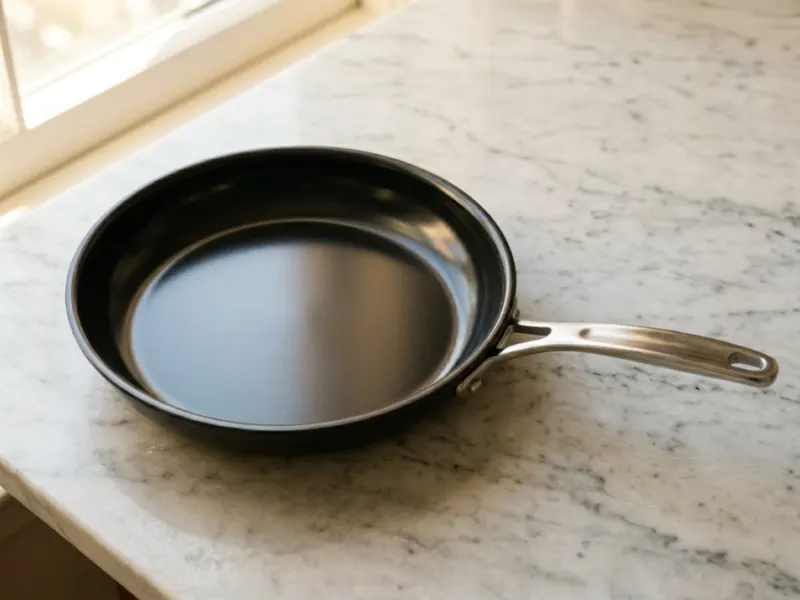
Is your "PFOA-free" nonstick cookware actually PFAS-free? For most nonstick cookware, no. PFOA was one processing chemical, phased out industry-wide by 2015 under the EPA's PFOA Stewardship Program. PTFE, the coating itself, is still a PFAS compound on every "PFOA-free" pan sold today, and that label answers a different question than most buyers think it does.
Our nonstick cookware buying guide covers the rest of the buying decision once PFAS status is verified: coating durability, oven limits, and induction compatibility.
We went looking for a way to actually check that claim instead of taking it on faith, and the label logic turned out to run deeper than we expected. Here's the part that trips up even careful shoppers: knowing PTFE is technically PFAS doesn't tell you which brand's "PFAS-free" claim to trust. Most ceramic brands say it. Only some back it up, and when we started checking those claims against the certifying body's own records, we found one brand's claim didn't hold up at all.
What Is PFAS in Cookware, Exactly?#
PFOA (perfluorooctanoic acid) was a processing chemical manufacturers used to apply nonstick coatings, not the coating itself. The EPA classifies PFOA among the PFAS compounds it tracks for health risk. Under the EPA's 2010/2015 PFOA Stewardship Program, manufacturers agreed to remove it from emissions and products by 2015. Every nonstick pan made today is manufactured without PFOA added on purpose, and that deadline is why the phrase shows up on nearly every label.
"On purpose" is not the same as "in fact." Later in this piece, Consumer Reports' own lab test found a PFOA-free-labeled pan that still tested positive for PFOA, likely as an unintended byproduct rather than a deliberate additive, which is why the claim needs checking rather than trusting outright.
The coating that remains, PTFE, is a different story. It's a synthetic fluoropolymer. Its chemical backbone makes it a PFAS compound by definition, no matter how it was made.
A "PFOA-free" sticker addresses one chemical used during manufacturing. It says nothing about the finished coating still on your pan.
This isn't a fringe reading of the labels. The Ecology Center, an independent nonprofit testing lab, reported that nearly 80% of the cookware pieces it tested carried a PTFE coating. That's the industry's dominant nonstick chemistry, confirmed by someone other than the manufacturers.
What PTFE Actually Does at the Stove#
PTFE's carbon-fluorine bond is the hallmark of every forever chemical. It's one of the strongest bonds in chemistry.
That's exactly what makes a nonstick pan work. It's also what makes PTFE stick around once it leaves your kitchen.
At the stove, the risk is different from the environmental one. PTFE is FDA-authorized for food contact under 21 CFR 177.1550. The coating is chemically inert. Per the Missouri Poison Center, a flake that gets swallowed travels through the intestines and comes out in the stool intact, without harming the body.
Fumes only become a risk at temperatures well past normal cooking. Per NCBI/StatPearls, PTFE starts releasing fumes around 500°F. Human symptoms don't usually start until 662°F, and real breakdown begins at 752°F.
You'd need to leave an empty pan on high heat, far past any real recipe, to reach that range. With food or oil in the pan, you never get close.
Broader PFAS concern is mostly about factory runoff into water supplies, not about using a finished pan on your stove.
Nearly all people in the U.S. already carry measurable PFAS in their blood, per the CDC's ongoing biomonitoring. That biomonitoring tracks blood levels across the whole population; it does not attribute the burden to any single source, cookware included.
The Real Question Isn't Ceramic vs. PTFE#
Most buyers sort cookware into two buckets: "ceramic is safe" and "PTFE is not." That split misses the real dividing line.
Ceramic (sol-gel) coatings genuinely contain no PTFE or PFOA. But "PFAS-free" isn't equally checked across ceramic brands.
Some publish outside lab tests or list their exact ingredients. Others put the same three words on the box with nothing behind them.
Uncoated cookware sidesteps the question entirely. Stainless steel, cast iron, and carbon steel have no coating, so there's no PFAS claim to check in the first place. If you're weighing that option, our ceramic vs Teflon comparison covers the tradeoffs on the coated side.
How to Actually Verify a "PFAS-Free" Claim#
We dug into how these claims actually get verified, and before you trust a claim, here's how we rank what's backing it.
The strongest signal is an independent lab certification. NSF launched Certification Guideline 537 for PFAS-Free Products.
It requires a formulation review and yearly retesting for total organic fluorine. A brand with that certification gets checked by someone other than itself, every single year.

The next-best signal is a specific composition disclosure. That means a brand names its exact sol-gel silica ingredients instead of printing a bare marketing label.
The weakest signal is the bare words "PFAS-free" printed on a box, with no certification mark and no disclosed ingredients behind them. That's a marketing claim, not a verified fact.
A labeled claim can fail even independent lab testing, not just brand self-reporting. According to Consumer Reports, which tested three nonstick pans for 96 different PFAS compounds, two ceramic pans marketed PTFE-free came back clean, zero of the 96 PFAS detected. The third pan tested, the PTFE-coated Swiss Diamond, was marketed PFOA-free but tested positive for 16 of the 96 PFAS checked. That included an average of 4 parts per billion of PFOA itself, the chemical its label claimed to be free of.
Consumer Reports drew the practical conclusion and stopped displaying "PFOA-free" in its own nonstick cookware ratings after this result, since that claim held up in testing and PFOA-free did not. California's law, effective 2023, bans a cookware seller from claiming freedom from one PFAS (like PFOA) in an online listing if the product contains any other PFAS, like PTFE itself. Colorado followed with a similar law in 2024. Swiss Diamond's own US distributor told Consumer Reports it would drop the PFOA-free claim from its website and packaging to comply.
There's a signal worse than the weakest one, though, and we found it while double-checking the strongest one: a certification claim that turns out to be false when you check it. GreenPan's Reserve Pro product page markets its Thermolon 9G coating as "the first NSF Certified ceramic nonstick." We went to NSF's own Public Notices page to confirm it, and NSF says otherwise. A notice dated March 13, 2026 states GreenPan "does not have a NSF certification at this time and is not authorized to claim NSF Certification or use the NSF Certification Mark."
Plenty of ceramic brands make a PFAS-free claim with nothing behind it. GreenPan shows there's a worse version of that gap: a brand claiming the strongest verification tier without actually holding it.
Where This Leaves the Certification Question#
NSF 537 itself is real. The lubricant maker ROCOL was the first manufacturer NSF actually certified under it, per NSF's own announcement. No cookware brand is confirmed by NSF's own materials to hold it, GreenPan included.
That doesn't mean every ceramic "PFAS-free" claim is false. It means the one signal we told you to look for can itself be misused, and checking the box isn't enough. You have to check the certifying body's own records.
There's a simpler way around the whole problem: skip the coating entirely. A Lodge cast iron skillet has no coating, so there's no PFAS claim to verify, no certification to check, and no NSF notice to worry about. It won't replace a nonstick pan for eggs, but it sidesteps this entire verification question for the pans where it works.
If you want a nonstick surface and are willing to keep checking labels, why nonstick pans stop working covers what actually decides a coated pan's lifespan. That timeline isn't affected by PFAS status either way.
The Mistake Worth Fixing#
The first mistake isn't using a nonstick pan. Intact PTFE at normal cooking temperatures carries minimal risk, by the weight of the evidence. Avoiding it entirely doesn't meaningfully change your own exposure either, for the reasons already covered above.
The second mistake is treating a certification claim as settled just because it's printed on the box. GreenPan's "first NSF Certified" language reads exactly as confident as a claim that actually holds up, and NSF's own notice is the only reason we know it doesn't. The fix isn't distrusting every label. It's checking the certifying body's own site before a claim like that changes your purchase.
If you're shopping for a nonstick pan today, the material selector quiz can help you weigh coated options against uncoated ones, once you've settled the PFAS question for yourself.
The cookware cost calculator is worth a look too if you're weighing a coating that needs replacing every few years against a Lodge skillet that doesn't.