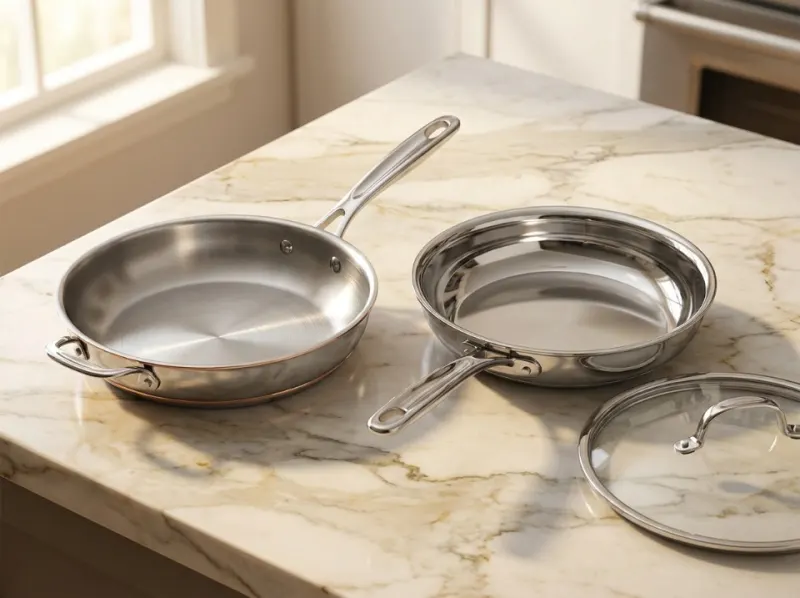
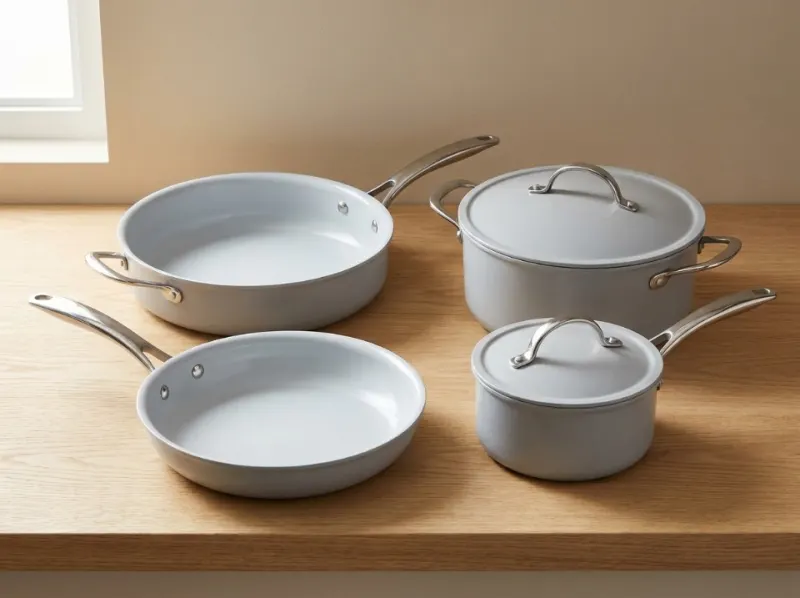
The most overpriced pan in this comparison sits in the same price bracket as All-Clad's premium stainless line but fails at the one thing its price is supposed to buy.
What we found after digging through owner reports across the most expensive cookware brands and budget pans built the same way confirmed the pattern. Some premiums buy real engineering that shows up in your hand but not on your plate. Others buy nothing at all. The difference takes a specific test most buyers never run.
Why Most Overpriced Cookware Brands Lists Get It Wrong#
Most "overpriced cookware" lists name specific brands to avoid and move on. That works until a new brand launches, and it never gives you a way to evaluate a name that is not on someone's list.
The deeper mistake most overpriced cookware lists make is treating "expensive" and "overpriced" as the same question. They are not. Expensive asks what something costs; overpriced asks whether the cost is buying anything you can verify. Separate the two, and most cookware pricing falls into one of two failure modes.
Check One: Does a Cheaper Pan Use the Same Construction?#
Look at the product listing for a stated construction method. You want a layer count, a core material, or a coating type printed on the spec sheet, not the ad copy. A listing that offers only words like "premium" or "chef-grade" with no spec behind them is the first tell.
Once you identify the construction type, search for it alongside "review" to see what alternatives exist. "Fully clad stainless steel skillet review" surfaces Tramontina Signature and Cuisinart MultiClad Pro alongside All-Clad.
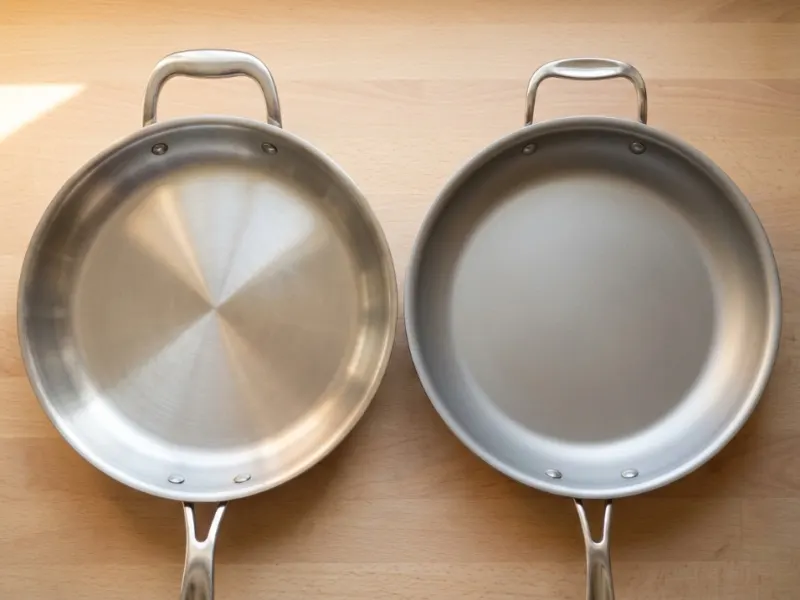
Verify the cheaper option is genuinely equivalent by checking the rim. Distinct layers of metal at the lip mean the aluminum core runs base to rim. That is fully clad. A rim that looks like a single sheet of steel is disc-bottom, regardless of the product name.
Owners who have run both Tramontina Signature Tri-Ply Clad and All-Clad D3 side by side report identical food. Identical cooking results according to long-term r/cookware ownership threads.
The gap shows up in handle comfort, balance on the cooktop, and a lifetime warranty that gets honored reliably. Those are real differences, just not differences that change what you cook. The Tramontina sits at roughly a quarter of All-Clad D3's price for the same fully-clad skillet size.
That makes All-Clad expensive, not overpriced. If you are budget-conscious and cooking results are what matter, the Tramontina gives you the same food for a quarter of the cost. But a brand earns the "expensive, not overpriced" label when the premium buys better finishing or ergonomics rather than a different cooking tool.
Check Two: Do Owners Report the Core Claim Failing?#
Search the product name plus "Reddit" or "forum" and look for a complaint pattern. A single negative review is noise. A thread where person after person reports the same failure is signal.
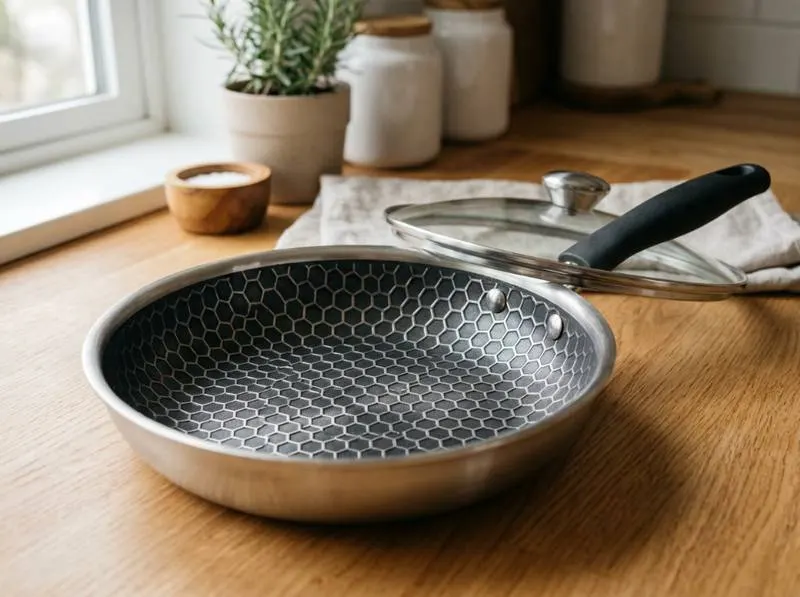
HexClad is the clearest example of this failure mode. The brand prices its hybrid stainless-nonstick pan in the same bracket as All-Clad's D5 stainless line. Its build is genuinely different: a tri-ply body with laser-etched hexagonal steel peaks that protect nonstick-coated valleys.
The peaks sear like stainless and shield the coating from metal utensils. The valleys are supposed to deliver effortless food release. That hybrid geometry is a real engineering distinction.
The problem is what owners report in practice. In our research, the complaint across independent communities is the same: food sticking to a surface sold as effortless nonstick. A widely-referenced r/Costco thread and a 2022 r/cookware thread call HexClad overpriced and prone to sticking. In Amazon reviews from 2020 to 2022, buyers describe eggs bonding to the surface despite following HexClad's care instructions.
The nonstick release that the valley geometry promises is, according to these reports, exactly what fails. When owners across independent communities report the same failure, the premium is not buying what it advertises.
Compare that to All-Clad again. Nobody on r/cookware complains that All-Clad D3 produces worse food than Tramontina, because All-Clad never claimed it would. The premium buys handle comfort, flush rivets, a rolled lip, and a lifetime warranty. Owners confirm those differences exist, and the brand delivers what it promises.

The Outcome Matrix#
Both checks together produce four possible results, and each one resolves into a clear verdict:
A cheaper same-construction alternative exists AND owner reports contradict the core claim. This is the worst case. Based on what owners report across Reddit and Amazon, HexClad lands here: budget nonstick pans deliver the release that HexClad's hybrid geometry promises but that owners say it fails to provide. The cookware cost calculator compares repeat nonstick purchases with one uncoated pan at the prices you enter.
A cheaper same-construction alternative exists BUT the brand delivers what it promises. Expensive, not overpriced. All-Clad and Le Creuset both land here.
Owners who have run Le Creuset alongside Lodge enameled cast iron report identical braising results. Those same owners report the enamel resisting chipping better over years of use, and the pot runs noticeably lighter to lift. Real construction differences, honestly delivered.
No cheaper equivalent exists AND the core claim holds. Justified premium. Rare in cookware. Most construction methods are shared across brands at different price points, so a truly unique build is the exception.
No cheaper equivalent exists BUT owners report the core claim failing. Still overpriced, because the premium promises a result it does not deliver regardless of how unique the construction looks on paper.
Where the Two-Part Test Breaks Down#
The test works less cleanly on one category: nonstick coatings. Stainless steel and cast iron are lifetime materials where a construction premium can pay off over a decade. A nonstick coating is consumable no matter what it costs.
According to Amazon owner reports, PTFE coatings commonly lose their nonstick release around the two-to-three-year mark with normal use. On Amazon, GreenPan owners frequently report losing release within months to about a year and a half.
Paying a steep premium for a nonstick pan is a structurally different mistake than paying the same amount for stainless steel. The second purchase can last decades. The first one is on a replacement schedule regardless of brand.
If you want to compare what brands actually disclose about their coating composition rather than relying on marketing labels, the PFAS safety checker tracks which ones publish data and which repeat a claim without backing. Before running either check on a nonstick purchase, ask whether a consumable coating justifies a premium at all. Often the honest answer is no. The nonstick pan replacement guide covers the math.
The Direct-Sales Red Flag#
One pattern reliably identifies the worst-case scenario before you even run the checks. Kitchen Charm sells cookware exclusively through in-home demonstrations at a steep premium.
The brand uses T-304 stainless steel. That is the same T-304 (18/8) food-grade stainless steel Tramontina uses in its fully-clad line. Kitchen Charm's construction is not the same as Tramontina's, but the steel grade is identical and the price gap is dramatic. The premium funds the direct-sales model, not unique metallurgy.
If a brand skips retail shelves entirely and sells only through demos or social funnels, that sales model is where the margin goes. Ask for the alloy grade and layer count printed on the pan. If the answer is the same T-304 grade available at retail for a fraction of the cost, you have your answer.
Where to Start If You Are Shopping Now#
If you want a pan that passes both checks, the Tramontina Signature Tri-Ply Clad is the default we point to. Same fully-clad construction as the premium brands charging several times more, matching the cooking results owners report head-to-head against All-Clad D3.
The handle is shorter and straighter than All-Clad's, less comfortable under heavy loads when lifting a full pan. That is the tradeoff you accept for the savings.