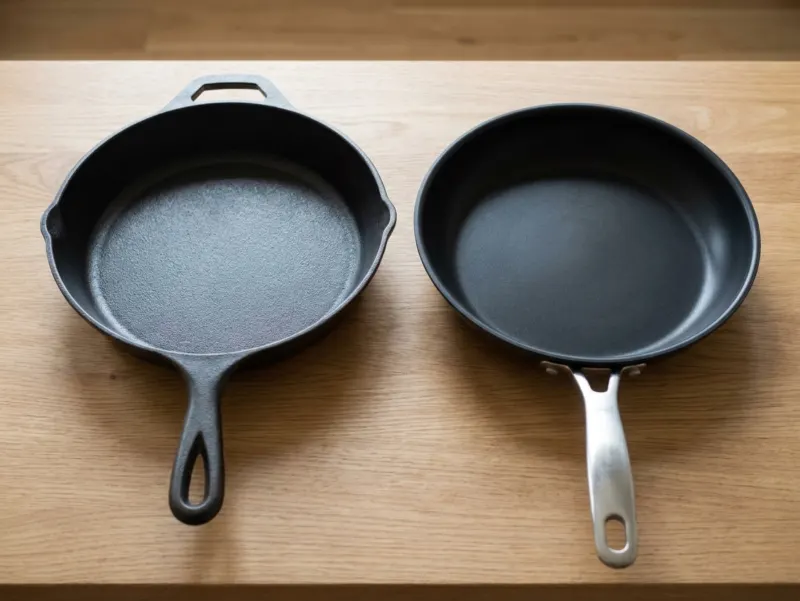
Ask why cast iron beats nonstick, and most people give the same answer. Cast iron spreads heat more evenly. We went looking for the engineering data behind that claim, checked it against professional thermal-conductivity tables, and found the opposite turns out to be true.
Cast iron actually distributes heat less evenly than a nonstick pan does, not more.
If cast iron still wins for your cooking, our cast iron cookware guide covers the seasoning habit and the enameled alternative.
Iron conducts heat roughly three to four times slower than the aluminum body under most nonstick coatings. A cast iron pan builds a genuinely hotter center with a cooler edge.
Nonstick spreads heat laterally across the whole surface instead. Cast iron's real advantage is thermal mass, the ability to store heat and refuse to give it up, not evenness.
That distinction changes which pan actually belongs in your hand for a given dish. It has nothing to do with the marketing on either box.
The Heat Distribution Claim Everyone Gets Backwards#
Professional engineering-reference tables put gray cast iron's thermal conductivity at roughly 52 to 53 W/mK. Aluminum, the metal under most nonstick coatings, runs roughly 190 to 193 W/mK.
That gap is three to four times. Heat introduced at one point on a solid cast iron pan has to crawl sideways through the metal far more slowly than it would through an aluminum-bodied pan.
That's the whole mechanism, and it's simple physics rather than a guess. A slower-conducting metal cannot spread heat from the burner across the rest of the pan as quickly as a faster-conducting one can. Aluminum, at three to four times the conductivity, moves that heat sideways before much of a gap can build up. Cast iron, at a third to a quarter the speed, does not.
This directly contradicts the marketing and general cookware advice that treats "cast iron distributes heat evenly" as settled fact. The conductivity numbers say otherwise, regardless of how the claim gets repeated.
Where Cast Iron Actually Wins#

Cast iron's edge is thermal mass, not distribution. Its thick walls store a large amount of energy.
When cold food lands on a properly preheated surface, the temperature barely dips. That is what produces a deep, even crust on a steak: not lateral evenness, but a surface too heavy to lose its heat on contact.
Standard pan-frying and deep-frying both hold their oil in the 350 to 375°F range. Cast iron's stored energy keeps that oil temperature from crashing the moment cold food goes in.
Cornbread baked in a preheated skillet, a pizza crust crisped at high oven heat, a sear that needs to hold steady for several minutes: these are jobs where thermal mass matters more than an evenly heated surface ever could. Cast iron also has no meaningful heat ceiling for home cooking. It moves from stovetop to broiler to open flame without a second thought.
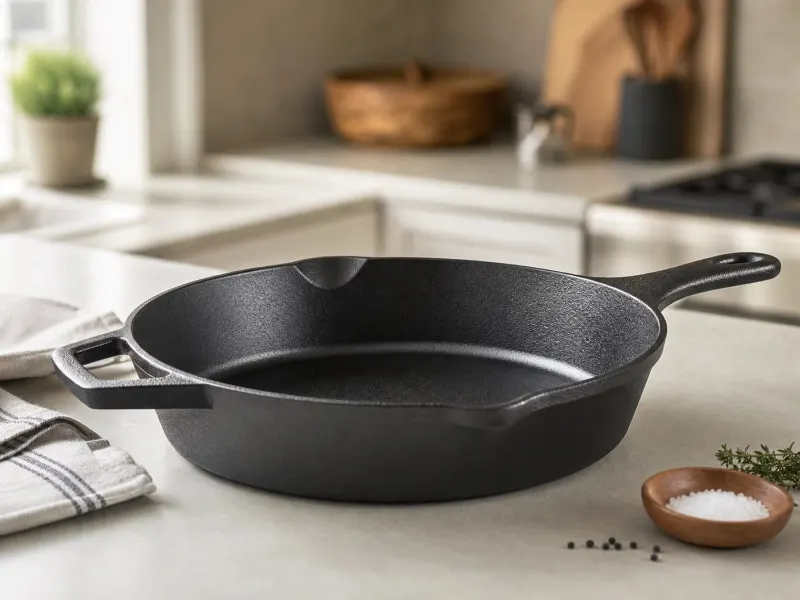
The tradeoff shows up before the seasoning builds. Common to the Lodge 10.25-Inch Cast Iron Skillet's rough-cast finish, shared with most budget cast iron: the pebbly texture from the sand-mold casting process means eggs and delicate food don't release cleanly for the first several months of regular use.
That's what to do when a cast iron surface stays sticky after seasoning if you're in that window right now.
Where Nonstick Wins#

Nonstick exists to solve one problem completely: food release without technique. Eggs, fish, crepes, anything that tends to bond with hot metal slides off a PTFE coating with no preheating ritual.
There's no seasoning maintenance, either. The aluminum body underneath spreads heat evenly rather than building a hot center, so delicate food cooks more predictably across the whole surface too.
That convenience is rented, not owned. A pan like the OXO Good Grips Pro 10-Inch Nonstick delivers that immediate release on day one, but PTFE is a consumable coating. Every cycle of heat and cooling stresses the bond between coating and metal, and it eventually fails regardless of price paid.
Owner reports across the mid-range PTFE category span a wide range. Some lose release in as little as about a year. Others get four to five years out of the same coating chemistry with careful, medium-heat-only use and hand washing.
Premium PTFE pans run the identical chemistry as mid-range ones. A higher price buys handle comfort and body quality, not a longer functional life.
The Heat Ceiling#
PTFE coatings are chemically stable well below their failure point. That failure point is more specific than the "500°F" figure most guides repeat.
PTFE can begin releasing fumes at temperatures as low as 500°F. Human symptoms, rapid and self-limiting influenza-like symptoms called polymer fume fever, generally don't start until the coating reaches roughly 662°F, with full pyrolysis beginning near 752°F. Reaching that range takes leaving an empty pan on high heat well past any normal cooking use.
Pet birds don't get that buffer. (If you're weighing PFAS/PTFE safety across your whole kitchen rather than just one pan, the PFAS safety checker covers more cookware than we can fit here.) A peer-reviewed veterinary case report puts the bird-specific toxicosis threshold at around 536°F, describing pulmonary hemorrhage and edema in exposed birds.
Their unusually efficient, unidirectional respiratory systems make them far more sensitive to airborne particulates than humans are. If birds share your kitchen, that's the number that matters, not the higher human threshold.
None of this touches the older PFOA scare. That manufacturing chemical was phased out industry-wide by 2015 under the EPA's PFOA Stewardship Program, and modern PTFE is FDA-authorized for food contact under 21 CFR 177.1550.
Normal cooking, even hot cooking, never approaches the temperatures where any of this becomes relevant. The risk lives entirely in the empty-pan, forgotten-on-high-heat scenario. That's also exactly the scenario that kills the coating fastest.
The Real Maintenance Comparison#
People overstate the effort gap between these two.
A cast iron routine after cooking is quick and active. Rinse under hot water, scrub with a stiff brush, dry on the burner, then wipe with a thin layer of oil.
Seasoning builds naturally through regular cooking. The surface improves the more it gets used.
Nonstick's routine looks simpler in the moment: sponge, soap, dry. It carries a hidden cost, though: constant vigilance about what NOT to do.
Metal utensils, aggressive scrubbing, aerosol cooking sprays, and high heat all shorten a coating's life. The pan itself is low-effort, but staying alive requires attention every single use.
Dishwasher safety is where the maintenance gap actually surprises people. It isn't a blanket rule.
Nordic Ware's own care page calls dishwasher use "not recommended," framing it as a lifespan tradeoff rather than a hard ban. Calphalon's warranty is stricter: it requires hand washing and voids coverage for dishwasher use on lines it hasn't approved.
Check the specific pan's own care page rather than assuming one brand's rule applies to another.
Lifespan and the Long Math#
Cast iron lasts generations. Lodge has been making the same basic design since 1896, and pans inherited from grandparents still perform.
There's no coating to fail. Barring physical damage, there's no clock running on a cast iron skillet at all.
Nonstick's clock never stops. The replacement math is a range, not a single number: about a year on the short end with heavy or careless use, up to four or five years with medium-heat-only cooking and hand washing.
Ceramic nonstick, the kind marketed as PTFE-free or "green," runs the same replacement cycle on a shorter clock. Owners consistently report losing release faster than PTFE, sometimes within months. We looked at that specific tradeoff in our ceramic vs Teflon comparison if you're deciding between coating types rather than between cast iron and nonstick.
A cast iron skillet bought once outlasts every one of those replacement cycles combined. That's the whole reason its higher up-front effort pays off the longer you own it. Enter the prices of a nonstick pan and a cast iron skillet in the cookware cost calculator to see a range of replacement costs across your chosen years.
Who Should Pick What#
If most of what you cook sits at medium heat or below, eggs, fish, delicate sauces, a quick weeknight sauté, nonstick wins on convenience. It's genuinely the more evenly heated pan for those dishes, too.
If you regularly push a pan above medium, searing, cornbread, pizza, high-heat oven work, reach for cast iron despite its hot-center quirk. Stored thermal mass matters more than lateral evenness once the goal is sustained high heat.
Those two heat regimes rarely overlap. That's the real reason most people who cook seriously end up needing one of each, rather than picking a permanent winner.
The Verdict#
Cast iron gets better the longer you own it. It handles heat that would destroy any coating and never starts a replacement clock.
Nonstick makes eggs, fish, and anything delicate close to foolproof, with one tradeoff: the clock is always running on the coating underneath.
If budget forces a single choice, lean cast iron: the Lodge 10.25-Inch Cast Iron Skillet covers more of the cooking you'll actually do over time, and it never asks you to buy it twice.
If you're adding a nonstick pan on top of that, we've made the case that the expensive options aren't worth the premium. The coating chemistry is the same either way. Put the money into the cast iron piece that will still be working in twenty years instead.