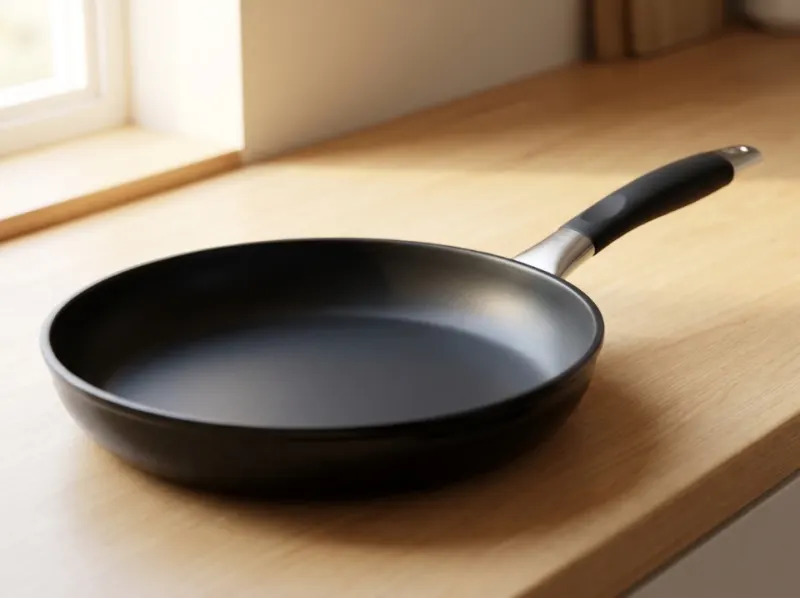
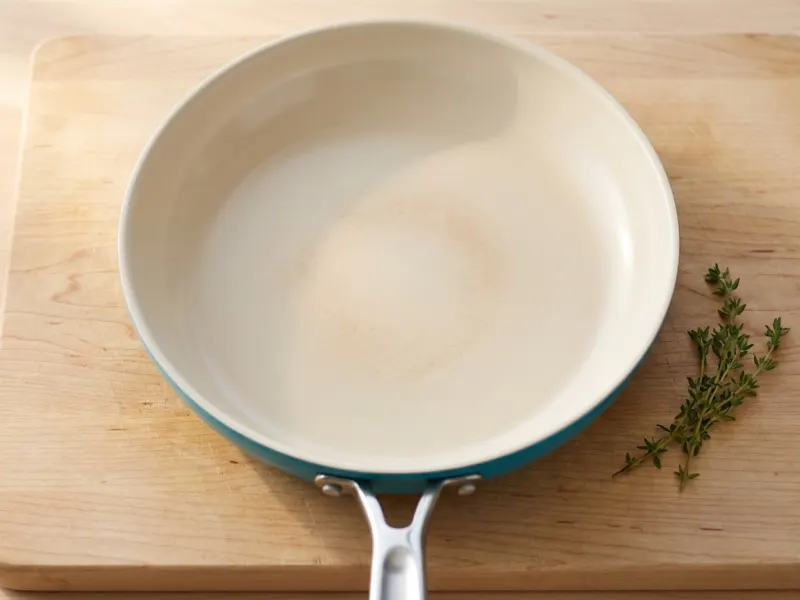
Six pans. Six different manufacturers. One peer-reviewed lab test heated every single one. Every coating showed the same bond damage, scratched or not.
Nonstick pan peeling isn't only caused by scratches, dishwasher cycles, or a hot pan meeting cold water. A peer-reviewed study found that heat alone, with zero mechanical damage, measurably weakens the bond between a PTFE coating and the metal underneath. It starts well inside normal cooking temperatures.
Our nonstick cookware buying guide covers the rest of what actually shortens, and extends, a coating's working life.
That changes what peeling actually means. It also changes what you can do about it.
What Causes Nonstick Pan Peeling (It's Only Half the Story)#
Every guide to nonstick pan peeling reaches for the same three culprits. Metal utensils. The dishwasher.
Cold water on a hot pan. We won't argue with any of them.
A metal spatula scratches the coating's edge. That scratch gives everything else a place to start working underneath. We've covered plain sticking, without visible damage, as its own separate problem.
Dishwasher detergent is worse than most people assume. It's alkaline, built to dissolve baked-on food. It doesn't tell the difference between food residue and the adhesive holding your coating to the pan. Consumer Reports puts it plainly: without a dishwasher-safe label, the wash cycle itself can wear the coating away.
Thermal shock mostly shows up as warping, not a single dramatic snap. A warped pan loses even contact with the burner. That unevenness creates hot spots, and hot spots wear a coating faster everywhere else on the surface.
None of that is new information. Here's what almost every article on this topic leaves out: the part that happens even when you do everything right.
Heat Alone Is Already Wearing the Bond#
A peer-reviewed study by Alaboodi, Sivasankaran, and Ammar, published via PubMed Central, heat-tested six commercial nonstick pans. Three PTFE, three ceramic, from six different manufacturers.
Researchers heated each one from room temperature up to 450°C, changing only the heat and the time. No scratches. No utensils. No dishwasher chemistry.
Every pan showed progressive damage as heat exposure climbed. Surface roughness increased. An adhesive pull-off test showed the same pattern: sustained heat breaks down the carbon-fluorine bond that gives PTFE its structure, along with the equivalent bonds in ceramic coatings. The study's own recommendation is a ceiling of 250°C, about 482°F, for no more than 45 minutes at a stretch.
That number matters for a specific reason. It sits below PTFE's fume threshold of 500°F, but well inside normal high-heat searing range. Medium heat keeps you comfortably under it. High heat does not.
Your pan isn't defective. The bond runs on a heat-driven countdown from the day you buy it. The usual "three habits" framing undersells how much even careful, normal cooking adds to that countdown.
What the Flakes Actually Are (and When They Matter)#
PTFE is chemically inert. It's FDA-authorized for food contact under federal regulation. Swallowed flakes pass through the body unabsorbed. A few specks in your eggs are not a health emergency.
The bigger risk is behavioral. A coating that stopped releasing food tempts you to add more heat to compensate.
PTFE starts releasing mild fumes around 500°F. Symptoms in humans generally don't begin until 662°F. Pyrolysis starts at 752°F. Reaching that range takes an empty pan on high heat, left there well past any normal cooking use, but a failing pan is exactly the scenario that pushes people toward it.
Consumer Reports sets its own safety line earlier than most home cooks do. Any scratch or pitting, not just visible flaking, is enough to risk releasing coating material into food. We think that's the right cutoff.
Why Re-Coating Kits Don't Work#
Once the bond fails, nothing you apply at home restores it. The factory process sinters the coating.
Heat and pressure partially melt the PTFE so it bakes together and solidifies as it cools, according to Germany's federal food-safety authority. That's an industrial step. A spray bottle doesn't reproduce it.
A spray-on repair product sits on top of an already-degraded surface. It can't rebond to the metal beneath, because it was never built to survive the conditions that created the original bond.
Warranty coverage reflects this directly. Calphalon's own warranty, typical for the category, covers manufacturing defects in the pan body.
It explicitly excludes coating loss and coating-performance loss from normal wear. Peeling isn't a defect in the manufacturer's own terms. It's the expected end of a consumable.
The Four Things That Stress the Bond#
If your pan peels well ahead of schedule, check these four habits first. Each one compounds the normal heat-driven wear covered above.
- High heat. Medium heat meaningfully extends coating life compared to high heat, based on community-reported use patterns. It's the single biggest lever you control.
- Metal utensils. Silicone, wood, or nylon only. One scratch becomes next month's failure point.
- Dishwasher cycles. Hand wash with a soft sponge instead. The gap between hand and machine detergent is the difference between a quick rinse and a full cycle of chemical exposure.
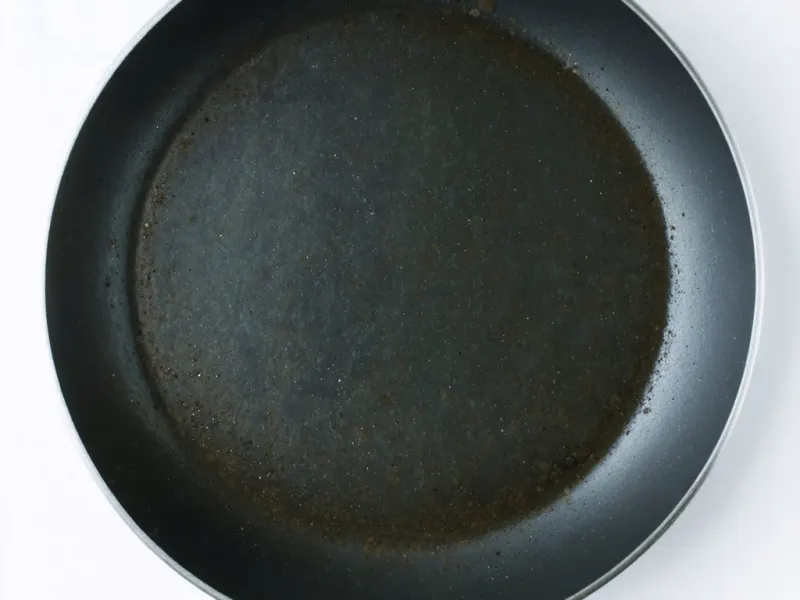
- Aerosol cooking spray. The residue bakes into a brown film that mimics coating failure and tempts you to scrub harder, causing real damage on top of fake damage. A small pour of regular oil skips the problem entirely.
Avoid all four, and a coating still won't last forever. It'll just land on the honest end of the range. Owner reports put mid-range PTFE anywhere from about a year on the short end to 4-5 years with careful use, not one fixed number.
Ceramic doesn't do better here, despite marketing that implies otherwise. Owners on r/cookware and r/Cooking report ceramic losing release faster than PTFE, with reports ranging from a few months up to about a year and a half. If you see a "safer, longer-lasting" claim about ceramic in a buying guide, treat the durability half of it with real skepticism.
What Hard-Anodizing Actually Buys You#

A hard-anodized body doesn't make the coating bond stronger. The anodized layer sits under the coating. It doesn't touch the coating's chemistry, so a hard-anodized nonstick pan degrades on the same schedule as any other aluminum body.
What it does buy you is a warp-resistant, evenly-heating body. That's genuinely useful, since warping and hot spots are two of the mechanisms that speed up coating wear in the first place, but it's a body-durability edge, not a coating-durability one. The Anolon Advanced Home Hard-Anodized Nonstick Skillet is one example built around that tradeoff: a flat body that stays flat removes one stressor from the pile. It can't touch the heat-driven degradation described above, and no pan at any price does.
We're not recommending the Anolon Advanced Home Hard-Anodized Nonstick Skillet because it will out-survive a cheaper pan's coating. Nothing at this price tier does. We're recommending it because a hard-anodized body warps less readily under normal heat than a thin, stamped-aluminum one, and that unevenness is one of the mechanisms that makes any coating wear faster, regardless of brand.
Less readily doesn't mean immune. That's a real, if modest and comparative, edge, not a coating-longevity edge, and the price reflects that honestly: mid-range, not premium, in a category where premium buys handle feel more than it buys extra coating life.
One 2-year owner review of this exact pan still describes some warping and reduced release. That's consistent with a comparative edge rather than a guarantee, and it's the honest range for a mid-range PTFE pan either way. If you want to compare it against a lighter-duty option first, our material selector walks through that tradeoff before you buy.
What Peeling Actually Tells You#
Peeling isn't a verdict on your habits. It's a coating running out a heat-driven countdown that starts the day you first cook on it, sped up by scratches, the dishwasher, and thermal shock, but never fully stopped by avoiding them.
Once you see bare metal, persistent sticking despite proper technique, or actual flakes in food, the bond has already failed. No home fix reverses that. Replace on the honest schedule instead of the guilty one. Enter the price of a replacement nonstick and an uncoated pan in our cost calculator to compare their total costs over your chosen years.