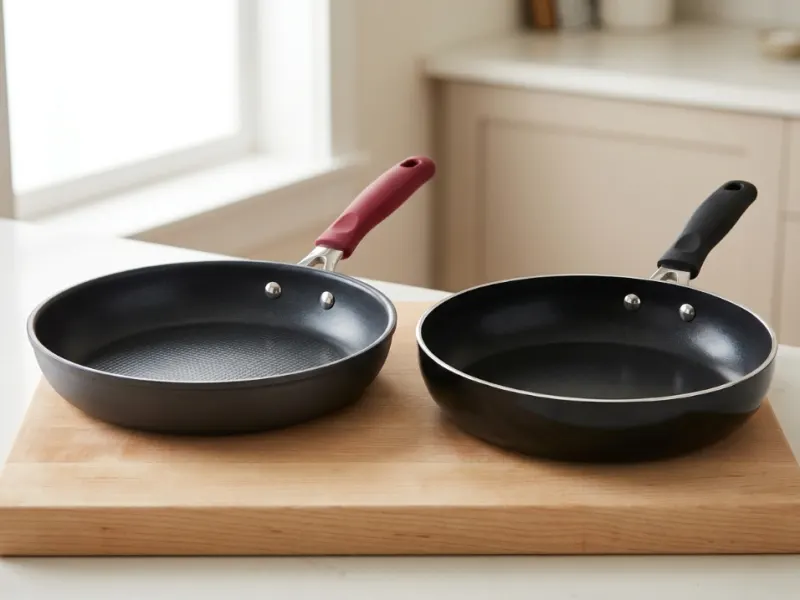
We went back through every nonstick review and PFAS-verification note on this site, and pulled out the buying decisions that separate a pan worth keeping from one you'll replace within a year.
Nonstick cookware is any pan with an applied surface coating that releases food without a metal-on-metal bond forming. The coating is either PTFE (Teflon-based) or ceramic (sol-gel), and every version of it is a consumable that degrades through repeated heat cycling, not a permanent finish.
A nonstick pan is worth buying for one job: delicate, low-to-medium-heat food release, like eggs, fish, pancakes, and crepes.
That research surfaced one failure nobody prints on the box: an induction disc that grips a magnet at the rim but not the center, cooking a scorched ring around a cold middle. The Induction Compatibility axis walks through the two-second check.
PTFE and ceramic both handle that job well on day one. Where they split apart is durability, the oven-safe ceiling, and how gracefully each one ages.
That split matters more than the marketing language on the box.
If the job is high-heat searing, deep browning, or a pan-sauce fond, nonstick is the wrong tool. A dedicated stainless or cast iron pan handles it better.
No brand changes that. No price tier does either.
Nearly every nonstick set claims to be PFAS-free, dishwasher-friendly, or oven-safe to some headline number. That claim is true in the narrow sense printed on the box, and incomplete in the sense a buyer actually needs.
A ceramic pan marked PFAS-free might back that claim with a lab test, or might not say. An oven-safe rating usually assumes hand washing and no metal utensils, and most boxes never say so.
How Nonstick Coatings Actually Work#
We went looking for why one coating holds up for years while the other quietly gives out within months, and the answer turned out to be chemistry, not marketing.
A nonstick coating is a separate layer applied to a metal body, usually aluminum, then baked (sintered) so it bonds under heat and pressure.
The coating is not part of the metal itself. That's why it can fail independently of the pan underneath it.
PTFE is a synthetic fluoropolymer. Its fluorine atoms create a near-frictionless surface at the molecular level.
It has coated cookware for decades and remains the dominant nonstick chemistry. The Ecology Center, an independent nonprofit testing lab, found nearly 80% of the cookware it tested carried a PTFE coating, regardless of PFOA-free labeling.
PTFE is chemically inert once cured and FDA-authorized for food contact. It stays stable well past normal cooking temperatures.
It only becomes a concern at sustained heat far beyond stovetop use, like an empty pan on high heat.
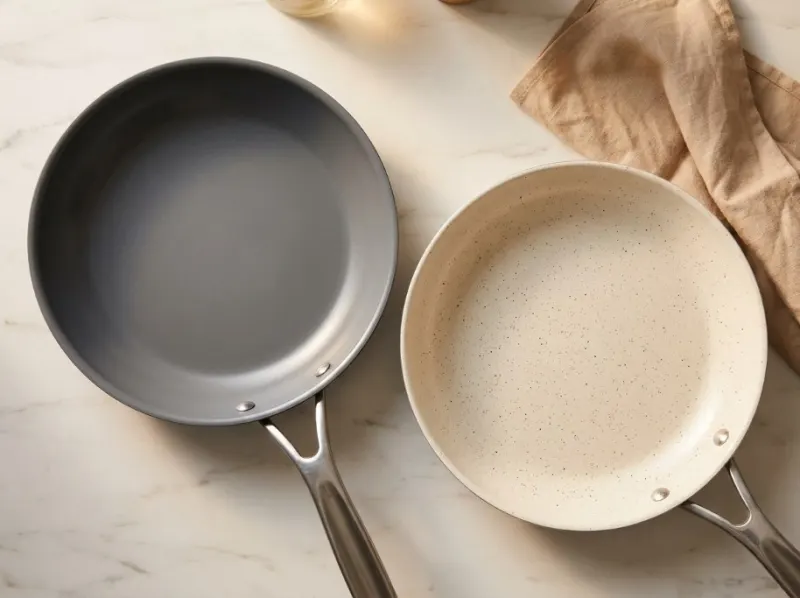
Ceramic sol-gel coatings are not actual ceramic. They're silicon dioxide, essentially liquid sand, sprayed onto the metal body and cured at high heat.
The pitch is a PTFE-free, PFOA-free angle. Ceramic starts out just as slippery as PTFE.
But its thin oleophobic surface layer breaks down through the same thermal cycling faster than PTFE's molecular bond does. That's the mechanical reason ceramic coatings age out sooner.
That's also the part the PFAS-free pitch never mentions. Freedom from one class of chemicals and durability are two separate questions, and a box that answers one confidently says nothing about the other.

The Buying Decision, By Axis#
Which nonstick pan is safe, durable, or oven-safe isn't one question. It's several, and they don't all point to the same brand.
Coating Chemistry: PTFE vs. Ceramic#
One T-fal owner, in a dated Amazon review for the Experience Nonstick line, reports four to five years of release before replacement. A separate r/Cooking owner reports a similar range on a second site.
Ceramic reports run the opposite direction. Two dated Amazon reviews for OXO's ceramic Enhanced/Professional line, September 2022 and December 2024, describe sticking starting within one month to a few months of daily use, worsening until unusable. Owners on a Cooking Stack Exchange thread spanning multiple ceramic brands, including Le Creuset, report the same pattern on a third site: losing release in as little as six to around nine months, even while avoiding metal utensils and high heat.
Owners across three platforms report losing ceramic release within months, while PTFE owners report years. Ceramic's edge is the PFOA-free angle, not everyday performance.
Both start out slippery, so the gap doesn't show on a showroom floor. It shows up months in, when one pan still releases eggs and the other doesn't.
Our ceramic vs. Teflon breakdown walks through that degradation mechanism side by side.
Is It Actually Safe? PFAS and PFOA, Verified vs. Claimed#
PTFE and ceramic are both safe for normal cooking. But PFAS-free is not a uniformly verified claim.
PTFE is technically a PFAS compound, but the FDA authorizes it for food contact because it's chemically inert and doesn't leach into food at normal cooking temperatures. The PFOA manufacturing chemical that drove most of the original health concern was eliminated industry-wide under the EPA's 2010/2015 Stewardship Program.
Ceramic brands all market a PFAS-free position. Only some back it with a disclosed composition or an independent lab test.
That gap matters more than the coating category. A brand disclosing its formula or citing third-party verification earns more trust than one that just prints "PFAS-free."
Our PFAS in cookware guide covers which brands currently clear that bar. Our is ceramic cookware safe piece breaks down the same verification gap for ceramic lines specifically.
HexClad is the clearest case study here. Per the settlement, HexClad can no longer repeat its old PTFE-era claim. That PTFE coating stays FDA-authorized for food contact either way. HexClad's newer ceramic coating makes a separate, unverified PFAS-free claim of its own.
GreenLife sits on the other end of that gap. It discloses its coating composition and its PFAS, PFOA, lead, and cadmium-free status directly on its own FAQ page, the same disclosure bar HexClad's old claim failed to clear.
Hard-Anodized Nonstick: a Different Body, Not a Different Coating#
Hard-anodized describes the pan's aluminum body, not the coating on top of it. A hard-anodized nonstick pan uses the exact same PTFE or ceramic chemistry as a standard aluminum one underneath, and anodizing itself is what settles a separate question, whether aluminum leaches into food, that has nothing to do with which coating sits on top.
The real trade-off is body durability and warp resistance against weight and price. It is not coating longevity, since the coating on top degrades the same way regardless of the metal underneath.
That distinction gets flattened in a lot of marketing copy, which implies "hard-anodized" itself means longer-lasting nonstick. It doesn't.
Our hard-anodized vs. nonstick comparison unpacks what the anodized body actually buys you. Our is hard-anodized cookware safe piece covers the safety side, including why a specific line's own care page is the only reliable source for its temperature limits. If you're shopping this category specifically, our hard-anodized nonstick frying pan guide covers who actually needs the heavier body and what the extra spend buys instead.
Oven-Safe Temperature Limits#
Nonstick oven ratings vary by coating and by line. Some ceramic and hard-anodized pans cap out lower, and some PTFE constructions run higher.
The manufacturer's own care page for that specific pan is the only reliable source for the real number. Per NCBI/StatPearls, PTFE begins releasing fumes at 500°F, a temperature an empty pan left on high heat can reach, but actual symptoms in humans do not start until a much higher 662°F.
So a lower oven rating on a given pan is usually a construction limit, like handle material or rivets, not a PTFE safety ceiling.
Checking that number matters most before a broiler or high-heat oven finish, not regular stovetop cooking. Broiler elements can exceed a coating's rated ceiling in a way normal baking rarely does.
Our can you put a nonstick pan in the oven guide covers how to find and read that rating correctly. For one brand where that number varies sharply by line, our Calphalon oven-safety breakdown shows how a handle-material swap alone can drop the ceiling by fifty degrees.
Induction Compatibility#
The coating on top is irrelevant to induction compatibility. What matters is whether the pan's base has a bonded magnetic steel disc, since induction cooktops heat through magnetism, not surface contact.
Most current PTFE and ceramic lines add that disc for induction. Not all do. Not close.
Here's the two-second test: drag a refrigerator magnet slowly from the pan's rim to its center. A strong, even pull the whole way means the disc runs the full base.
A pull that grabs hard at the edge and goes weak by the center means the disc is a thin ring, not a full one. That pan heats a scorched ring around a cold middle on an induction burner, regardless of what the box claims.
Our induction-ready cookware guide covers that check in more depth, across materials, not just nonstick.
Care, Utensils, and When to Replace#
The habits that shorten a coating's life keep showing up across the reviews we've done on this site, pan after pan, regardless of brand. Nonstick coatings fail faster under high heat, metal utensils, dishwasher cycles, and aerosol sprays. Every one of those habits is avoidable at zero cost.
Medium heat instead of high. Silicone or wood utensils instead of metal.
Hand washing instead of the dishwasher. A refillable oil mister instead of aerosol spray.
Those four changes extend a coating's working life more than brand or price ever does.
Replace a pan when you see bare metal, food sticking despite proper heat and oil, or visible coating flakes. Consumer Reports draws the safety line earlier than most owners assume: once a nonstick surface is scratched or pitted, it can potentially release pieces of coating into food, so treat visible scratching itself as a replacement signal rather than waiting for peeling.
Our how long do nonstick pans last piece covers the real ownership math. Nonstick pan peeling and scratched nonstick pan safe cover the two most common failure signs.
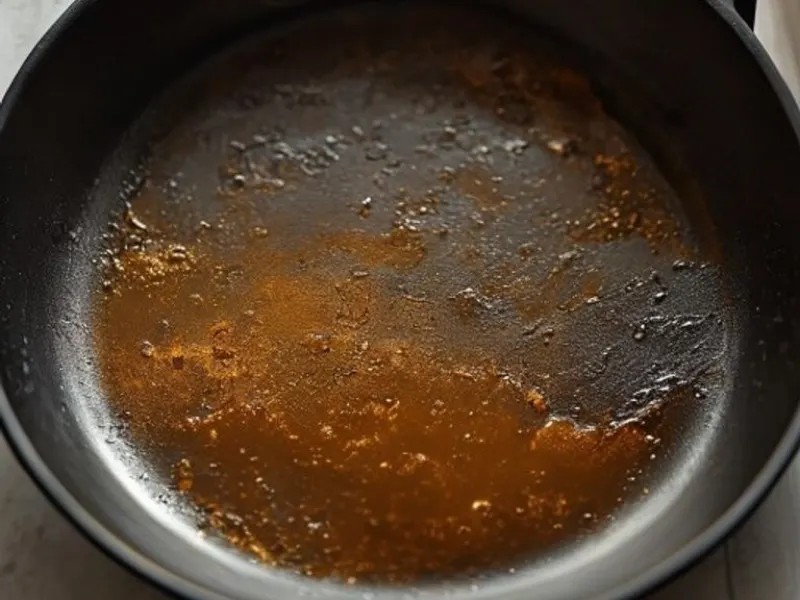
Does cooking spray ruin nonstick pans explains the sticky-residue mechanism that gets mistaken for coating failure.
Wondering whether you need to season a new one before that first use? How to season a nonstick pan breaks down when an active oil step actually matters and when it's a routine your specific pan doesn't need at all.
If the hand-wash-only label has you wondering whether that's a real rule or just liability language, can you put nonstick pans in the dishwasher breaks down the chemistry behind it.
Cleaning technique matters more than most owners assume, and not for the reason they'd guess. How to clean nonstick pans covers the boil-and-cool method for burnt-on food and the peer-reviewed reason scrubbing a hot pan does far more damage than scrubbing a cooled one.
Bought secondhand or found a pan with no legible label at all? How to know if a pan is nonstick walks through the manufacturer-marking check, the texture test, and the egg test that settles it when the label's gone.
Where to Go From Here#
Start from your own question, not a brand name. Here's where we'd send you for each one:
- Deciding between the two coating families for a first pan: ceramic vs. Teflon.
- Comparing nonstick against a different material entirely: nonstick vs. stainless steel.
- Weighing cast iron's seasoning against a coated pan: nonstick pan vs. cast iron.
- All-Clad's nonstick line and whether its safety story differs from cheaper PTFE: is All-Clad non-stick safe.
- Whether "granite" or "stone" branding means anything different: are granite/stone pans worth it.
- Blue Diamond's diamond-infused ceramic line: Blue Diamond pan review.
- Caraway against GreenPan, the two ceramic brands buyers compare most: Caraway vs. GreenPan, whether Caraway's premium is earned: is Caraway cookware worth it, and what's actually driving that premium: why is Caraway so expensive.
- GreenPan on its own, including an NSF claim worth double-checking: GreenPan review.
- Whether ceramic's shorter functional life is really shorter in practice: how long does ceramic coating last.
- T-Fal on its own merits: is T-Fal good cookware, or matched against Cuisinart: T-Fal vs. Cuisinart.
- A pan that used to release cleanly and suddenly doesn't: why do nonstick pans stop working.
- Whether a pricier pan actually outlasts a budget one: expensive non-stick pans not worth it.
- The pick built for daily use, not a showroom demo: best non-stick pan that actually lasts.
- Ballarini's Granitium coating against its own carbon steel line, plus what owners report after years of use: Ballarini cookware review.
Common Pitfalls Before You Buy#
Category-wide: these five mistakes aren't brand-specific. All five shorten a coating's life.
Assuming "ceramic" is automatically the safer or more durable choice. Ceramic and PTFE are both safe at normal cooking temperatures. Ceramic typically wears out faster, not slower, than PTFE.
The category name on the box tells you less than the brand's own disclosure and care instructions do.
Paying a premium expecting a longer-lasting coating. Some premium lines market extra coating layers, but no owner report or test in this guide's research confirms those layers add years of life. The base chemistry is the same PTFE.
The extra spend buys handle comfort and body quality, not confirmed coating life.
Using the dishwasher because the pan "seems fine" going in. Dishwasher detergent is high-pH and often bleach-based.
That attacks a nonstick bond faster than a quick hand wash does, even on a pan that isn't visibly damaged yet. Check that specific pan's own care page rather than assuming a general nonstick rule.
Reaching for a metal spatula "just this once." One scratch creates a failure point that widens with every use, well before it looks like a problem.
Habit beats one bad moment.
Buying an aluminum-body pan online and assuming it's induction-ready because it looks modern. A listing photo can't show whether the base has a magnetic disc.
Check the listing for an explicit induction-compatible claim; our induction compatibility checker gives a sourced verdict per line.
Start With the Axis, Not the Coating Name#
Confirm what the pan needs to do: low-heat release, or a job nonstick was never built for.
After that, the axis that decides your purchase is whichever trade-off you're least willing to accept: coating durability, verified PFAS-free status, oven ceiling, induction compatibility, or how carefully you'll actually treat the pan. Our PFAS safety checker gives a sourced verdict per brand and line for the coatings you're comparing.
None get settled by the word "nonstick" on the box, or by price. The guides above are organized by the actual question a buyer has, not a flat "best nonstick pan" ranking.