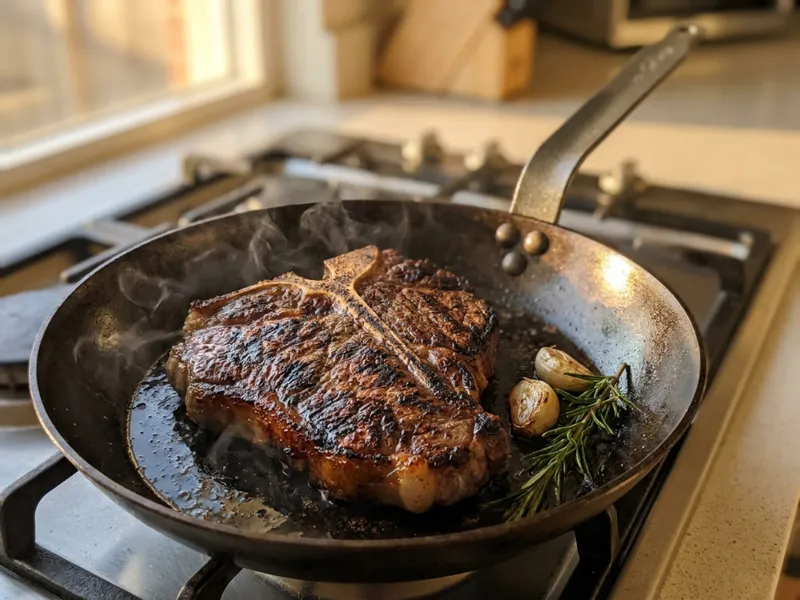
You bought a pan that promised nonstick performance without a chemical coating. Three weeks later, eggs are welding themselves to the surface.
We spent weeks cross-referencing Misen's own care documentation against multi-month owner reports, and the pattern is clear: the Misen Carbon Nonstick 10-Inch Deeper is a genuinely capable pan that punishes one specific mistake. If your oil smokes before food hits the surface, this pan will stick. If you preheat on medium for 45 seconds and hear a gentle sizzle when you add food, you are in the window where it works for years.
The split between glowing reviews and frustrated returns traces back to a contradiction in Misen's own published guidance. Figuring out what that contradiction actually is, and which side of it you fall on, determines whether this pan belongs in your kitchen.
What the Carbon Nonstick Actually Is#
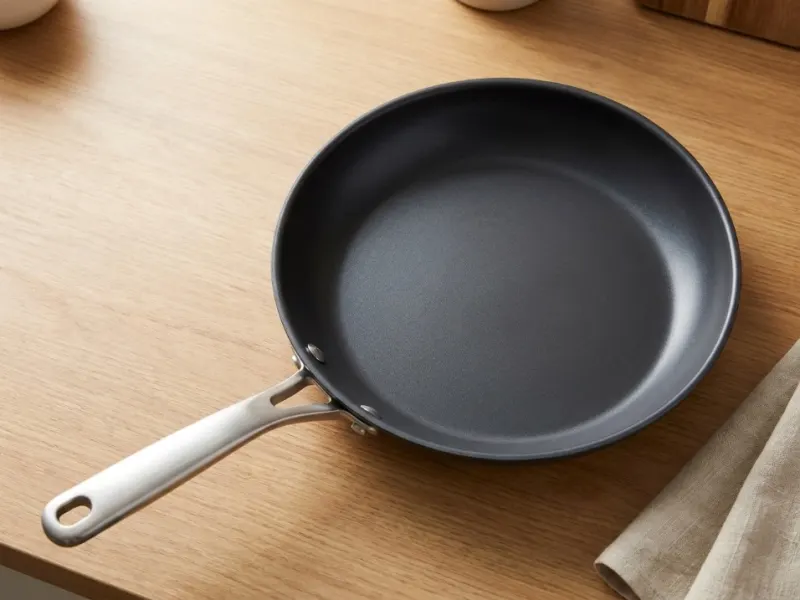
Misen built this pan as a three-layer sandwich. An aluminum core sits between two sheets of nitrided carbon steel, baked in a nitrogen-rich oven to harden the surface and boost corrosion resistance. There is no Teflon here. No ceramic sol-gel coating either.
Food release comes from the hardness and smoothness of the treated metal itself, similar to well-seasoned carbon steel but without the upfront seasoning ritual. The pan ships ready to cook on day one.
It is oven-safe to 1100°F. Stovetop, oven, broiler, grill. No temperature ceiling to worry about.
That pitch funded itself before Misen sold a single retail unit. Per their Kickstarter campaign, over 15,000 backers pre-ordered the pan before it reached retail shelves in 2025.
The Contradiction Hiding in Their Own Pages#
Here is where we found the real story. Misen's official FAQ page states plainly: "You don't need to season your Carbon Nonstick pan. By simply cooking with it, you'll be seasoning it; the more you use it, the more seasoned it becomes."
Their separate Use and Care page tells a different story. It instructs you to condition the pan after every single cook, rubbing in a microscopic amount of oil with a paper towel. And buried in that conditioning section sits the critical line most owners never read: "More oil makes the pan stickier, not less."
That single sentence flips the mental model. On traditional carbon steel, more seasoning means better release. On this nitrided surface, excess residue actively causes sticking. The care page is telling you the opposite of what the marketing page implies.
The Sizzle Test That Separates Happy Owners From Frustrated Ones#
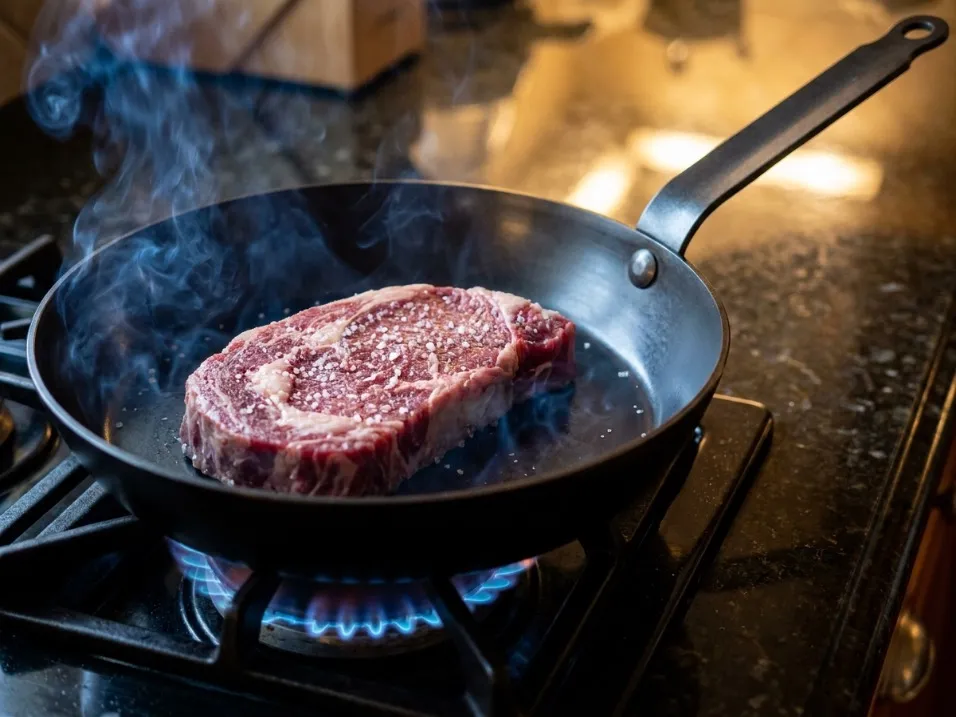
Misen's care page identifies the preheat protocol as "the single most important thing you can do to prevent sticking." Medium heat, 45 seconds, then oil. If the oil moves like water and ripples slightly, you are ready. If it smokes, you are too hot and the pan will punish you.

Owners who follow this sequence report consistent release after the first month of adjustment. One owner on YouTube documented six months of daily use, starting from frustrating early sticking and arriving at consistent release once technique caught up. His verdict: "This pan is a fine pan, but it should never have been called nonstick."
Owners who preheat on high to save time, or who skip the post-cook wipe-down and let residue accumulate, hit a wall within weeks. Some contacted Misen support and were told to season the pan, which directly contradicts the marketing claim that sold it to them.
The difference is not a defective batch. It is a behavioral test you can apply right now.
Crank the dial past medium and watch your oil. If it smokes before you add food, you will fight this pan. If you keep it below that threshold, the nitrided surface does exactly what it promises.
The Sidewall Fix Worth Knowing About#
The original Carbon Nonstick shipped with sidewalls of 1.5 inches on the 8-inch and 1.75 inches on the 10 and 12-inch sizes. That is shallow compared to most skillets, and it limited how much you could toss or saute without food riding over the edge.
Misen has since released a Deeper version with taller sidewalls across all three sizes. At 2.48 pounds for the 10-inch, it weighs roughly half what a comparable cast iron skillet does. It is a genuine design fix, not a marketing refresh, and it is the version worth buying today if you do any volume cooking in the pan.
If you have read carbon steel vs nonstick pans and decided you want the durability of carbon steel without the seasoning commitment, the Deeper version removes the one legitimate complaint about capacity that the original had.
The Handle Problem Nobody Fixed#
One owner described the handle as "a very, very lightweight, short little stubby handle, fairly cheaply-made." The round cross-section without a flat top groove means it can rotate in the socket when your hand is wet or you are wearing an oven mitt. You will notice the difference the first time you try a quick flip.

This is specific to Misen's handle design. The smooth round tube is comfortable to hold dry, and uncomfortable the moment conditions change.
Which Misen Pan Fits Your Tolerance#
Misen sells more than the Carbon Nonstick. The brand also makes a standard PTFE nonstick pan, a conventional pre-seasoned carbon steel skillet, a 5-Ply Stainless line, and a saucier. Each has its own maintenance ceiling.
If you want zero-thought nonstick with no behavioral adjustment at all, we would point you to a standard PTFE pan. It will frustrate you less on day one, even with a shorter useful life overall. If you want to understand what is in each coating type before deciding, the PFAS safety checker breaks down the materials by brand.
Want the classic carbon steel experience and do not mind building seasoning from scratch? The pre-seasoned line skips the Carbon Nonstick's quirks entirely, in exchange for you doing the seasoning work upfront.
The Carbon Nonstick sits between those two camps. It needs less maintenance than raw carbon steel and outlasts any coated pan, but only if you accept that it behaves like hardened metal rather than disposable Teflon. Common to all aluminum-core pans: it cools faster than solid carbon steel, making back-to-back searing of several portions slightly harder than a heavy single-material pan.
For anyone who can keep their burner at medium and wipe the surface after cooking, the Misen Carbon Nonstick 10-Inch Deeper is the version to buy. The improved sidewalls fixed the design flaw. The nitrided surface fixed the lifespan problem that kills coated pans. The only thing left is whether you will follow the preheat rule, and you already know the answer to that.
If you are already comfortable with the sizzle test and want to understand why nonstick pans stop working in the first place, that breakdown explains the one-way degradation mechanism that coating-free pans like this one sidestep entirely. Readers weighing the long-term cost difference can run the numbers themselves with the cookware cost calculator.