HexClad's marketing called its pans non-toxic. A court-approved, multimillion-dollar settlement says that word does not apply to every pan the company sold.
The honest answer depends on which pan you own. Hybrid pans bought between February 2022 and March 2024 used a PTFE nonstick coating while marketed as free of PFAS chemicals, a family the EPA defines as including PTFE. A settled lawsuit now blocks HexClad from repeating that wording for that specific coating. Pans built with the newer TerraBond ceramic coating make a different, still-unverified non-toxic claim.
That split is what most search results skip past. We read the settlement agreement and the amended complaint directly rather than relying on news summaries of them, and our nonstick cookware buying guide covers how to check any brand's PFAS-free claim, not just HexClad's.
What the Settlement Actually Changed#
The case is Cliburn v. One Source to Market, LLC, doing business as HexClad Cookware. It was filed in the Superior Court of California, Los Angeles County.
Plaintiffs alleged the company's advertising wrongly called certain cookware free of forever chemicals. HexClad agreed to a class action settlement covering a multimillion-dollar fund, no trial required.
The deal covers anyone who bought one of the named Hybrid pans, woks, pots, griddles, or saute pans, or a set containing one, between February 1, 2022 and March 31, 2024. That window is not a rough estimate. It is the literal boundary the settlement uses to decide which purchases qualify.
Going forward, HexClad must stop advertising any product with PTFE as PFOA-free, PFAS free, or non-toxic, per the EPA's own PFAS definition that includes it. Court filings call that restriction the injunctive relief.
Two things stay untouched, though. HexClad can still call its cookware metal utensil safe. It can also still describe a product as non-toxic if that product is genuinely free of the PFAS family the EPA tracks, which is the position its current ceramic line sits in.
One detail changes how you should read all of this. The settlement states plainly that it is not an admission of wrongdoing. A company can settle a false-advertising claim to avoid years of litigation cost.
No court ever ruled on whether the underlying ad claim was true. That is different from a product being proven dangerous, and mixing the two up is how this search ends with an overconfident answer.
What the Complaint Actually Alleged#
The amended complaint makes one claim worth isolating. It alleges HexClad advertised its cookware as free of PFOA and PFAS, while its own materials elsewhere acknowledged a coating containing PTFE.
PTFE is the compound sold under the older brand name Teflon. It counts as a PFAS chemical under the EPA's own definition, no matter what the box calls it.
The complaint flags something stranger, too. Per the filing, HexClad's own blog once cited a National Library of Medicine article, "PTFE-coated non-stick cookware and toxicity concerns: a perspective," while the company's marketing separately called PTFE safe and inert.
Was that a real contradiction, or a quote pulled out of context? It never got tested. A settlement resolves a case without either side proving its version.
For scale on the actual chemistry, PTFE is FDA-authorized for food contact use under federal regulation 21 CFR 177.1550. Documented human symptoms from PTFE fumes generally begin at 662°F, per NCBI/StatPearls. Normal cooking with food or oil in the pan never gets close to that mark.
That question, the chemistry, is separate from whether HexClad's ad copy was accurate. Keep the two apart.
How to Check Your Own Pan#
Start with the purchase date, not the name on the box. A Hybrid pan, wok, pot, or set bought between February 1, 2022 and March 31, 2024 falls inside the settlement's window.
That means your pan most likely used the coating the case was actually about. If your purchase falls outside that window, or the listing names HexClad's TerraBond coating specifically, you are looking at a newer, different claim. The settlement's restrictions do not reach backward to judge that coating.
Either way, nothing about owning a covered pan changes today. The settlement does not require a recall. It does not make an existing pan unsafe to keep using.
The TerraBond Claim Is a Different, Unverified Statement#
HexClad's own FAQ page states that its cookware uses its "proprietary HEXCLAD TerraBond ceramic nonstick coating, which is PTFE-free and PFAS-free." That is the manufacturer's current position on the 7-inch Hybrid pan and the rest of its newer line.
But no one outside HexClad has checked it. No outside lab test backs it. No published recipe for the coating does either. That puts TerraBond in the same caution category as several other ceramic coatings making the same claim with the same gap.
Some ceramic brands publish lab results. Others share the exact sol-gel silica mix, so a buyer can check the claim directly. TerraBond has done neither, based on what is public today.
None of this means the coating secretly contains PTFE. It means the claim sits exactly where the older Hybrid marketing sat before a lawsuit tested it, checked by no one but the company that makes it.
The Nonstick Performance Gap Nobody's Suing Over#

Separate from any coating chemistry question, HexClad's core promise has its own real gap. Four independent Amazon verified-purchase reviews from 2020 to 2022 describe eggs sticking immediately, even after washing the pan exactly as the label says. Review titles run from "Turns eggs into epoxy" to "Great pans but NOT non-stick." Our induction compatibility checker tells you whether a pan has a truly magnetic base or just a thin disc.
A 2022 r/cookware thread describes the same pattern. Several commenters confirmed it independently.
That is a cooking complaint, not a safety one. It deserves its own space.
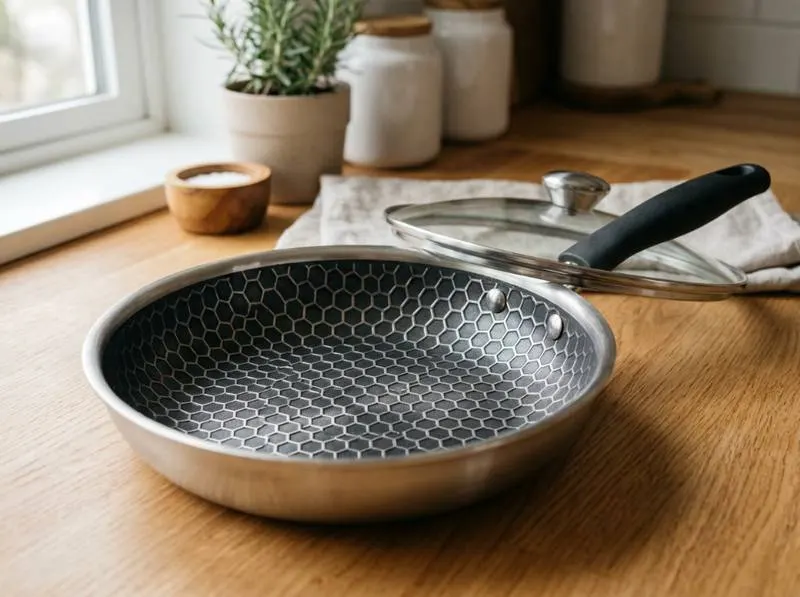
The hexagon-peak design is a real, useful choice. Raised steel ridges keep metal utensils from scraping the coated valleys directly. Keeping food from sticking without oil is a separate promise, and several owners report the pan does not reliably keep it.
Is HexClad Non-Toxic? Our Verdict#
Treat this as two separate questions, because the settlement already does. For a Hybrid pan bought between February 2022 and March 2024, the coating was PTFE, part of the PFAS family the EPA regulates. The wording calling that coating non-toxic is now off-limits for HexClad to repeat. Nothing in the case proves the pan itself caused harm.
For a current pan built with TerraBond, the honest answer is different. The PFAS-free claim is plausible. It just isn't checked by anyone outside the company, the same spot most ceramic brands making that claim sit in.
If the marketing history bothers you more than the underlying PTFE chemistry, HexClad's 7-inch Hybrid pan, rated oven-safe to 900°F, is still one of the better-built hybrid designs on the market. The metal-utensil durability holds up regardless of coating generation. We track which of these are genuinely PFAS-free in our cookware safety checker, with the evidence behind each verdict.
If you want a non-toxic claim backed by a third-party lab, rather than a page on the brand's own site, that is the sharper question our nonstick cookware guide is built to answer.
The lesson here reaches past one brand. "Non-toxic" and "false advertising" settlements both trace back to the same gap: a claim on a box, checked or not, by anyone outside the company. For how HexClad stacks up against a fully-clad stainless alternative, see our HexClad vs. All-Clad comparison.