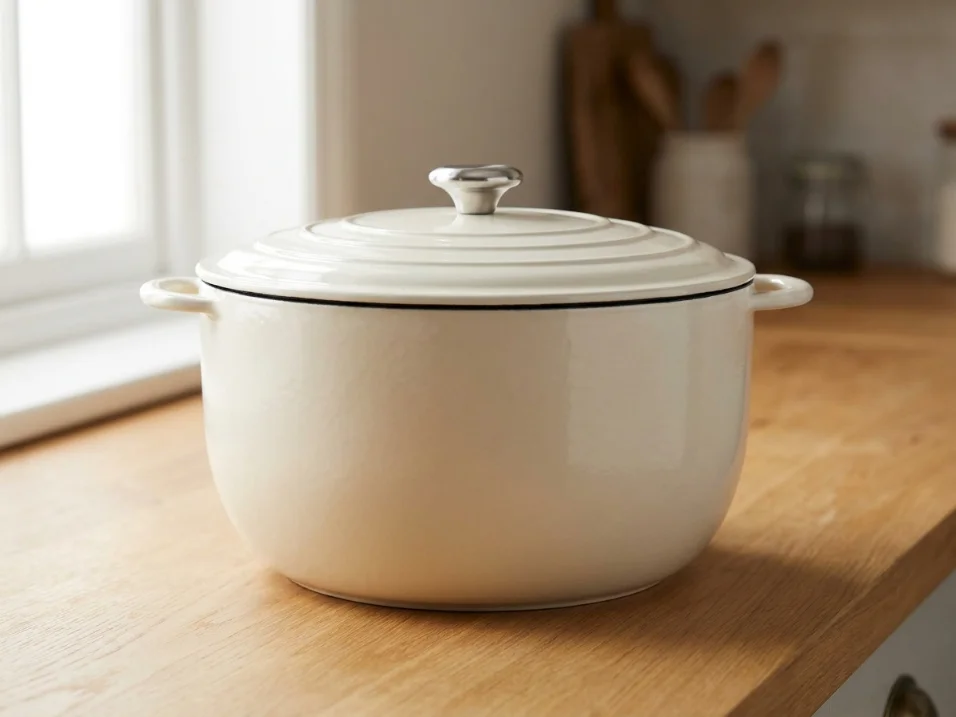
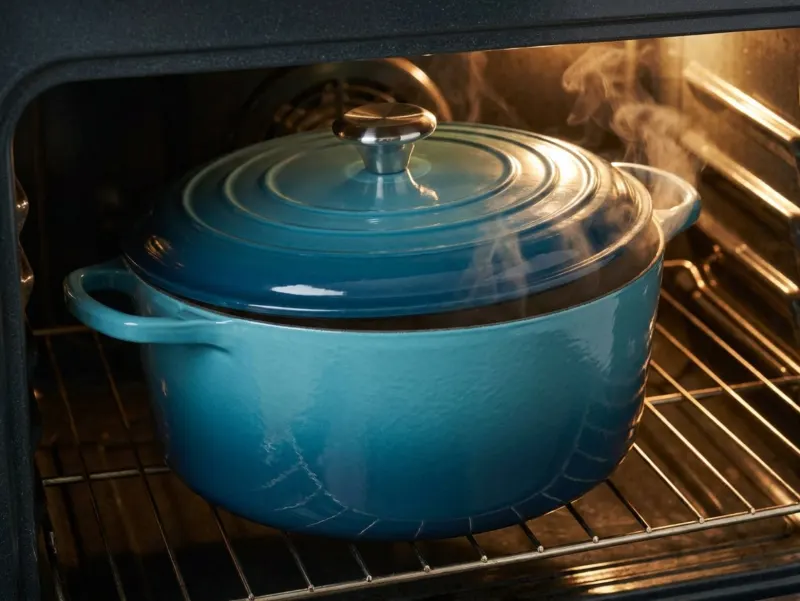
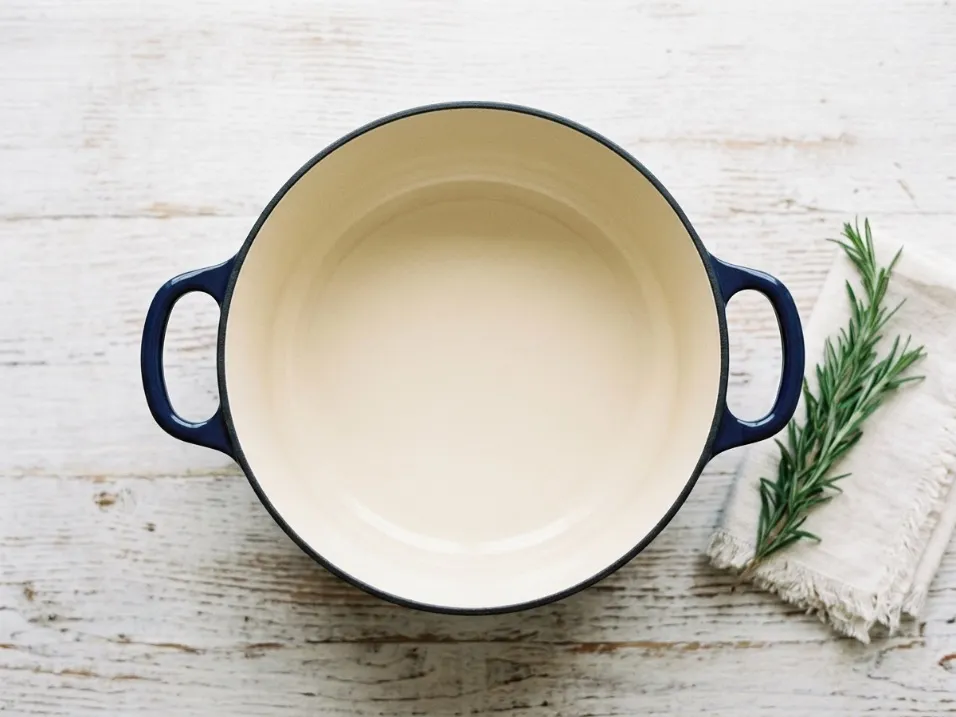
Can a lead-testing video and a brand's own safety claim both be right about the same pot? You have probably found both online: a brand insisting its enamel is fully compliant, and a viral video showing a "high" reading on the exact same cookware. Both can be true at once, and there is a specific, government-documented reason why.
Enameled cast iron from Lodge, Le Creuset, Staub, or any brand sold through major US retailers is safe to cook with when the enamel is intact.
Our cast iron cookware guide covers the rest of the bare-vs-enameled decision once safety is settled.
Lead and cadmium each carry their own FDA leaching limit. The viral scanner readings you may have seen are measuring something else entirely. They read total metal content in the glaze, not what actually reaches your food. We get into that gap below, along with the one situation where a chip genuinely does change the answer.
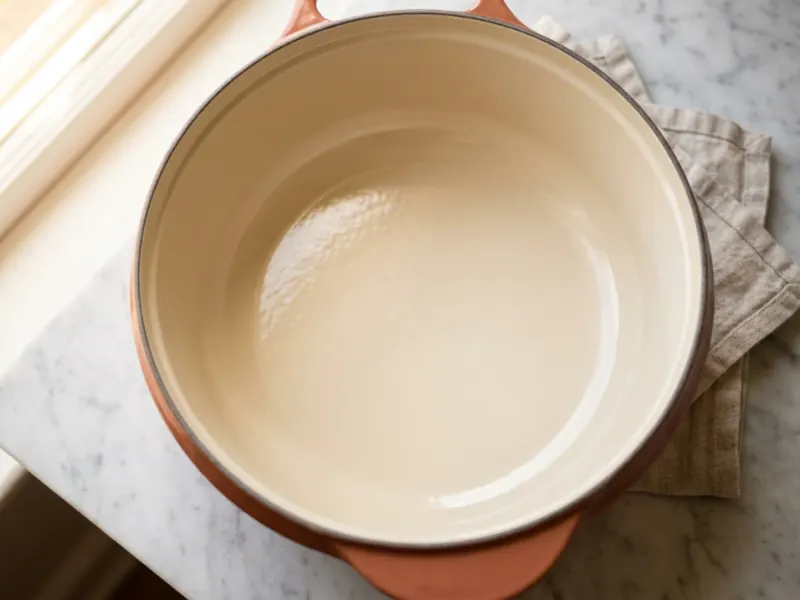
The Lead and Cadmium Question#
Enamel gets its color from metal oxide pigments. Cadmium compounds are a documented pigment ingredient, among other industrial uses. That is part of why cadmium is regulated right alongside lead in ceramic glazes.
Here is a detail most articles on this topic get wrong. Lead and cadmium are not covered by one shared rule. They each have their own Compliance Policy Guide.
CPG 545.450 sets the lead limit at 1 microgram per milliliter of leaching solution for large hollowware, the category that covers a standard dutch oven. CPG 545.400 sets a separate cadmium limit at 0.25 micrograms per milliliter for the same category.
California layers on its own rule. Proposition 65 sets a Maximum Allowable Dose Level of 0.5 micrograms per day for lead.
That number lives on a different axis than the limit above. It counts every source of exposure in a day, not just one pot. You cannot convert one number directly into the other.
Both government limits trace back to the same lab procedure, ASTM C738. It extracts a sample with a 4 percent acetic acid solution for 24 hours at room temperature, then measures what actually dissolved out. The standard itself describes this as a deliberately severe test, one built to accelerate lead release well beyond what normal cooking would ever do. If a dutch oven passes that test, it is measuring real exposure with a built-in safety margin, not repeating a marketing promise.

Why a Lead-Testing Video and a Brand's Safety Claim Can Both Be True#
Most viral lead-testing videos use a handheld XRF scanner. That tool does a different job than the leach test above.
The Consumer Product Safety Commission has its own standard procedure for XRF. The document is literally titled a method for determining total lead content, not leachable content. XRF reads the total amount of an element sitting in the top layer of a surface. It cannot tell whether that metal is chemically locked inside melted glass or sitting loose on top of it.
That gap matters here. A well-fired, sealed-in pigment does not dissolve into an acid test the way a poorly fired or damaged glaze would. A colored enamel can show a high XRF number and still easily clear that leach limit, because the metal never actually gets out.
There is a second wrinkle the government's own paperwork flags directly. CPSC's standard XRF method states plainly that it "is not suitable for testing glazed ceramics" at all. A consumer scanner reading on a glazed, colored dutch oven is not just answering a different question than the leach test. It is doing so with a tool the government's own procedure does not consider reliable for that surface type in the first place.
None of this means every scary-looking lead video is wrong. It means total content and leachable content are two different measurements, and only one of them is what regulators actually test cookware against before it reaches a US shelf. A light-colored interior does not carry any special leach-test advantage over a dark or brightly pigmented one either way. Compliance depends on the finished glaze passing the same acid test, not the color you picked.
Chipped Enameled Cast Iron: When Iron Exposure Actually Matters#
Once enamel chips, you are looking at the same bare cast iron underneath that you would cook on in a regular seasoned skillet. That is genuinely food-safe for most people.
Bare iron cookware does add some iron to food, especially anything acidic or slow-cooked. That effect is real enough that researchers have studied it as a public-health tool. A systematic review in the Journal of Human Nutrition and Dietetics combined three trials that tested whether cooking in iron pots could raise blood iron levels for people who don't get enough iron, in developing countries.
The results were mixed, not universal. Two of the three trials found a real improvement. The third found no overall difference, except in one age group. This is real-world evidence that cast iron adds iron to food, not proof that every meal gets a guaranteed boost.
For most home cooks, that transfer is not a concern. The math changes only if you have hemochromatosis, an inherited disorder where the body absorbs and holds onto too much iron instead of regulating it normally.
If that applies to you, or you cook something acidic on a significant interior chip every single day, it is worth retiring that specific piece rather than pushing through it. For an occasional chip on the rim, or a light cook, there is no reason to replace the pot.
Category-wide: every enameled cast iron pot, from any brand, can crack from thermal shock, cold water hitting a hot surface being the classic trigger. A hard drop on a tile floor is a separate risk, physical impact rather than a temperature swing, but it can chip the same coating just as permanently. Neither is a manufacturing defect specific to one maker. Once it happens, the fix is to retire that piece, not to keep testing your luck on the exposed spot.
Among the brands named here, owner reports do not put chip resistance on equal footing. Owner reports say Lodge's enamel chips more readily than Le Creuset's, especially on the rim where the lid seats, a difference owners consistently attribute to enamel finish rather than a defect in either line. That gap changes how soon you might see a chip.
It does not change what a chip means once it happens. The coating, not the iron underneath, is what carries the lead and cadmium question. A chip on a budget pot is the same iron-exposure situation as a chip on a premium one.
The PFAS Confusion#
We see this mix-up constantly. People worried about enameled cast iron often started out worried about PFAS, the forever chemicals associated with some non-stick coatings, and assume the concern carries over.
It does not. Enamel is vitrified glass, made from powdered glass and metal oxides, fired at high heat. PTFE and PFAS are man-made chemicals built through a totally different process. There is no chemical overlap between the two.
That is also why enamel does not degrade the way a non-stick coating can, and has no equivalent to the overheated-Teflon fume question. If PFAS-free construction is your actual goal, hard anodized cookware and ceramic-coated pans solve the same problem through different, non-glass approaches, and our cookware safety checker can tell you whether any specific pan is bare metal, PTFE, or something else. Either material is worth comparing if you are still deciding, and the material selector quiz can match your specific cooking habits to one in under a minute.
For anyone still weighing enameled against bare cast iron generally, that is a separate decision from the safety question here, covered in our enameled cast iron vs cast iron breakdown.
Put it together and the answer holds for most kitchens. A dutch oven from a major US brand, with an intact cooking surface, is safe no matter what color you picked or what a viral scanner reading claims.
Chips shift the question from lead and cadmium to plain iron exposure, a much smaller concern for almost everyone. The one group that should treat a chip differently is people managing a real iron-overload diagnosis. For them, the fix is simple. Retire that specific piece, not the whole category.