Most Caraway reviews repeat the same line. The ceramic non-stick coating lasts several years if you take care of it. We went looking for the evidence behind that claim. We could not find it.
Caraway's coating carries a one-year warranty that excludes coating wear. Amazon owner reports we found describe coating problems starting as early as one month in, with more surfacing through the rest of the first year and just beyond it. If that is the realistic replacement window, the honest cost-per-year works out to roughly $445 per year, not the fraction most reviews imply.
Our nonstick cookware buying guide covers how ceramic coating lifespan compares across brands generally, not just Caraway.
That number is worth checking against what owners who actually bought Caraway pans report. Not what the warranty page says. Not what the marketing copy implies.
The Real Cost, Not the Marketing Cost#
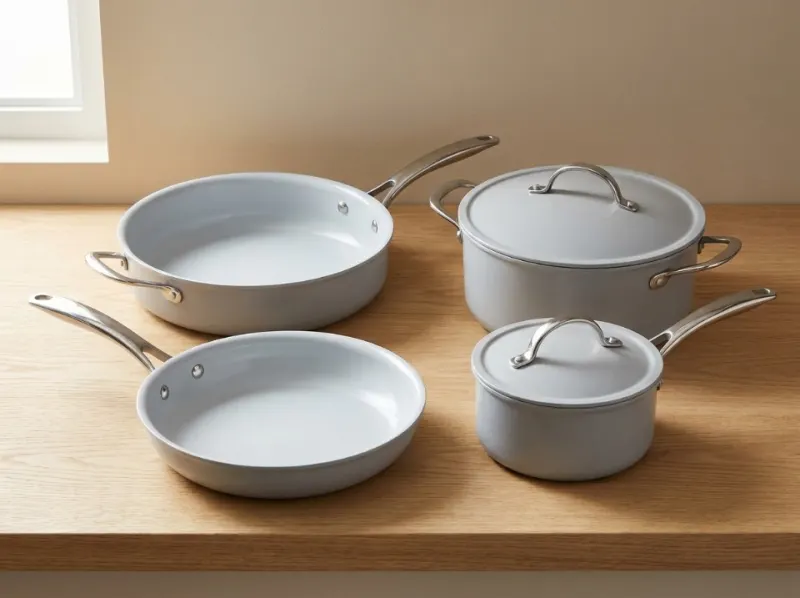
Caraway's 12-piece Cookware Set is the four-pan bundle with storage that most buyers mean when they say the Caraway set. Its list price is discounted by about a third on Caraway's own site every time we have checked, not as a limited-time flash sale but as the price shoppers actually pay at checkout. That discounted price, not the sticker list price, belongs in a cost-per-year calculation. For what actually drives that price, see why Caraway costs what it does.
Here is the arithmetic, shown rather than asserted. Amazon owner reports below describe coating failure starting anywhere from about one month to about a year in, so we are using roughly one year as the realistic replacement window. Dividing a set price by a one-year window leaves the number unchanged, which is exactly why the discounted price and the honest annual cost land on the same figure: $445 per year.
The warranty tells you what Caraway itself expects from the coating. It runs exactly one year, US only. Its own terms exclude "non-stick deterioration, discoloration, warping, or metal separation due to high heat, prolonged heat exposure." In plain terms: normal coating wear voids nothing, because the warranty never covered it.
Compare that to the rest of the ceramic category. Caraway's coating coverage ties for the shortest we found. GreenPan's own warranty page caps its Thermolon coating at 2 years.
Our Place covers its current Always Pan for 3 years. Scanpan and HexClad both offer lifetime warranties against manufacturing defects. HexClad's own terms leave out normal cosmetic wear, the same kind of carve-out Caraway's warranty uses. Even so, a one-year clock is shorter than any of them, and it is Caraway's own admission of how long it expects the coating to hold up.
What Owners Who Actually Own One Report#
Marketing copy and a one-year warranty term only tell you what the company expects. Amazon owner reviews tell you what actually happens. We read through Caraway's reviews looking specifically for when coating complaints start. We found four independent accounts spread across the ownership timeline, not clustered at one predictable point.
One owner reported nonstick failure after about one month of daily use. Another titled their update "review after 10 months" just to flag coating wear at that mark.
A third owner put it bluntly: "after a year of use, I can safely say I will never buy a Caraway pan again."
A fourth report describes the coating failing in one cooking session. A turkey burger on medium heat ruined it, with no gradual wear at all.
None of the four describes the coating still releasing food cleanly beyond the one-year mark. That is a small sample. But it lands in the same order of magnitude as GreenPan's owner-reported range for ceramic coatings, months to about a year and a half. It does not match the multi-year claim that keeps circulating without a source attached to it.
The "Still Going Strong" Reviews Online#
Search for a longer-term Caraway review and you will eventually find someone claiming the set still performs great a year or more in. Read those closely before trusting them.
We found two YouTube reviews revisiting Caraway at the one-year mark. Both disclose a financial relationship with the brand. One creator thanks Caraway "for sponsoring this video" and promotes an affiliate discount code throughout.
The other explicitly says she reached out to work with Caraway again after an earlier partnership, and also promotes a discount code. Both report the coating still working well at almost exactly the point where our independent Amazon accounts start reporting failure.
That timing is not automatically dishonest. A creator who genuinely likes a gifted product can still be telling the truth. But a follow-up sponsored video is also a natural deliverable of an ongoing brand relationship, and neither video discloses whether Caraway reviewed the content first.
We also found one organic, non-sponsored report claiming "three or four years" of ownership. It only speaks to cosmetic condition: the finish still looks good, and the handles stay tight. It never addresses whether the coating still releases food without sticking. Cosmetic durability and nonstick performance are two different questions, and the marketing blurs them into one.
What the Premium Actually Buys You#
None of this means Caraway is a bad product. The coating covers the interior and exterior of every piece, which keeps the outside looking clean even though it is also the surface most prone to cosmetic chipping. Caraway's own spec sheet rates every Caraway piece oven-safe to 550°F, and every piece works on gas, electric, and induction cooktops without a separate check.
The included storage solves a real problem for anyone without a deep cabinet: pan racks and a canvas lid holder. It is genuinely rare among competing sets. If you are deciding whether a full matched set beats buying pieces separately, the storage system is one of the few places a bundled set earns its premium honestly.

And if PTFE-free construction matters to you regardless of the coating's lifespan, Caraway shares its coating recipe and backs the PFAS-free claim with outside testing. More ceramic brands should do that. Most do not. If you want a sourced verdict on a specific brand's coating, our PFAS safety checker covers Caraway and dozens of competing lines.
Is Caraway Cookware Worth It Compared to T-fal and Tramontina?#
Run the numbers against the two most common budget alternatives and the gap is not subtle. T-fal's PTFE coating uses the same chemistry across its lines. General T-fal owner reports describe up to 4 to 5 years of use with careful care.
That range is not a direct review of the T-fal Ultimate Hard Anodized 17-piece set itself. It is a same-chemistry inference, the same reasoning this wiki uses for All-Clad's premium PTFE line. So we are not dividing this set's price by that range. Doing so would manufacture a precise number the evidence cannot support.
The inference still supports a plain read. A mid-range PTFE set that lasts years longer than Caraway's one-year window likely costs less per year overall. Caraway's honestly-earned $445 per year is the number worth remembering here.
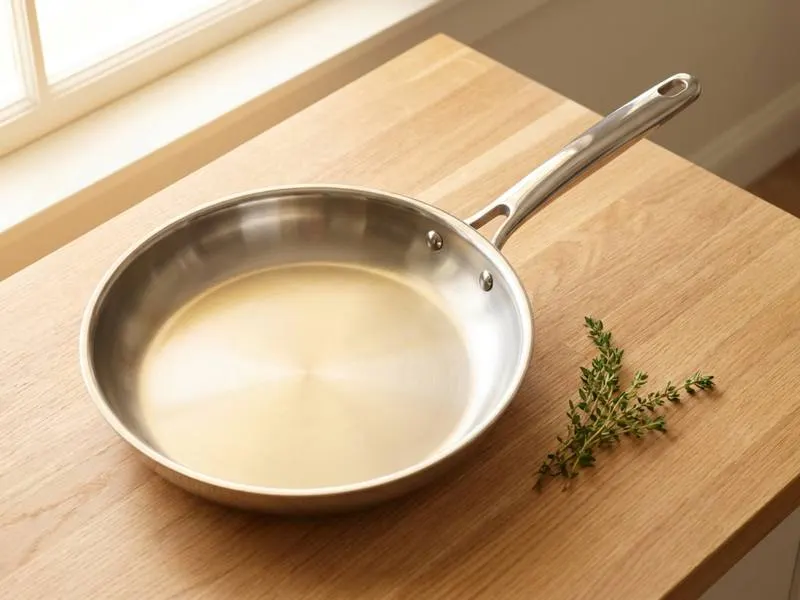
Tramontina's Tri-Ply Clad construction changes the question entirely. There is no consumable coating to wear out. It is the same fully-clad tri-ply build used in premium stainless lines, and fully-clad stainless steel commonly outlasts the kitchen it's bought for, based on long-term owner reports. Priced at a fraction of Caraway's set cost and stretched across a lifespan measured in decades, its annual cost rounds down to pocket change.
None of this makes Caraway a scam. It makes the decision framework simple. If replacing this set within its first year of regular use would genuinely bother you, the sourced evidence says that is a real possibility, not a worst-case outlier.
If the coating's PTFE-free composition, the aesthetic package, and the included storage are worth $445 per year to you on essentially a one-year clock, buy it with that expectation instead of the marketed one. The cookware cost calculator lets you run this same math against your own usage habits.
Who Should Actually Buy Caraway#
Caraway genuinely is the right call for three groups. Buyers who want PTFE-free construction specifically, and are willing to pay a premium for it, since ceramic remains the leading PTFE alternative regardless of lifespan. Buyers who value the aesthetic package and included storage enough to treat the cost as design spend rather than a cooking-performance investment.
Light cooks are the third group: a few meals a week, careful hand-washing, the best realistic shot at stretching past that first-year window. For those three groups, the premium buys a specific look, feel, and PTFE-free peace of mind that the budget alternatives simply do not offer.
Everyone else should rule themselves out before buying. If you cook five or more times a week, use pans hard, or care more about coating life than looks, the sourced numbers do not favor Caraway. A T-fal Ultimate Hard Anodized set or a Tramontina Tri-Ply Clad set gets you into daily cooking for a fraction of the annual cost, just without the color options or the storage system.
Whether the trade toward aesthetics, PTFE-free peace of mind, and included storage is worth it to you is the only question that matters, and for the right buyer, it genuinely is.