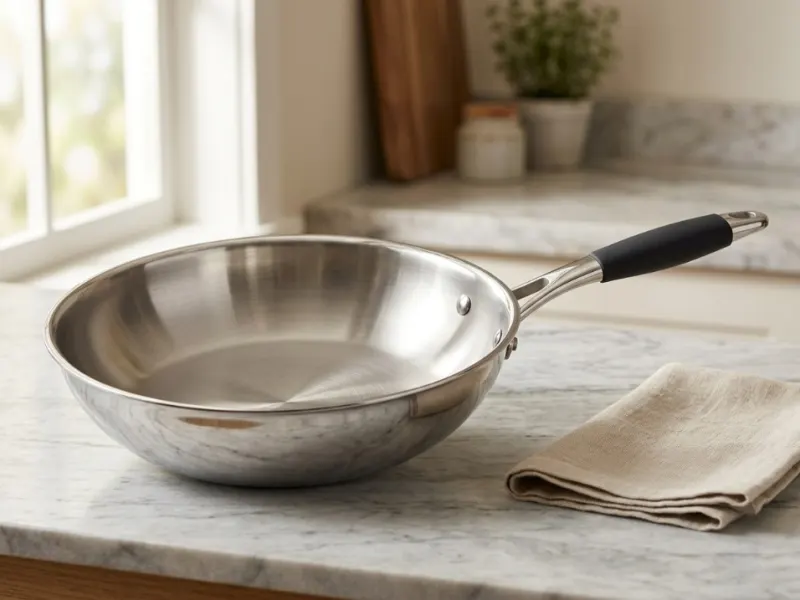
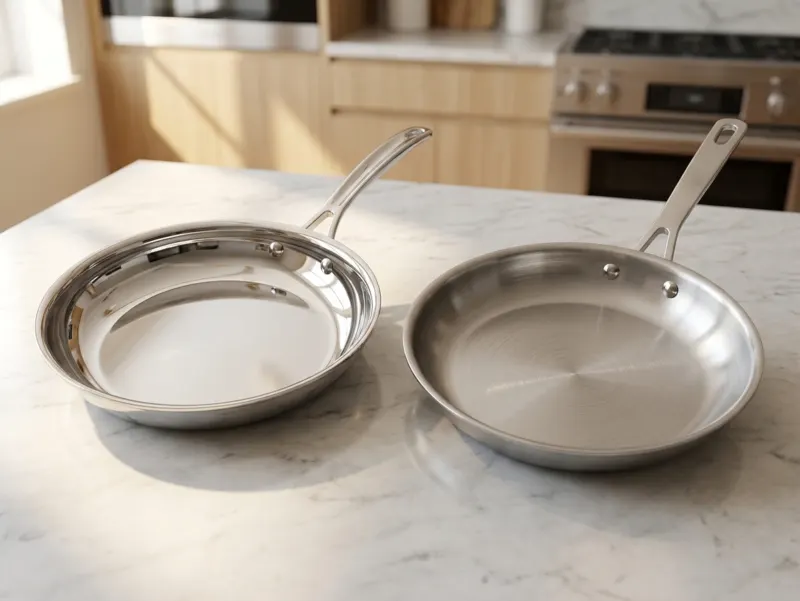
Most shoppers assume All-Clad's price buys a better warranty and sturdier construction than a budget tri-ply pan. Check both brands' own paperwork, and that assumption falls apart fast.
All-Clad's premium mostly buys manufacturing continuity and brand history, not a documented warranty or performance edge. Tramontina's Tri-Ply Clad line carries the same category of lifetime warranty against defects. An independent Consumer Reports lab test rated it Excellent for cooking evenness, food release, and handle temperature, with no Poor or Fair score anywhere in the results.
Our stainless steel cookware guide breaks down that same premium-vs-budget question for construction, induction compatibility, and care overall.
So what does the roughly three to four times higher price at the 12-inch size actually buy? The answer depends less on the pan and more on what you already know about your own cooking habits.
The Warranty and Lab-Test Myth#
We compared All-Clad's own product documentation against Tramontina's use-and-care sheet. We also looked for the only independent lab test either brand has publicly on file. The price story gets more complicated than "you get what you pay for."
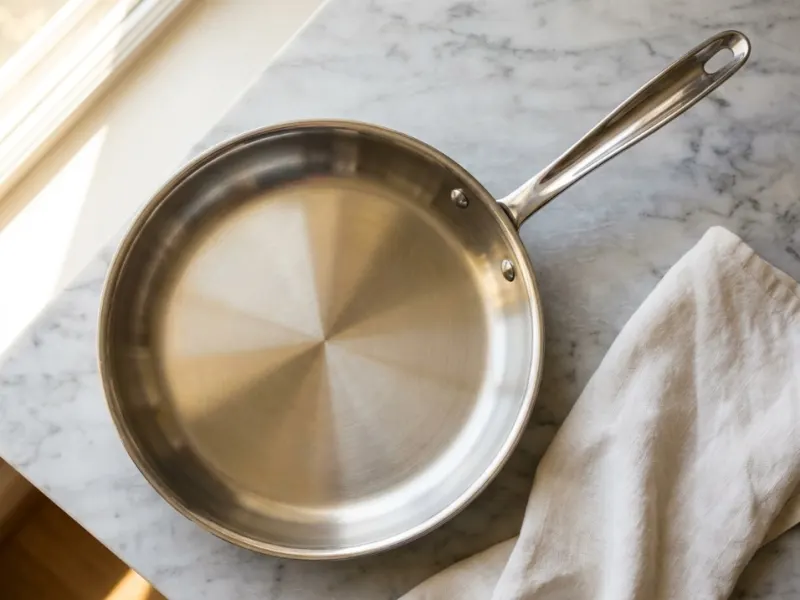
All-Clad's D3 line is fully-clad tri-ply stainless. It has been made in Canonsburg, Pennsylvania since 1971, and it is oven and broiler safe to 600°F. A Limited Lifetime Warranty backs it.
Tramontina's Signature Tri-Ply Clad uses the identical construction type: aluminum core running base to rim, made in Brazil. It carries a lifetime warranty against material and workmanship defects, per the brand's own care instructions. Warranty coverage is not the gap the price implies.
The performance question is more interesting. Consumer Reports independently lab-tested Tramontina's Tri-Ply Clad line. Cooking evenness across the entire surface: Excellent.
Food release, multiple test eggs sliding off unassisted with no scraping needed: Excellent. Handle temperature, cool enough to touch without a potholder: also Excellent. No Poor or Fair score turned up anywhere in the accessible results.
We have not found an equivalent independent lab test for All-Clad D3. There is no head-to-head verdict to report here. Only a fact worth sitting with: the budget pan cleared a real, third-party bar. The premium pan's marketing simply asserts one.
One thing we will not pretend to know: handle comfort and balance. Neither brand publishes an independently verified comparison. No lab test we can cite measures it either. Treat any "more comfortable handle" claim from a listing page as marketing copy, at least until someone who has actually cooked with both says otherwise in a way you can check.
The Cost-Per-Year Math#
Here is the real math, and where it runs out. All-Clad D3 runs roughly three to four times higher in price than Tramontina's Signature Tri-Ply Clad at the 12-inch size, per both brands' own current listings. Neither company attaches a number of years to its warranty. Both call it a lifetime warranty, which is honest, but it is not a figure you can divide a price by.
So here is what we will not do: invent a lifespan just to produce a clean dollar-per-year figure. What we can say honestly: an All-Clad D3 used daily for a decade and a half costs a fraction of its retail price per year of ownership, once you spread it out.
Say a Tramontina lasts several years of daily use. No source ties an exact figure to typical wear on this line, so treat that span as a stand-in for illustration, not a fact. Even on that assumption, it costs less per year than the All-Clad.
Replace the Tramontina once, at that same three-to-four-times price ratio, and the total spent still lands below what a single All-Clad D3 costs at retail over that same span. Most realistic ownership horizons favor the budget pan, even after a replacement.
There is one real exception. All-Clad holds documented, recurring factory-seconds sales on cosmetic-flaw stock, not used goods. At that kind of discount, the cost-per-year drops low enough to meaningfully change the calculus in All-Clad's favor.
For a closer look at how All-Clad compares with a lower-priced stainless option, see our All-Clad versus Tramontina guide.
Have you not already logged a year of regular cooking on a fully-clad stainless pan? Start with the budget tier first. The Cooks Standard Multi-Ply Clad 12-inch runs on the same construction physics as every pan above it on this list, at a fraction of the price.
Which All-Clad Line, If Any, Is Worth It#
Not every All-Clad line earns the same verdict. The mid-tier options between budget and All-Clad deserve a mention too.
D3 is the benchmark. Three bonded layers, fully clad through the sidewalls, oven-safe to 600°F, made in the same Pennsylvania factory since 1971. If the factory-seconds discount above is in play, and you already want the brand specifically, this is the line to buy.
D5 adds two more alternating layers of steel and aluminum, at a meaningfully higher price than D3. We have not found an independent test confirming whether those extra layers change the finished food on a standard home burner. We are not going to assert one anyway. If ply count interests you beyond marketing copy, our 3-ply vs 5-ply breakdown covers the construction question directly.
HA1, the hard-anodized nonstick line, is the one to skip. Oven-safe to 500°F per All-Clad's own spec page, it runs on the same PTFE coating chemistry as far cheaper nonstick pans, per that same nonstick disclosure page. Mid-range PTFE owner reports span a wide range: short-end reports describe losing release in as little as about a year, while careful-use reports describe 4-5 years from mid-range PTFE. Our cookware safety checker lists which lines are bare metal and which carry a coating, with the source quoted for each.
Nothing HA1-specific in the record claims that premium pricing extends that window. You are paying extra for a heavier body and a nicer handle, not a coating that lasts longer.
Weighing nonstick against stainless more broadly? Our nonstick vs stainless steel breakdown covers when each actually makes sense.
Between the Cooks Standard budget tier and All-Clad sits Cuisinart's MultiClad Pro: the same fully-clad tri-ply construction type, at a mid-tier price. It is a reasonable step up if the budget option's inconsistent Amazon stock has burned you more than once. Weighing All-Clad specifically against Cuisinart's more common budget line? Our All-Clad vs Cuisinart comparison breaks down the real construction gap between Copper Core and Chef's Classic Stainless.
The Honest Verdict#
All-Clad's price is justified by manufacturing continuity, brand history, and a real factory-seconds discount that only kicks in if you catch the sale. It is not justified by a documented warranty advantage: Tramontina backs the same construction type with the same category of coverage.
It is not justified by an independent performance test either. The only lab data on file favors the budget pan.
Already know you want the brand? Or have you logged real cooking time on a fully-clad pan, and specifically want the factory-seconds math to work in your favor? Buy D3, and watch for the outlet sale.
Everyone else should start with the Cooks Standard Multi-Ply Clad 12-inch, cook on it for a year, and use the material selector quiz if you are still unsure whether stainless is even the right material for how you cook.
And if anyone tries to sell you stainless cookware at a bridal show for several times what any of these pans cost, read our Kitchen Charm breakdown before signing anything.