You set the oven exactly where the recipe said, and the bread still came out dense. We spent weeks digging through r/Breadit and r/castiron looking for what actually separates a great dutch oven bake from a mediocre one, and the answer kept pointing at a single mistake almost everyone makes.
A gentle simmer converts collagen to gelatin without squeezing moisture out of a braise, while an aggressive boil does the opposite.
For bread, cranking the oven hotter to chase a better crust often backfires. A crust that sets too early traps the dough before it finishes rising, so the loaf never reaches its full spring. Most people assume the fix for uneven results is a better starter or a better cut of meat. The oven dial is usually the actual problem, and the dutch oven's lid knob has a temperature limit almost nobody checks until it cracks.
Your Lid Knob Has a Ceiling You Probably Never Checked#
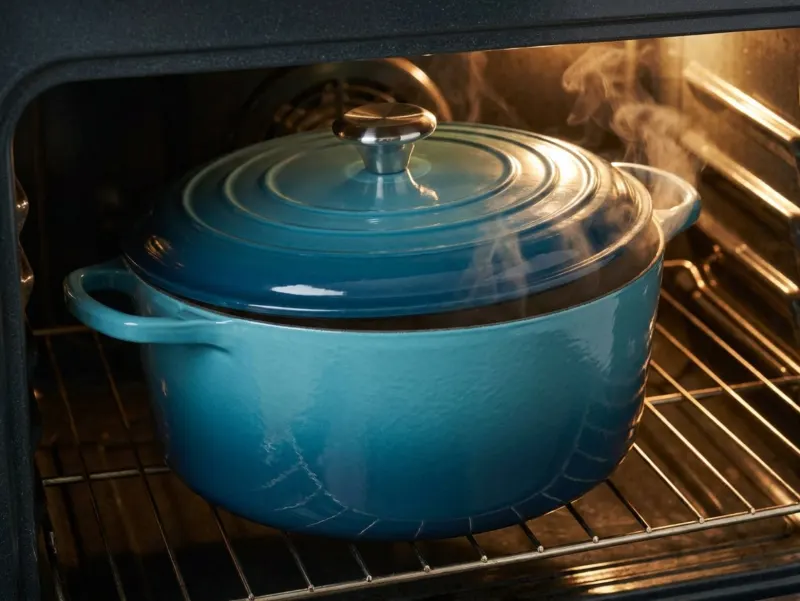
The body of an enameled dutch oven handles up to 500°F on the Lodge 6-Quart Enameled, matching the industry standard across major brands. The knob on top of the lid tells a different story. The confusion around it is worse than most owners realize.
Le Creuset's current Signature phenolic knob is rated to 250°C per Le Creuset's own product listing. That is not the flat 500°F many buyers assume applies to every knob on the pot. Metal knobs, whether stainless, gold, or copper finish, are rated to 500°F with no separate ceiling.
Lodge sidesteps the confusion entirely. The 6-Quart Enameled ships with a stainless steel knob rated to 500°F, which is one reason bread bakers who push higher temperatures gravitate toward it. The pattern shows up across r/Breadit and r/castiron. Someone bakes above the older phenolic knob's rating, it softens or cracks, and they only learn the limit after the damage is done.
If your pot has a phenolic knob and you're not certain of its generation or rating, the safest move is a stainless aftermarket replacement. It's inexpensive and screws on in seconds. Once it's on, you stop thinking about knob limits at all.
How to Use a Dutch Oven in the Oven for Bread Without Overheating It#
Conventional wisdom says a hotter oven means a better crust, so home bakers crank the dial looking for that dramatic ear and blistered crumb. Past a point it works against them. Blast the oven and you set a hard crust fast, while the dough underneath is still trying to expand.
The fix is a steady, moderate oven rather than the highest number the dial will reach. The real lever, though, is not the temperature at all. It is the lid, and how long you leave it on, which the lid section covers in detail.
The same trap catches braises. If yours come out dry despite sitting in liquid start to finish, the oven is running hotter than the dish needs and has tipped the liquid from a gentle simmer into a boil.
You Are Preheating an Enameled Pot Empty#
Bare cast iron shrugs off empty preheating. It's standard practice, especially for bread. Enameled cast iron plays by different rules. An empty enameled pot heats unevenly and fast, and that uneven heat stresses the bond between the glass-based enamel coating and the iron underneath.
Owners on r/castiron and r/Breadit consistently describe this as the moment a hairline crack or chip first shows up.

If a bread recipe calls for a screaming-hot preheated pot, the workaround is the cold-start method. Dough and pot go into a cold oven together, and the oven comes up to temperature with both already inside. Bakers on r/Breadit report results close enough to a traditionally preheated loaf that the enamel risk isn't worth taking.
If you're weighing enameled against bare cast iron for different situations, our enameled cast iron vs cast iron comparison breaks down where each one actually wins. The material selector quiz can help narrow it down further.
Your Oven Is Probably Lying to You#
Every oven's thermostat sensor sits in one spot and reports one temperature. r/Cooking members report their ovens running noticeably hotter than the display shows. Rack position, calibration drift, and how recently you opened the door all play a role.
It comes up again and again across r/Cooking. People buy an inexpensive oven thermometer expecting nothing, and it explains months of inconsistent braises and scorched bread bottoms.
Rack position compounds the problem. The middle rack distributes heat most evenly. The bottom rack sits closer to the heating element, which scorches bread bottoms and sticks stew to the pot's base. If your bread bottoms keep burning, move up one rack and check the actual temperature at that height.
You Are Pulling the Lid Off Too Early#
The lid does two jobs. It traps moisture so nothing evaporates away, and it blocks direct radiant heat from above so the whole pot heats evenly instead of browning unevenly on top.
Keep the lid on for the entire braise or stew. For bread, the trapped steam of the covered phase keeps the dough surface flexible while it rises, which is what produces oven spring. Take it off toward the end of a braise to let the sauce reduce, and after the dough has finished its main rise so the crust can brown.
The most common mistake we see reported is pulling the lid too early, before the steam phase has done its job. Once the crust sets, expansion stops. You're left with a dense, stunted loaf that never got its full rise.
Never Take It From the Fridge Straight Into a Hot Oven#
Thermal shock cracks enamel far more often than it cracks the iron underneath. Enamel and cast iron expand at different rates when heated, and a sudden jump from cold to hot widens that gap past what the bond can absorb.
The rule holds both directions. Never move a hot dutch oven onto a cold or wet surface. Never move a refrigerator-cold pot straight into a preheated oven.
Let a hot pot cool gradually on a wooden board or folded towel. Let a cold pot warm toward room temperature before it goes into a hot oven. Or start it in a cold oven and bring both up together. For more on what protects the enamel long term, see our enameled cast iron safety guide.
Putting It Together#
Every mistake above traces back to the same root cause: treating your dutch oven's rated limits as flexible when they aren't. Know your knob's actual rating instead of assuming 500°F across the board. Trust a thermometer over your oven's dial.
Keep the lid strategy matched to what you're cooking. Skip the empty preheat on anything enameled, and never force a fast temperature swing. Get those right and a dutch oven delivers braises that fall apart at the fork and bread crusts that actually blister, on cookware that easily outlasts the oven it's baking in.
If you'd rather not think about knob ratings at all, the Lodge 6-Quart Enameled ships one 500°F rating for the whole pot, lid included, so there is nothing to check or swap out of the box. A Le Creuset phenolic lid gets you there too once you fit a metal knob, the swap we recommend above, so Lodge is not the only fix, just the one that saves you the step. The pot pairs a heavy lid that traps steam well with compatibility across all cooktops including induction. The price undercuts premium enameled brands by a wide margin.
We cover the full price-versus-performance breakdown in our Lodge vs Le Creuset comparison. If sourdough is the main reason you're shopping, our best dutch oven for sourdough bread piece goes deeper on size and shape.