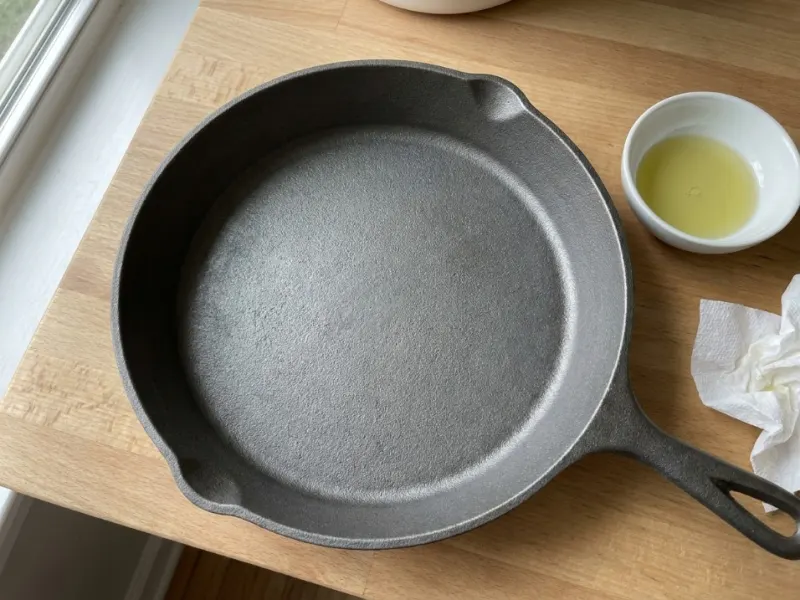
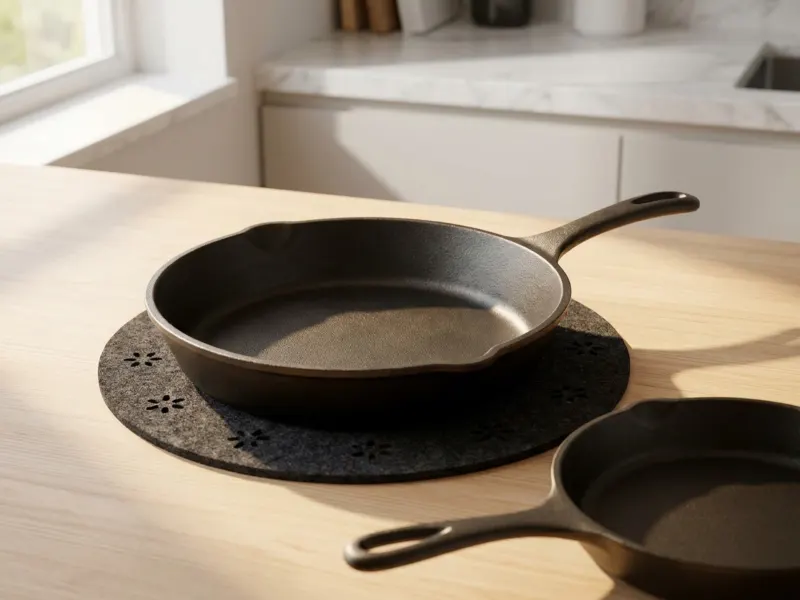
Every guide to cast iron seasoning treats a flaking pan and a patchy-looking pan the same way. Strip it all and start over. We checked two of the most common guides on this, and neither one draws the line we think actually matters.
Cast iron seasoning fails in only two real ways. Either the oil never fully cured (flaking, tacky residue), or it wore thin from use (patchy color, food sticking that used to release fine).
Our cast iron cookware guide covers the seasoning habit from the start, before it ever gets to this point.
The first needs the coating removed and rebuilt. The second needs nothing removed at all, just more cooking with fat. Confusing the two means stripping seasoning that was never actually broken.
Here is how to fix cast iron seasoning by figuring out which case you actually have.
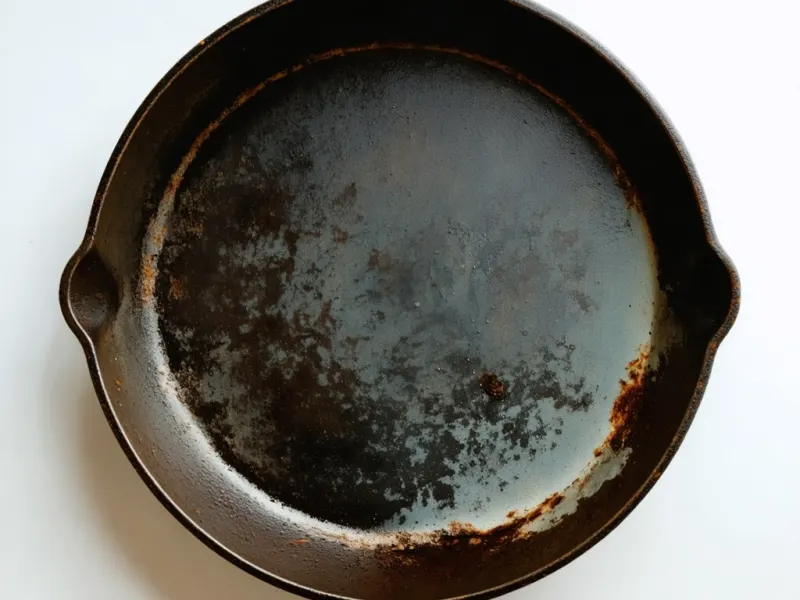
Situation One: Seasoning Is Flaking or Peeling#
This one is a real failure. Seasoning forms through polymerization: unsaturated fat molecules cross-link under sustained heat into a hard polymer bonded to the iron.
When a layer goes on too thick, the outside cures while raw oil stays trapped underneath. That trapped layer never bonds. It eventually separates and flakes off.
Oil choice matters here too. We went looking for a manufacturer willing to name a specific culprit rather than just saying "some oils flake," and Field Company's own care guide does exactly that, pointing to seasoning built with "certain types of oil, like flaxseed."
We checked the underlying chemistry to see if that held up, and it does: flaxseed is unusually rich in a fatty acid that maximizes cross-linking, producing a polymer so rigid it cracks under normal heat cycling instead of flexing with it.
For a few loose patches, scrub the flaking material off with a stiff brush or fine steel wool. Wash, dry completely on a hot burner, then apply one thin coat of oil heated until it stops smoking. For large peeling sections, do the full strip described below, an extended lye-based soak rather than a quick scrub.
Either way, the pan is not damaged. It is an inch-thick block of metal wearing a coating you can rebuild as many times as you need to.
Situation Two: The Surface Is Sticky or Tacky#
A tacky surface means the same problem as flaking, caught earlier. Too much oil, or an oven that never got hot enough to finish the reaction.
Our sticky seasoning guide breaks down the specific sub-types, uniform tackiness versus patchy pooling on a rough-cast pan. The short fix: put the pan back in a 450°F oven for an hour so the residual oil finishes curing. Still tacky after that? Scrub the gummy layer off and re-season with noticeably less oil.
Situation Three: Uneven Color or Patchy Spots#
This is where we think most guides overreact, and it is the one claim we specifically went looking for a manufacturer to confirm. Per Field Company's own cast iron care page, blotchy or two-toned seasoning on a newer or lightly used pan is totally normal. Their guidance is explicit: do not fix it with aggressive cleaning or extra seasoning. Just keep cooking.
Seasoning builds up in interlocking layers at different rates across the surface. A pan darker in the center and lighter at the edges is simply showing where it has seen the most heat and oil so far, not damage.
The real exception is a stripped patch, worn down to bare gray metal from repeated scraping in one spot. That patch will rust if left alone. Treat it like light flaking: wash, dry on a hot burner, apply a thin oil coat, and heat until it smokes.

Situation Four: Rust Spots Showing Through#
Rust means bare iron is exposed. It is never a dead end.
Our full rust removal guide covers the complete process. The short version: scrub surface rust with steel wool or a rust eraser until you hit clean gray metal, then rebuild with thin oven-seasoning coats.
The step people skip is drying fast. Per the Canadian Conservation Institute, bare iron corrodes more rapidly under a thin film of standing water than it does sitting in humid air alone. That is why a quick towel-dry followed by a hot burner beats just leaving a wet pan to air out.
Situation Five: Food Sticks Where It Used to Release Fine#
Nothing looks damaged. No flaking, no rust, no tackiness. Eggs just stick now when they slid fine last month. The pattern we kept noticing while researching this piece: every fix that involves removing something (flaking, tackiness, rust) traces back to chemistry going wrong, while every fix that does not (color, release) traces back to not enough time on the stove yet.
This is the second case that is not actually a failure. The seasoning has thinned from use, the same way it built up in the first place: layer by layer, one cook at a time. Cook drier, lower-fat foods for a while and the surface loses some release without anything going chemically wrong.
The fix is the easiest of the five. Cook several meals in a row using generous fat (bacon, oiled potatoes, anything that coats the pan). Or apply a stovetop maintenance coat: one thin layer of oil heated until it just smokes. No stripping required.
How to Fix Cast Iron Seasoning With the Right Oil#
If you are dealing with Situation One or Two and need to rebuild from scratch, the best oil for cast iron seasoning breaks down the full comparison. The short answer is grapeseed or avocado. Both have high smoke points, polymerize into a flexible layer, and carry no flavor.
Skip flaxseed oil despite its popularity in older guides. As covered above, Field Company's own care guide and the underlying cross-link chemistry both point to the same brittle-polymer problem. It looks impressively dark and hard right out of the oven, then cracks under normal heat cycling with regular use.
Factory pre-seasoning on new pans (Lodge, Victoria) is a thin base coat, not a finished surface. It looks patchy at first and performs below expectations until you build more layers through cooking. That is Situation Five, not a defect.
Prevention: Keeping Seasoning Intact#
Most failures share the same root cause: too much oil. Use less than you think, wipe until the pan looks dry, and let the thin invisible film left behind do the work.
Cook with fat regularly. Hold off on prolonged acidic cooking, tomato sauces, wine reductions, until the seasoning is well established. Dry the pan immediately after washing, and store it with a thin oil coat if you do not cook with it daily.
Cast iron survives mistakes that would end a non-stick pan's life or dull a stainless finish. Strip it, rebuild it, and get back to cooking.
Is a Dedicated Conditioning Oil Worth It#
Grocery-store grapeseed or avocado oil handles both re-seasoning and daily upkeep on its own. Lodge's own seasoning instructions cover the process in more detail.
That said, the Caron & Doucet Cast Iron Conditioning Oil solves a narrower problem: over-oiling. Its own directions call for pouring on a measured amount, working it in, and letting it sit and dry, a maintenance application rather than an oven bake. It is a plant-based, coconut oil-based formula built specifically for cast iron, and the coconut base resists going rancid on the shelf the way the polyunsaturated oils above eventually do.
Worth knowing before you buy the Caron & Doucet oil: per de Buyer's own guidance on using coconut oil for seasoning, it is less durable than grapeseed or sunflower and can carry a faint flavor. Think of it as a convenience product for dosing control during upkeep, not a substitute for the oven-bake fixes covered in Situations One and Two.