You already know how to clean the inside of a pan. The outside raises a different question.
Cleaning the outside of pots and pans depends on what that exterior is made of, not on how bad the buildup looks.
Bare metal (stainless steel, bare cast iron, bare carbon steel) tolerates real scrubbing and real chemistry. Painted, coated, or enameled exteriors need the same gentle care as the cooking surface itself: dish soap, a soft sponge, and time.
There's one more thing most cleaning guides get wrong about this topic, and it involves your stove. We'll get to that after the material-by-material breakdown.
What Creates the Buildup#
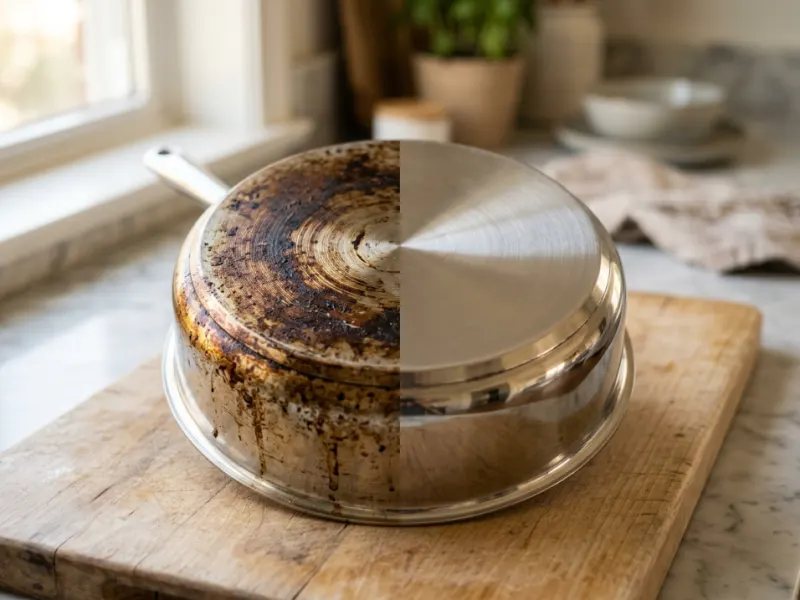
The dark layer on a pan's exterior is polymerized grease. It's chemically the same process as the seasoning that builds up inside a well-used cast iron skillet.
Heat breaks oil down and reforms it into a hard film that bonds to metal at a molecular level. On a cooking surface, that's the whole point.
On the outside of a stainless saucepan, it's just residue with nowhere useful to go.
Heat source changes where it lands. Gas burners wrap a flame around the pan's sides, so buildup tends to show up there as well as on the base.
Electric and induction cooktops concentrate buildup on the flat bottom instead, where the pan sits closest to the heat.
Severity decides your method. Light amber discoloration that wipes off with a firm sponge and some dish soap needs nothing stronger.
A thick, black, textured layer that catches a fingernail needs a real cleanser. Drag your nail across the dry bottom. If it catches and leaves a visible trail, you're in the second category, and the steps below matter.
How to Clean the Outside of Pots and Pans by Material#
Stainless Steel#
Bare stainless steel tolerates aggressive cleaning well. The chromium oxide layer that gives it corrosion resistance also shrugs off chemical cleansers and moderate abrasion.
Mix a baking soda paste at three parts baking soda to one part water. Spread it across the discolored area.
As a standalone paste with no reheating step, give it a few hours or overnight; the alkalinity needs that time to loosen bonded grease. Scrub with the rough side of a dish sponge afterward.
For heavier buildup, an oxalic acid powder cleanser works faster. Wet the surface, sprinkle the powder, and work it in for about a minute before rinsing.
Bar Keeper's Friend is built around this exact chemistry. The same one-minute contact limit that protects the inside of the pan applies outside too.
A genuinely neglected bottom benefits from the longer soak used on burnt stainless steel. The chemistry doesn't change just because you flipped the pan over.

Nonstick#
The cooking surface and the exterior finish on a nonstick pan are two different materials. That distinction matters more than most cleaning advice admits.
A painted or coated exterior, common on budget and mid-range lines, is exactly as vulnerable to abrasion as the PTFE cooking surface inside. We checked manufacturer care pages directly, and some are explicit about this: a nylon sponge only, on both the interior and exterior, with scouring pads and powders banned on either side. Our cookware safety checker can confirm any brand's PFAS status if you're unsure whether a given exterior is bare metal, PTFE, or something else.
The same logic covers hard-anodized exteriors, which some brands describe as carrying their own protective coating that scouring pads damage.
Default to warm water, dish soap, and a soft sponge. For stubborn spots, apply a thin baking soda paste with your fingers, let it sit for a while, then wipe with a microfiber cloth.
If buildup survives two gentle attempts, it has likely bonded with the finish itself. Removing it means removing the finish too, and a cosmetic stain that doesn't affect cooking beats a bare, oxidizing patch.
A genuinely bare, unpainted hard-anodized exterior is a different case. Dark grey, uniform, matte, with no separate coating on top: a nylon brush and baking soda paste handle that without the same risk. If you can't tell whether your pan's exterior is painted or bare anodized aluminum, check the care instructions first.
Carbon Steel#
Carbon steel's exterior sits between stainless and cast iron in how much latitude it gives you. Like the cooking surface, the outside develops its own seasoning, and that layer protects the metal from rust. Thinner walls mean the seasoning tends to be thinner and less even than on cast iron, especially near the handle.
Smooth, dark, and uniform means healthy seasoning. Leave it alone. Flaking, sticky, or uneven enough that the pan wobbles means it's time to strip and reseason the exterior the same way you would a problem interior: a coarse salt scrub with a little neutral oil, rinsed, dried over low heat for a few minutes, then a thin coat of oil heated until it just starts to smoke.
Enameled Cast Iron#
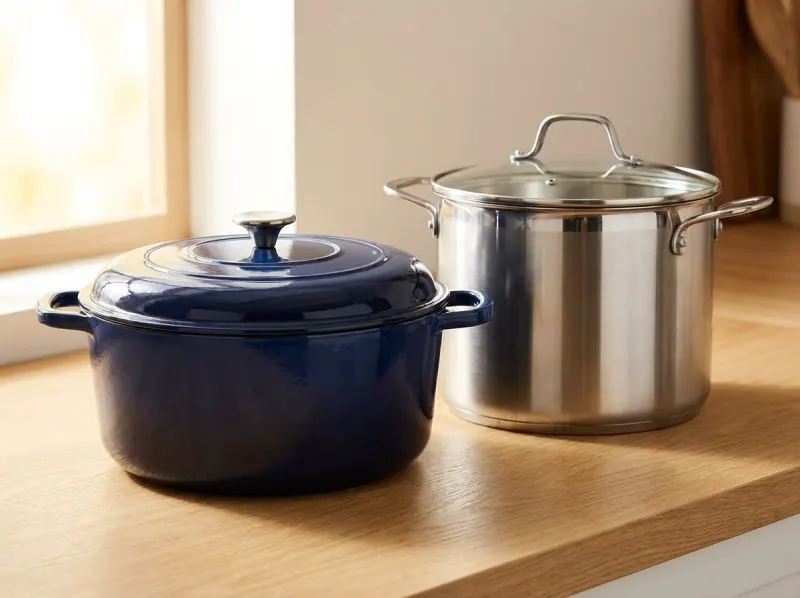
Enamel is glass, fired onto the cast iron underneath at a high enough temperature to fuse the two together. It tolerates mild abrasives but not impact or aggressive scraping, and a chip is permanent.
A baking soda paste and soft cloth handle most exterior discoloration, including a stubborn ring of baked-on drips around the base; give it longer to sit (a few hours, same as the stainless steel approach) rather than reaching for an oxalic-acid cleanser, which isn't safe on enamel exteriors.
Skip metal scrapers entirely. They're the one tool guaranteed to chip enamel rather than clean it.
Bare Cast Iron#
The black coating on a cast iron skillet's exterior isn't dirt. It's the same polymerized seasoning that builds the cooking surface inside, and it's protecting the iron from rust. Scrubbing it off exposes bare metal to exactly the problem the coating was preventing.
Only clean the exterior if it's causing a real problem: flaking off in chips, creating an uneven base, or leaving black marks on your hands. In those cases, a coarse salt scrub, a few tablespoons worked in with a nonabrasive brush, lifts loose material without stripping stable layers underneath.
Rinse, dry immediately over low heat, and apply a thin coat of oil. The exterior rebuilds itself within a few more cooking sessions.
For the interior side of the same problem, see how to fix cast iron seasoning.
Why This Matters More on Some Cooktops Than Others#
Nearly every cleaning guide on this topic makes the same claim. A dirty pan bottom "reduces heat transfer efficiency" and "wastes energy" on glass and induction cooktops alike. That claim conflates two different things, and confusing them leads to cleaning for the wrong reason.
The first thing is pan geometry. Whirlpool's own induction cooktop guidance is specific: flat-bottomed cookware gives the best heat conduction and energy efficiency, while a rounded, warped, ribbed, or dented bottom causes uneven heating. That's a shape problem, not a cleanliness one.
The second thing is residue on the cooktop itself. Manufacturer care pages warn that a wet or dirty pan bottom can leave deposits on the glass when heated. That's about keeping the cooktop's surface clean, not about how efficiently your pan heats up.
Induction specifically doesn't heat the way radiant or gas heat does. Per the U.S. Department of Energy, an induction cooktop generates an electromagnetic field that creates current directly inside the pan's base. Our induction compatibility checker confirms whether a given pan actually works on induction before you worry about how clean its bottom needs to be.
The heat forms inside the metal itself, not from a hot surface below. A thin film of grease doesn't get in the way of that electromagnetic coupling the way it slows conduction from a hot radiant coil.
The real, well-documented risk on induction and every other glass-top range is mechanical: a rough, built-up bottom scratching the glass.
For everyone else, a clean pan bottom is worth doing for your cooktop's surface and your pan's finish. It isn't silently costing you energy every time you cook.
The Method, Not the Guesswork#
Match the cleaner to the material, not to how bad the stain looks. Bare stainless, bare cast iron, and bare carbon steel forgive real scrubbing and real chemistry.
Painted, coated, and enameled exteriors don't. They deserve the same patience you'd give the cooking surface.
Get that one distinction right, and the rest of this is picking the right tool for a five-minute job.