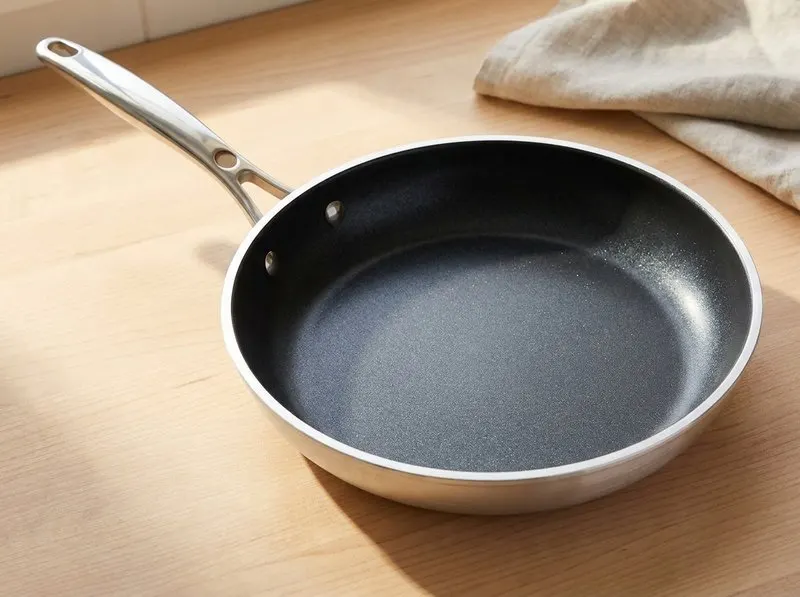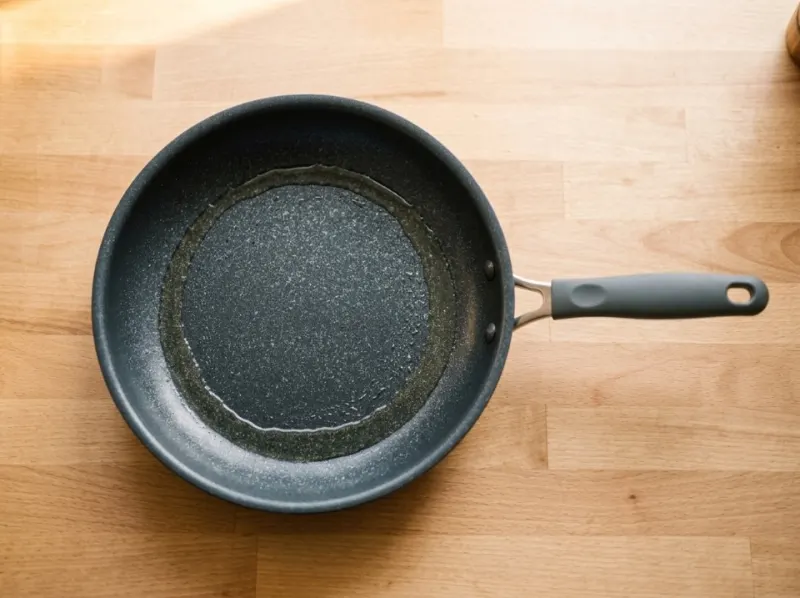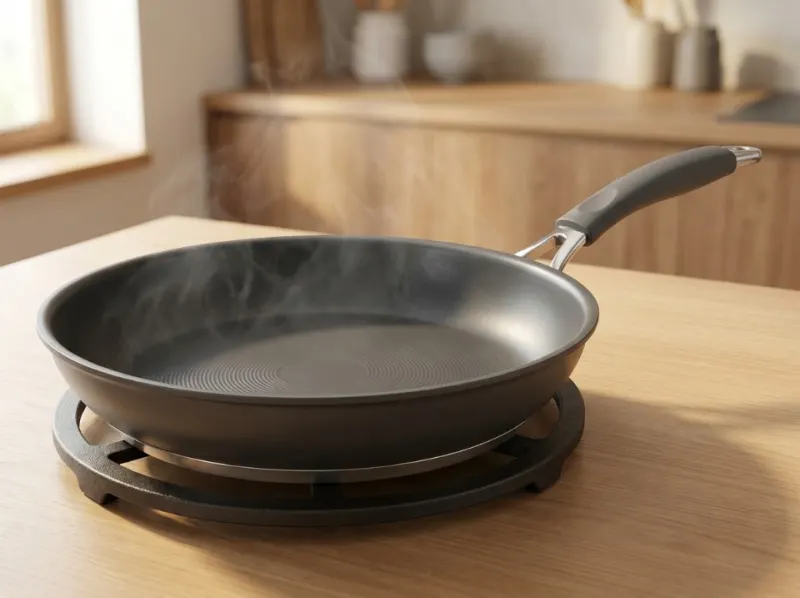
Every nonstick care guide tells you which sponge to use. None of them tell you the one thing that matters more: when you pick it up.
The single biggest mistake in cleaning a nonstick pan is scrubbing it while it's still hot. A peer-reviewed study tested six commercial nonstick pans and found that scrubbing them hot caused up to 81.12% more coating loss than scrubbing the same pans once they'd fully cooled.
Circulon's own instructions and Consumer Reports agree on something else: plunging a hot pan into cold water risks warping it outright. Cool the pan first, every time, no matter how burnt it looks.
The instructions on the box say hand wash with a soft sponge. What they rarely explain is the timing. The exact same wash, done ten minutes too early, does more damage than a stronger cleaner ever would.
We went looking for what actually separates a nonstick pan that survives for years from one that dies in months. The answer had almost nothing to do with which sponge sits next to the sink. This covers the cooking surface itself, one piece of the buying-and-caring picture in our nonstick cookware guide. If it's grime on the outside bottom of the pan, that's a different fix by material, not this one.
The Real Damage Happens Before You Pick Up a Sponge#
Nonstick coatings fail two ways at once, and heat drives both of them.
The first is mechanical. A peer-reviewed materials-science study heat-tested six commercial nonstick pans, three PTFE and three ceramic. It ran the same abrasion test at each temperature, from room temperature up to 450°C. At 250°C, the same abrasive contact caused 26.02% more material loss than at room temperature.
At 450°C, it caused 81.12% more. The scrubbing motion never changed. Only the pan's temperature did.
The second is chemical. The same study found that heat alone, with no scratching at all, breaks down the carbon-fluorine bonds holding PTFE together. Its own recommendation is specific: keep nonstick cookware below 250°C (482°F) for no more than 45 minutes of continuous heat.
Put those two findings together, and cleaning timing stops being a minor courtesy. It becomes the highest-leverage habit you have.
Circulon's own care instructions state it plainly: never expose hot cookware to cold water, since it can warp the pan and risk a steam burn while you're doing the dishes.
Consumer Reports gives an identical warning, independent of any single brand. The rule against plunging a hot pan into water is especially true for nonstick coating. A warped pan won't sit flat on the burner, and that uneven contact creates hot spots that finish off a coating heat has already weakened.
None of the standard cleaning guides we checked connect these two findings. They list "let it cool" as one bullet among a dozen. None explain why nonstick pays a bigger price for skipping it than stainless steel or cast iron does.
How to Clean Nonstick Pans With the Boil-and-Cool Method#
Burnt food is exactly when this rule gets broken. The pan is still hot, dinner is ruined. Running water over it feels like the fastest fix available.
Do this instead. Set the pan aside on the stovetop itself or a trivet and let it cool completely. Once it's fully cool, fill it with three parts water to one part mild dish detergent or white vinegar. Add enough to cover the burnt-on food.

Bring it to a boil, then turn off the heat and let the mixture sit until it cools again. By the time it does, most of the residue lifts away with a soft nylon sponge instead of a knife.
For spots that don't budge on the first try, Swiss Diamond recommends a different fix, relayed by Consumer Reports: spread a baking soda paste of baking soda and water over the residue and let it sit for up to 24 hours before washing.
Baking soda's crystals are soft enough to dislodge polymerized buildup without scratching the coating. That's exactly why steel wool and other abrasive scrubbers stay off the list. They might look tempting on a bad day, but they're not worth the risk.
Why the Grooves on a "Scratch-Resistant" Pan Can Work Against You#
Some nonstick lines market a textured, grooved cooking surface specifically to resist scratching. The Circulon ScratchDefense 10-Inch Nonstick Frying Pan is one of them. It's built over an edge-to-edge stainless steel base the company says keeps it from warping.
The grooves do resist scratches. They also trap food.
One owner reviewing the pan directly described the tradeoff. Food builds up in the grooves and is difficult to remove without excessive scouring. That scouring, the owner said, will ruin the surface of the pan over time.
That's the exact behavior the heat-and-abrasion math above punishes hardest. A textured surface tempts you into more scrubbing, on a pan that's often still warm from cooking.

The fix isn't avoiding textured pans entirely. It's applying the cool-first rule especially strictly to them. Their grooves give you more reasons to reach for extra pressure. That's exactly the moment heat has made pressure count for more.
What to Avoid: Dishwashers, Sprays, and the Wrong Sponge#
A few habits do lasting damage on their own, heat aside.
- Dishwashers wear the coating faster, even on labeled dishwasher-safe pans. Consumer Reports quotes Larry Ciufo, who has tested dishwashers at CR for over 20 years. He says the wash process itself can wear away a coating the manufacturer hasn't specifically approved for it.
- Aerosol cooking sprays leave a residue that bonds to PTFE and won't dissolve in normal dish soap. The emulsifier and propellant in the spray burn at a lower temperature than plain oil does. Our cooking spray guide covers the mechanism and the fix in more depth.
- Steel wool and scouring pads scratch the coating on contact, no heat required. Tefal's own official care instructions for its nonstick range ban abrasive tools on the cooking surface. That ban covers the painted exterior too, not just the inside.
- Stacking pans bare lets one pan's bottom scratch the next pan's coating. A folded towel or felt liner between them prevents it.
None of these habits is exotic advice. What's easy to miss is that they all get worse on a hot pan, doing more damage right off the burner than once the pan's had a few minutes to cool.
Skip steel wool entirely, even on the exterior. There's no scenario where a nonstick pan benefits from it.
Getting This Right, Every Time#
A nonstick pan that lasts years and one that dies in months get the same sponge and the same detergent, and they even get the same brand-name care instructions.
The difference is almost always timing. It comes down to whether the pan cooled a few minutes before anyone reached for water or a scrubber.
If your pan is already losing its release, that's a different problem than residue. It happens no matter how carefully you clean it, and no cleaning method fixes it.
A faint amber film that resists a fingernail is buildup. Grey or silver patches, or physical flaking, mean the coating itself is gone. That calls for a replacement, not another round of scrubbing.
For most kitchens, a straightforward PTFE pan with a stainless base built for even heating is a reasonable next pick. The Circulon ScratchDefense above is one option, as long as you keep the same cool-down discipline covered here, grooves and all. If you want to know exactly what is in a given coating, our PFAS safety checker gives a sourced verdict by brand and line.