Is that blackened crust on your pan actually ruined? Or is it just sitting on top of metal that's fine underneath?
That question sent us digging through manufacturer care pages, cleaning guides, and owner reviews to find out what's actually happening under a bad burn, and whether the usual advice to grab whatever "stainless cleaner" is under the sink actually holds up.
Burnt food and stainless steel discoloration are two different problems, and they need two different fixes.
Beyond cleanup, our stainless steel cookware guide covers the construction and induction questions worth checking before your next purchase.
Boiling water loosens most burnt residue in minutes. A baking soda step handles what's left through mild abrasion and alkalinity. A mineral-abrasive cleanser like Bon Ami finishes the last shadow, no acid involved. An acid-based cleanser like Bar Keeper's Friend does a different job entirely: it dissolves the oxide film underneath, not the burnt food itself.
That distinction is the gap in most cleaning guides we checked, including a restaurant-method breakdown and Made In's own care blog. Both list an acid cleanser and a mineral cleanser as interchangeable last steps. Neither explains why you'd reach for one over the other, and neither flags that both products carry the same real limit on how long you can leave them on and walk away.
Why Burnt Food Doesn't Ruin the Metal#
Stainless steel is a solid alloy all the way through. It is not a coating over a cheaper base metal. The International Stainless Steel Forum is direct about this: it's "a solid material and not a special coating applied to ordinary steel." Burnt food sits on that surface. It doesn't eat into it.
What makes the pan "stainless" is a chromium oxide film that forms on the surface. That film regenerates on its own once it's back in contact with air, per the same industry source. A scorch mark disrupts the film only where the food burned, not the metal underneath. Once the residue comes off, the film re-forms.
None of this changes how the pan cooks once it's clean. A burn is a distraction problem, not proof the pan runs hot or cooks badly. Why food sticks to stainless steel in the first place comes down to temperature and technique, not this kind of damage.
There's exactly one real exception: pitting corrosion. Chloride exposure, mainly from soaking a pan in salted water, causes localized pitting that genuinely damages the metal, not just its surface film. A cleanser can shine the discoloration around a pit, but it can't undo the pit itself. Actual pinholes or craters, rather than a flat burnt layer, are the one case where the metal itself took damage.
The Fastest Way to Clean a Burnt Stainless Steel Pan#
Before reaching for any powder, try the same trick that builds a pan sauce, pushed one step further. Add about a cup of water, or a 50/50 mix of water and white vinegar, to the pan. Bring it to a boil. Scrape the bottom with a wooden spatula while it simmers.
This loosens most of what's stuck, the same way deglazing lifts golden fond, just applied to residue that's gone past fond into genuinely burnt.
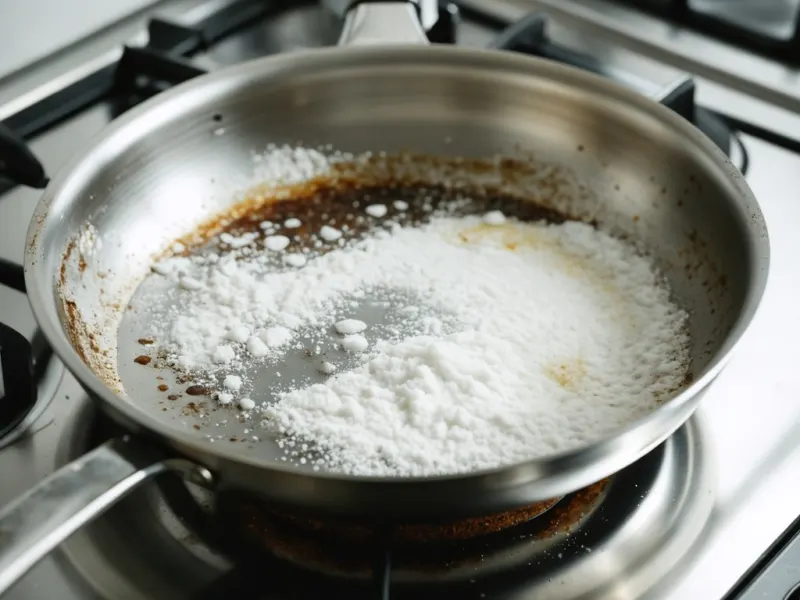
Pour the liquid out without drying the pan. Sprinkle baking soda directly onto the wet surface and let it cool. Scrub with a wet, non-scratch pad. For a lighter burn, this two-step sequence alone often finishes the job.
The Baking Soda Step, Done Right#
For a heavier burn, mix a paste at 3 parts baking soda to 1 part water, thick enough to fully coat the burnt area. Baking soda works here for two layered reasons: mild mineral abrasion lifts bonded residue, and its alkaline pH helps neutralize the acidic compounds in burnt food.
Here's where most guides undersell the timeline. A cold paste, left with no heat, needs a few hours or overnight to fully work. That's a longer wait than the 15 to 30 minutes one competitor guide suggests, with no source given for that figure.
If you don't want to wait that long, there's a real shortcut. Thin the paste with more water, put the pan back on the stove, and bring it to a quick boil before scrubbing. Either path gets you there. Only one of them is fast.
Two Different Finishing Jobs#
If a faint shadow remains after the steps above, feel the spot. That tells you which finishing product to reach for next.
Any texture, some bonded residue that hasn't fully lifted, means a mechanical cleaning job. A perfectly smooth surface with a tint (a rainbow sheen, a blue-brown cast) means oxide discoloration, a chemical job instead.
A mineral cleanser like Bon Ami finishes the mechanical job. Its five ingredients, feldspar, limestone, soda ash, baking soda, and a mild surfactant, work by gentle scouring. That's the same category of action as the baking soda step, just finer.
An acid cleanser like Bar Keeper's Friend finishes the chemical job instead. Its oxalic acid dissolves the oxide film rather than scrubbing it away, a fast chemical reaction rather than a soak, which is why it isn't meant to sit on a surface for long stretches either.
Reaching for it on food that's still bonded to the pan means scrubbing harder against a cleanser that isn't built for that job. That's exactly the scenario that scratches pans.
Bon Ami: What It Actually Does and Doesn't#
We point people to Bon Ami as the default finishing step because it has no harsh chemicals and doesn't require gloves. Its own maker's directions confirm it's safe on stainless steel, while explicitly excluding non-stick cookware and glass.

If the pan in question is cast iron rather than stainless, skip everything above. Cast iron needs a different, seasoning-safe approach.
One real limit to know before you rely on it: the manufacturer's own guidance says extended contact with the surface is not recommended.
That's a genuine constraint, not a walk-away, come-back-whenever product, whatever the gentler ingredients suggest. One verified owner review we found describes leaving a Bon Ami paste on caked-on stainless residue for an hour or more, sometimes overnight, well past that guidance. Treat that as one owner's reported habit, not a substitute for the label.
The honest tradeoff against Bar Keeper's Friend: Bon Ami is slower on a genuinely severe burn. Mineral abrasion asks more scrubbing effort than an acid reaction does. That's the price of skipping oxalic acid, not a flaw.
The Verdict#

A burnt stainless pan is not a ruined pan, and you don't need to guess which cleanser to trust. Deglaze with boiling water first. Give a baking soda paste real time, or take the boil-again shortcut. Finish with Bon Ami for whatever bonded residue is left, and keep an acid cleanser in the cabinet for oxide discoloration specifically, not as your first response to burnt food.
A non-scratch scouring pad does the scrubbing for every step above. Skip steel wool entirely; it's the one tool that leaves a mark none of this can fix. Regular metal utensils are a different story; the marks they leave stay cosmetic for the same reason a burn does.