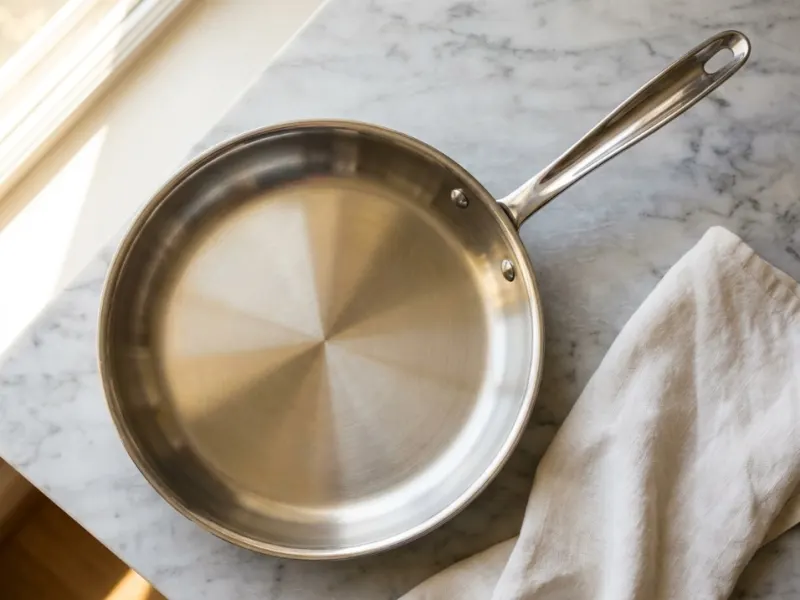
You inherited, thrifted, or bought a stainless steel pan years ago. Now it looks like it survived a war: rainbow patches, white spots, a road map of scratches. Is that pan actually failing, or does it just look that way?
Most of what makes a stainless steel pan look worn out has zero effect on how it cooks.
Our stainless steel cookware guide covers the construction and induction checks worth running before you buy the next one.
Real failure in stainless steel comes down to three mechanisms, and none of them are cosmetic. Everything else, the discoloration, the chalky spots, the scratches, is surface noise.
How long does stainless steel cookware last, then? Longer than most people assume, but not on a fixed schedule. "Fully-clad" on the label is not the guarantee it usually gets sold as.
Here is the part that surprised us during research. A fully-clad tri-ply pan is supposed to be the safe, durable choice. Multiple owners of one well-known fully-clad line report their pan warping within months.
Meanwhile, an ordinary stainless pot with no special construction claim ran for 25 years before anything went wrong at all. Construction type shifts the odds. It does not fix a number.
What Actually Kills a Stainless Steel Pan#
Only three things count as genuine functional failure:
- Warping (the pan no longer sits flat)
- Delamination (the bonded layers separate)
- Pitting (chloride corrosion eats small holes into the surface)
Each has a specific mechanism behind it.
Warping happens when a pan heats and cools unevenly. The metal expands and contracts faster than it can hold its shape. Thermal shock, running cold water over a hot pan, is one well-documented trigger.
A warped pan wobbles on a flat surface and loses even contact with a glass-top or induction element. Both rely on flat contact to transfer heat at all. On gas, where the flame wraps around whatever shape the pan actually has, a slight warp matters far less.
Delamination happens when the bonded layers of a clad pan separate. You will see bubbling, a raised ridge, or a visible gap where the layers meet, usually at the rim or base. This is almost always a manufacturing defect, not something you did.
Tramontina's own Tri-Ply Clad documentation calls its coverage a "LIFETIME WARRANTY," with no "Limited" qualifier. All-Clad backs its D3 line with a "Limited Lifetime Warranty." Duxtop's own listings for both its Whole-Clad Tri-Ply and Professional lines state a lifetime warranty too. If a clad pan delaminates, check the warranty before paying for a replacement out of pocket.
Pitting is the rarest of the three. It shows up as small dark pockmarks in the cooking surface. The mechanism is chloride corrosion: salt sitting in cold water attacks the thin, self-healing chromium oxide film that makes stainless steel "stainless" in the first place, per the International Stainless Steel Forum's own materials primer.
The fix is simple. Add salt only to water that is already boiling, so it dissolves before it can sit and concentrate against the metal.
Why "Fully-Clad" Isn't the Guarantee It's Sold As#
This is the part every buying guide we checked skips.
Fully-clad tri-ply construction, where the aluminum core runs from base to rim, lowers the odds of early warping. It spreads thermal stress across the whole pan instead of concentrating it at one weak joint. That is a real mechanism, not marketing.
But "lowers the odds" is not the same claim as "eliminates the risk," and the two get conflated constantly.
Cuisinart's MultiClad Pro line is fully-clad tri-ply, the exact construction every guide (including this one) tells you to look for. Two independent owners in the Amazon reviews for that line report the bottom warping early: one on their first pan, with no repair possible, and another within three months of normal use. In the Amazon reviews for a separate fully-clad line, a Cook's Standard skillet, one owner reported the same failure after just over a year.
Both lines carry strong overall ratings, so these are minority reports inside generally well-reviewed products, not proof the construction itself is defective. That is exactly the point. Even the "right" construction doesn't remove the possibility of getting a bad unit.
Contrast that with a stainless pot that made no special construction claims at all. On Stack Exchange's cooking community, one home cook reported using a Meyer stainless pot for more than 25 years before its base finally separated from the body. That is a slow-forming delamination, not an early defect.
Neither account is a controlled study, and neither should be read as the average. Together they show the actual range: a well-constructed pan can fail in months, and an ordinary one can run a quarter century. Construction type moves the odds in your favor. It does not write you a guarantee.
The Cosmetic Damage That Means Nothing#

Rainbow discoloration, the iridescent blue and gold patches, comes from the chromium oxide layer thickening unevenly under heat. It is the same layer that makes the metal stainless in the first place. It does not change how food cooks, how heat distributes, or how safe the pan is. Bar Keeper's Friend removes it quickly if the look bothers you.
White chalky spots are mineral deposits from hard water, not damage. A 1:1 simmer of vinegar and water dissolves them.
Scratches from metal utensils sit on the surface and nothing more. Stainless steel is a solid alloy through and through, not a thin coating over a different base metal. Per the International Stainless Steel Forum's own explainer, the protective oxide film "continuously regenerates when exposed to oxygen." That is why a scratch heals over rather than exposing anything different underneath. Contrast that with a non-stick coating, a thin applied layer with nothing self-healing beneath it once it is breached.
How Long Does Stainless Steel Cookware Last by Construction Type#
Construction is still the single biggest lever you control at purchase time, even with the caveat above. If you are still deciding whether stainless steel fits how you cook at all, the cookware material selector can help you rule it in or out before you shop by construction type.
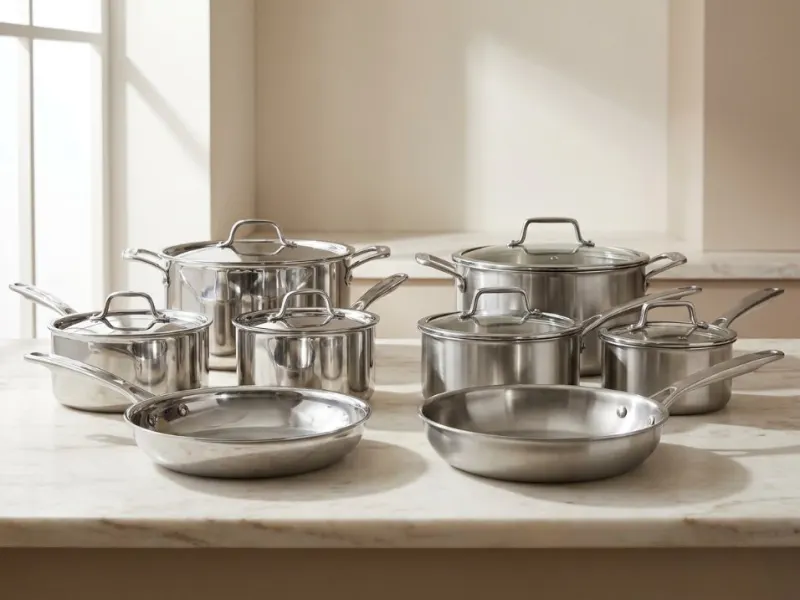
Fully-clad (tri-ply or 5-ply) pans sandwich a conductive core between stainless layers that run from base to rim. Heat distributes evenly across the whole pan, including the sidewalls, and thermal stress spreads out instead of concentrating at a single joint. This is why guides, including this one, recommend it as the default, statistically safer choice, with the honest caveat from the section above.
Disc-bottom pans bond a conductive disc only to the base, leaving the sidewalls as single-layer stainless. The disc-to-sidewall junction is a genuine weak point. It is where two different thicknesses of metal meet and expand at different rates under heat.
That junction is the likeliest place for a warp to start, especially on glass-top and induction cooktops where flat contact matters most. On gas, a slight warp at that junction has less practical effect, because the flame conforms to whatever shape the base actually has.
What a Cheap Replacement Cycle Actually Costs#
Running the numbers through the cookware cost calculator makes the comparison concrete. A non-stick pan on a repeated replacement cycle costs several times more over decades of use than one fully-clad stainless pan bought once and used for that same long stretch. There is no coating layer to wear through, and no fixed replacement clock at all.
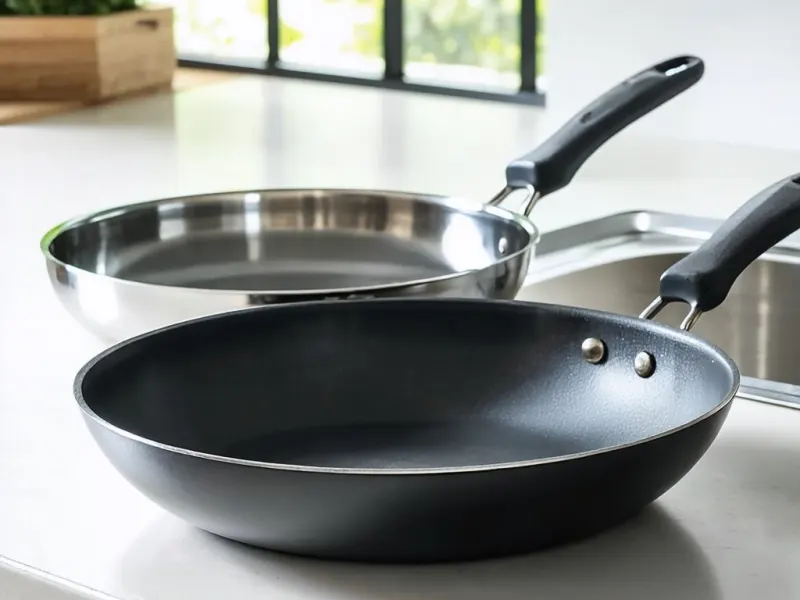
The trade-off is real. Stainless steel needs a genuine preheating habit to release food cleanly, and that learning curve turns some cooks off permanently. If you have already made peace with the technique, the long-run math favors stainless heavily. If eggs and delicate fish are most of what you cook, we would keep a cheap non-stick alongside it and lean on stainless for everything else.
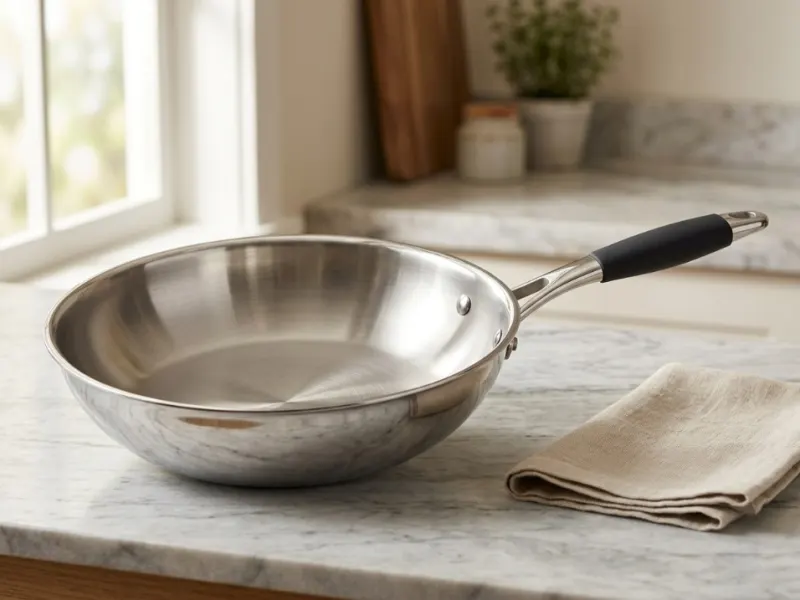
The Duxtop Whole-Clad Tri-Ply 10-Inch Fry Pan gives you the fully-clad construction described above at a budget-tier price. It has an 18/10 stainless interior with the aluminum core running base to rim, a magnetic exterior built for induction that also works on gas, electric, and glass-top, and a double-riveted, stay-cool handle.
Tramontina's Tri-Ply Clad line uses the identical construction principle, aluminum core base to rim, per each brand's own spec pages, and carries that explicit lifetime warranty if a defect does show up early. Either checks the fully-clad boxes this article covers.
If Your Pan Wobbles, Check This First#
Set the pan upside down on a flat counter and look for light passing underneath at any point. If it rocks slightly but the gap under it is barely visible, the warp is minor.
On gas, a warp this small often has no real cooking effect, because the flame still wraps around the base. On glass-top and induction, where flat contact is the whole mechanism, even a small warp shows up as uneven heating and a pan that spins when you stir.
There is no reliable at-home fix for a warped clad pan. A rubber-mallet flattening attempt may look successful at first, but the metal stays structurally compromised and will re-warp. If the wobble is visible and repeatable on a glass-top or induction cooktop, that is the point to stop troubleshooting and start shopping. We would look for fully-clad construction over disc-bottom again, and keep the receipt in case the warranty applies.
For everything short of that, the scratches, the discoloration, and the general wear patterns owners report are cosmetic. The pan underneath is doing exactly what it did on day one.
If you are shopping for a pan that gives you those odds from the start, the Duxtop Whole-Clad Tri-Ply 10-Inch Fry Pan is our pick at the budget-tier price point: real fully-clad construction, a lifetime warranty if a defect does show up, and nothing about the price that cuts corners on the aluminum core.