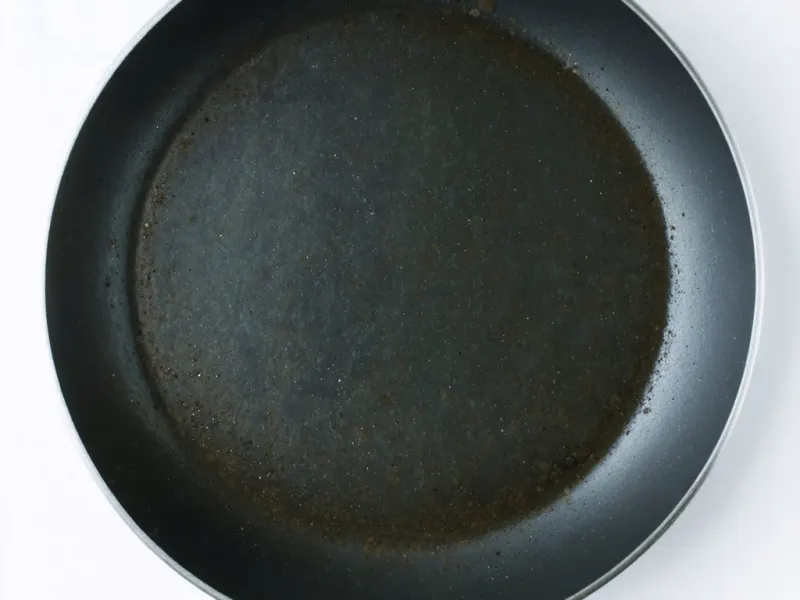
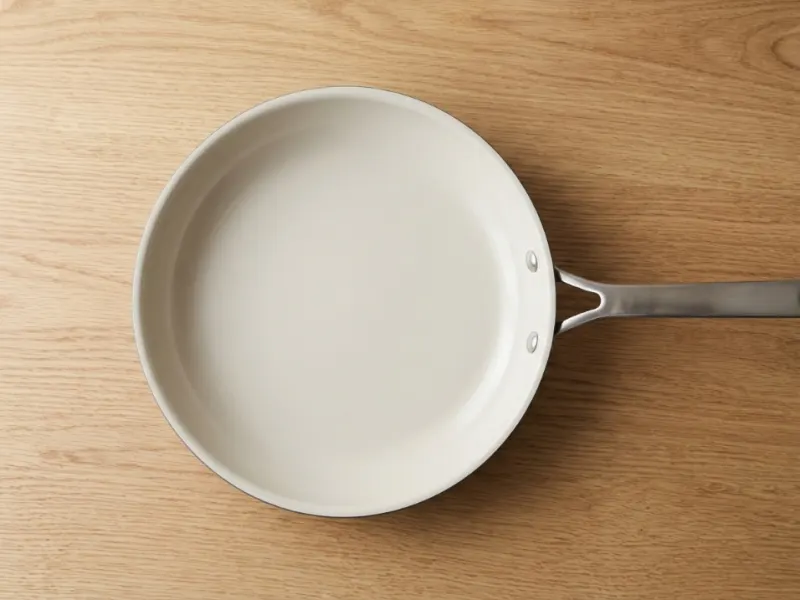
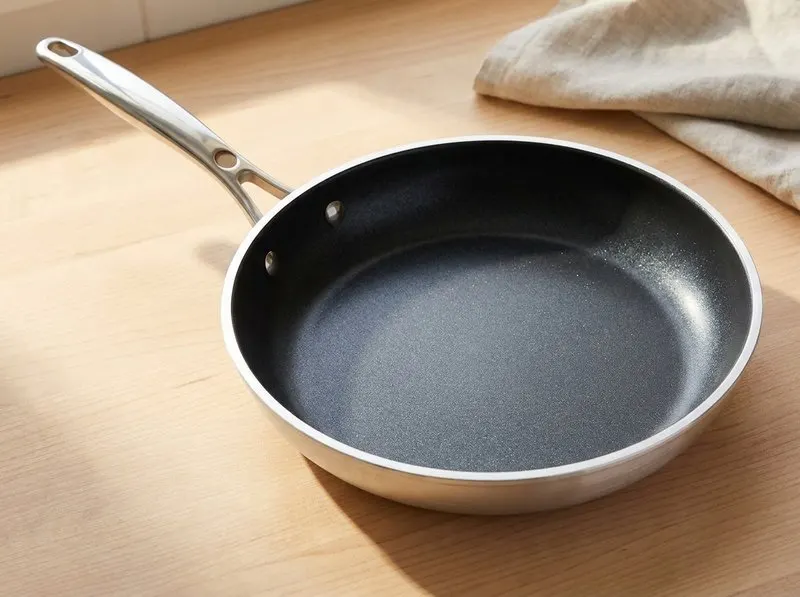
GreenPan's own product pages for its priciest ceramic line promise a coating that "lasts longer." It also calls the coating "the most advanced we've ever made." Owner reviews for that exact pan tell a different story.
Ceramic coating generally holds up for a few months to about a year and a half of normal home cooking before it stops releasing food cleanly, and a bigger price tag does not reliably buy you more time.
Our nonstick cookware buying guide covers how that same pattern holds across ceramic brands generally, not just this one line.
In two brands we checked, the priciest ceramic line in the catalog drew more owner complaints, and earlier ones, than the cheaper line sitting right next to it on the same shelf. That is the part almost nothing else written about ceramic coating tells you. Brand pages hand you a number and move on. We wanted to know whether the number holds up against what owners of the exact pans actually report.
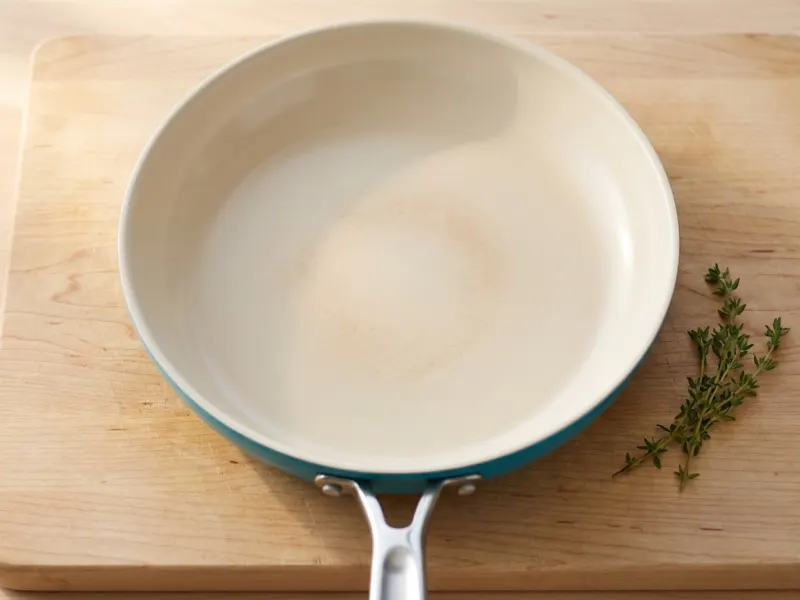
How Long Ceramic Coating Actually Lasts, By The Numbers#
Ceramic, or sol-gel coating, is not glass or stoneware. It is liquid silicon dioxide sprayed onto aluminum and cured into a hard mineral film. That film starts out slippery. It also starts breaking down sooner.
Owner reports we reviewed put ceramic's functional life somewhere between a few months and about a year and a half of regular cooking. PTFE nonstick tends to hold up for a year to four or five years with the same care habits. That gap is the tradeoff you accept for going PFAS-free. No brand's marketing changes the physics behind it.
The Ceramic "Upgrade" That Failed First#
GreenPan's GP5 line, built around its newest Infinite8 coating, is the most expensive ceramic pan in the brand's catalog. GreenPan's own listings describe it as metal-utensil safe. In the brand's own words, this generation of the coating "lasts longer, performs better."
Four independent Amazon owners of the GP5 report the opposite. One GP5 owner's review title reads "nonstick quality lasted for about one month despite following all care instructions." Another GP5 owner wrote, "I wish I had purchased a cheap teflon coated pan even though it might last just a few years."
That is more complaints, and an earlier reported failure point, than GreenPan's own budget Treviso line drew in our research. It also beat the mid-range Valencia Pro to failure.
We are not claiming a lab-verified verdict that premium ceramic loses across the whole category. Owner review counts can reflect sales volume as much as failure rates. What the evidence does support is narrower, and just as useful: GreenPan's specific "lasts longer" claim for its most expensive line does not match what that line's own owners report.
A Second Brand Shows the Same Pattern#
OXO tells a similar story. Its Enhanced and Professional ceramic pans are positioned as the PFAS-free step up from its original PTFE Good Grips Pro line. Dated Amazon reviews from 2022 and 2024 describe sticking that starts within one month to a few months of daily use. It worsens until the pan stops releasing food at all.
That timeline sits well inside the range where ordinary PTFE nonstick, the coating OXO's own upgrade was meant to improve on, is typically still going strong. Switching to a "better" coating did not fix the price-to-lifespan math here. It made it worse.
Why Heat Damages Ceramic Faster Than You'd Expect#
Here is the part that explains why two owners with identical habits can get very different results from the same pan. A peer-reviewed study by Alaboodi, Sivasankaran, and Ammar, published in the Alexandria Engineering Journal via PMC, measured how much extra mechanical wear the exact same abrasion contact causes once a coated pan is hot.
The finding: heating a pan to 250°C before an abrasion test produced 26.02 percent more material loss than the identical test run at room temperature. At 450°C, the gap widened to 81.12 percent more wear, from the exact same contact.
Heat is not just a chemical stressor working quietly in the background. It multiplies how much damage every scratch, every utensil drag, and every stack of pans causes on top of it. That is a bigger lever on your pan's lifespan than the brand name stamped on the handle.
The Habit That Kills Ceramic Coating Fastest#
Aerosol cooking sprays are a common, and easily misdiagnosed, cause of early-looking ceramic failure. The propellant and lecithin in sprays like PAM burn at low heat. They leave a sticky residue right where the rim gets hottest.
That residue looks exactly like a dying coating, and plenty of owners toss a pan over it. Before you give up on a sticking ceramic pan, check whether the stickiness sits at the outer edge while the center still releases food. If so, a baking soda paste left on for up to a day, then wiped off with a non-abrasive sponge, usually restores the release.
Dishwashing does real, separate damage. High heat, alkaline detergent, and water jets erode the ceramic bond in a way a quick hand wash never does. Consumer Reports advises against the dishwasher for any nonstick pan the manufacturer has not explicitly rated for it, since the washing process can wear away the coating.
When to Replace Your Ceramic Pan#
Three signs mean the coating has reached the end of its functional life, whatever the calendar says.
- The egg test fails. Medium heat, a little butter, one egg. If it grips and tears instead of sliding free, the coating is done.
- Food sticks despite proper technique. Medium heat, enough oil, the right utensils. Food still clings to the center. That is degradation, not a habit problem.
- The pan rocks. A warped base means uneven contact and uneven wear from here on.

These signs are about performance, not danger, as long as the surface has no visible pitting or flaking. Ceramic coatings contain no PTFE or PFOA. Ceramic never used PFOA in the first place, and major PTFE manufacturers eliminated PFOA from production entirely by 2015 under the EPA's PFOA Stewardship Program.
Consumer Reports draws its own safety line at visible damage: once a coating is scratched or pitted, it can shed pieces into food, which is the point to stop using any nonstick pan, ceramic included. If you are weighing ceramic against other PFAS-free claims across brands, the PFAS safety checker sorts verified disclosures from bare marketing.
Short of that visible damage, the real cost of an aging ceramic pan is more oil and more scrubbing, not a safety risk.
What We'd Buy Instead#
Price tier has not reliably bought a longer coating life in the pans we checked. That makes the Blue Diamond Enhanced Ceramic Nonstick 12-Inch Fry Pan the more defensible buy. Consumer Reports' own lab abrasion test rated the coating surface very durable, and separately rated food release and cooking evenness excellent. The pan also claims a 600°F oven-safe ceiling, a claim CR flagged as unusual (most nonstick pans in its ratings top out at 500°F) but did not independently test.
Real-world use still caught up with it. CR's own reviewer needed a little extra oil to keep eggs releasing cleanly after four months. The reviewer also picked up a small surface pit despite following the manufacturer's own care instructions.
That is not a knock against this specific pan. It confirms that even a lab-durable, budget-tier ceramic pan lands in the same few-months window as everything else we researched. That is exactly why paying more for "advanced" ceramic has not paid off in the reports we found.
If the replacement cycle itself bothers you, carbon steel is the permanent alternative worth learning to season. Enter the prices of a ceramic nonstick pan and a carbon steel pan in the cookware cost calculator to see if and when the uncoated pan pays for itself within your chosen years.
The Mistake Worth Correcting#
The mistake is not choosing ceramic. It is assuming a bigger price tag, or a "reinforced" marketing claim, buys you a coating that survives longer. In the brands we checked, it did not, and the plain Blue Diamond pan above still delivered real Consumer Reports lab results without the premium price.
Budget for replacement on a ceramic pan the same way you budget for a new sponge. Let the marketing copy on the box carry less weight than it currently does.