Same premium price bracket. Same lifetime warranty language. One pan has a coating that can fail. The other has nothing to fail at all.
Multiple independent owner reports describe HexClad's hybrid surface sticking on dry, low-fat food, the exact job nonstick pans exist for, even when owners follow the manufacturer's instructions.
If you'd rather skip the hybrid gamble, our stainless steel cookware guide covers plain fully-clad construction, technique, and induction compatibility.
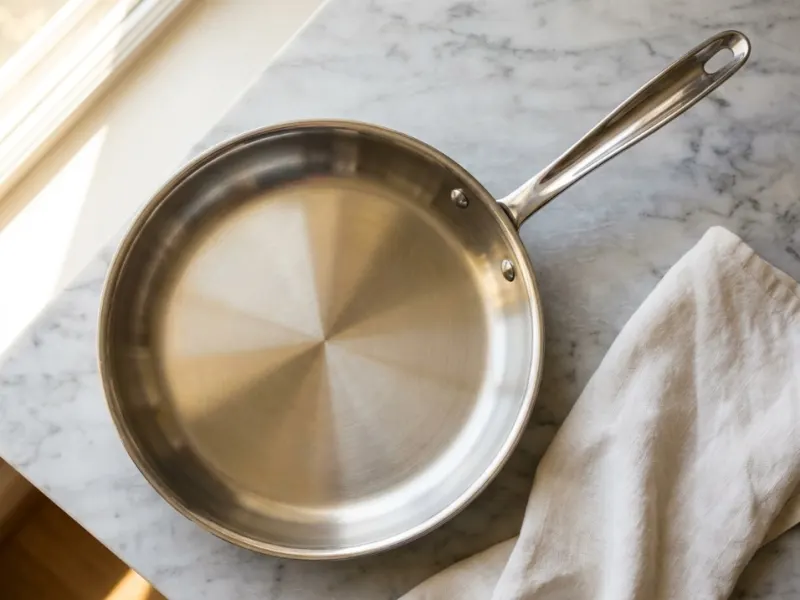
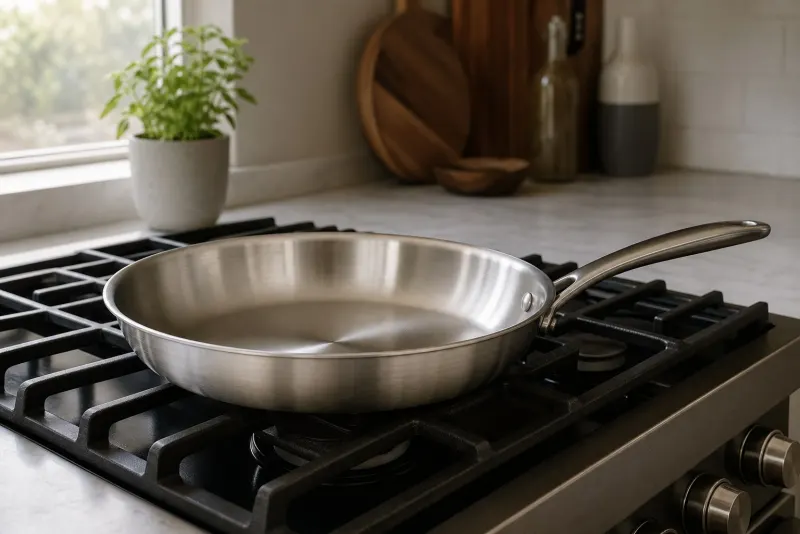
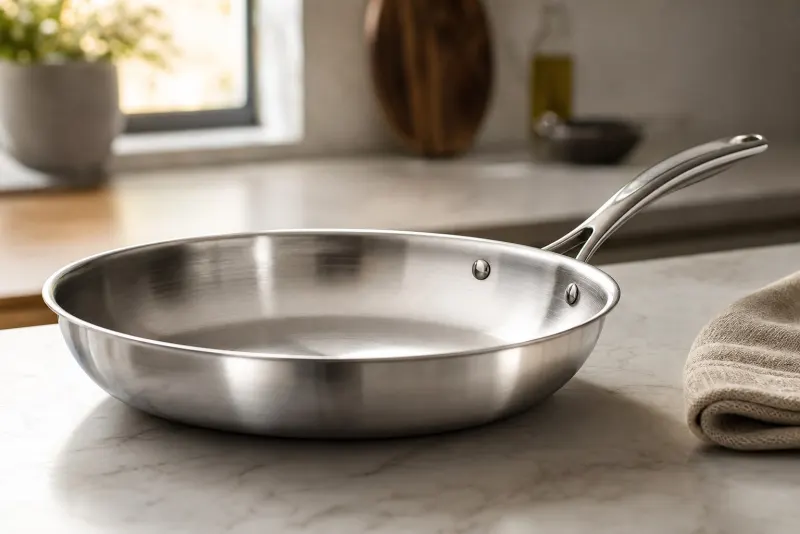
All-Clad D5 never claims to be nonstick. Its five-ply stainless surface has nothing to underdeliver on. It asks for technique instead of a coating, and that coating never wears out, because there isn't one.
HexClad markets itself as the last pan you will ever need to buy: one hybrid surface that sears like stainless and releases like nonstick. We went looking for the specific evidence behind that promise. Owner reviews, a long-term video review, and HexClad's own FAQ, rather than another feature-by-feature rundown of construction and price.
What HexClad's Hexagon Surface Is Actually Doing#
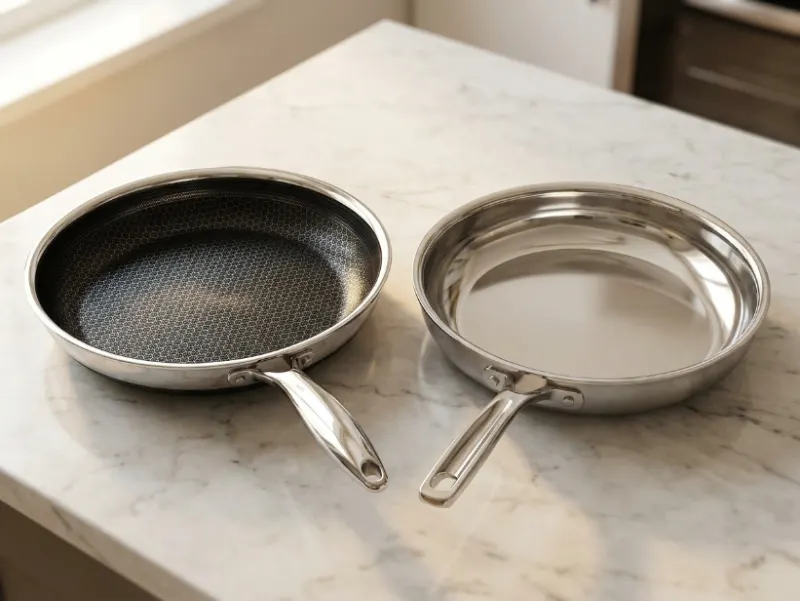
HexClad's cooking surface is a tri-ply build. A magnetic stainless exterior, an aluminum core for heat distribution, and a hybrid interior of laser-etched steel hexagons with nonstick-coated valleys between them. The raised peaks keep a spatula riding on bare steel, never touching the coating underneath.

That geometry is a real design idea. It is also why HexClad's own FAQ can say metal utensils are fine to use. "Metal spatulas, whisks, spoons, and other metal utensils are fine," the brand states.
All-Clad's stainless makes the same claim true for a simpler reason: there is no coating to protect in the first place.
Where the hybrid design gets tested is dry release, food cooked with little or no added fat. HexClad calls itself nonstick. Four independent Amazon reviewers of the same pan disagree.
One buyer fried an egg straight out of the box with no oil: "It stuck, and the yolk broke." Another owner followed the manual exactly, washed and dried the pan as instructed. Their review title says it best: "Turns eggs into epoxy."
Two more reviewers report the same pattern no matter how much oil they used. A corroborated 2022 r/cookware thread tells the same story.
The One Long-Term Review That Shows Both Sides#
One long-term owner filmed his HexClad after a full year of daily cooking. The coating had started peeling around the edges. He suspected his own occasional dishwasher use, despite HexClad's own FAQ recommending hand washing to avoid dulling the finish.
He emailed photos to HexClad. He had a replacement within about a week, with zero friction.
On the replacement pan, he tried the classic nonstick test: an egg, with a little bit of oil. It released cleanly on the flip. That result does not contradict the Amazon pattern above. Those reviewers describe zero oil, or "no matter how much oil."
It lines up with a narrower, more honest read of the hybrid surface: it performs with fat in the pan, and its performance without fat is inconsistent enough that a real share of buyers hit the failure mode HexClad's marketing implies should not happen.
The same reviewer also admitted he never uses metal utensils on the pans, even though HexClad's FAQ says they are fine. For cookware costing this much, caution outlasts the marketing claim. At least for one long-time owner.
All-Clad D5: Nothing to Fail, Because Nothing Is Coated#
All-Clad's D5 line commits to the opposite bet. No coating, no versatility claim, five alternating layers of stainless and aluminum bonded from base to rim. Its own care page states D5 is oven and broiler safe to 600°F, a lower ceiling than HexClad's rated 900°F. The difference rarely matters outside a broiler finish, and if you are not sure what your own cookware can handle, the oven-safe temperature lookup covers most major lines.
The tradeoff for skipping a coating is technique. A stainless pan releases food when you preheat it properly, watch water bead and roll across the surface, then add oil until it shimmers before the food goes in. Owners who skip that step get sticking.
Owners who learn it get a pan sauce base that no coated surface can produce. That is not a hidden cost. It is the entire reason bare stainless still exists next to nonstick and hybrid options.
What stainless does not do is degrade. Owners posting long-term updates on r/BuyItForLife and in Amazon reviews commonly report fully-clad stainless pans still performing after decades of normal care, because there is no applied surface to wear through. All-Clad's own build carries a lifetime warranty too. But there is functionally nothing on the cooking surface for that warranty to ever need to cover.
What Actually Changes What You Cook#
The table above lists four differences. Only one of them changes what ends up on your plate: dry-food release. Construction, coating risk, and oven ceiling matter to a spec sheet. They do not change whether your eggs stick tomorrow morning.
That is the trap in HexClad's own pitch. The tri-ply vs five-ply construction question sounds like the deciding factor. It isn't. The deciding factor is whether you cook dry often enough to hit the failure mode the Amazon reviewers describe.
HexClad is not the exception to the rule that most kitchens still need a dedicated nonstick pan for eggs, alongside a stainless pan for everything else. It is a strong stainless-adjacent pan with a consumable coating layered on top, at a price close to a coating-free stainless pan with nothing to ever replace.
Which One Belongs in Your Kitchen#
Buy All-Clad D5 if you want a pan with no expiration date, are willing to learn the water-and-oil technique, and already own or plan to buy a separate nonstick pan for eggs. Pair it with any budget tri-ply pan for a second burner and you get the same fully-clad performance without paying twice for the premium name. We cover that tradeoff in our All-Clad vs Tramontina comparison.
Buy the HexClad 12-Inch Hybrid if you genuinely cannot store two pans, you cook mostly with butter or oil already, and you accept HexClad's warranty process as routine maintenance rather than a failure. Go in knowing the dry-release promise does not hold for every buyer. Keep a backup plan for eggs if yours turns out to be one of the pans that sticks.
HexClad's own pricing sits close enough to genuine five-ply stainless that the argument that it is cheaper than buying two separate pans mostly evaporates. We found the same pattern across several overpriced cookware brands.
Still not sure which construction fits your cooking habits? The material selector quiz sorts it out in under a minute.
HexClad's mistake is not the hexagon design. It is asking one coating to do two pans' worth of work, and expecting nobody to check whether the coating actually holds up its end.
That same unchecked-claim pattern shows up past cooking performance too. According to a court-approved settlement, HexClad is now barred from calling its older PTFE-coated Hybrid pans non-toxic or free of the PFAS family the EPA tracks, the exact wording the brand used to market them. Our Is HexClad non-toxic? breakdown covers which purchase dates and coating generations that settlement actually reaches.