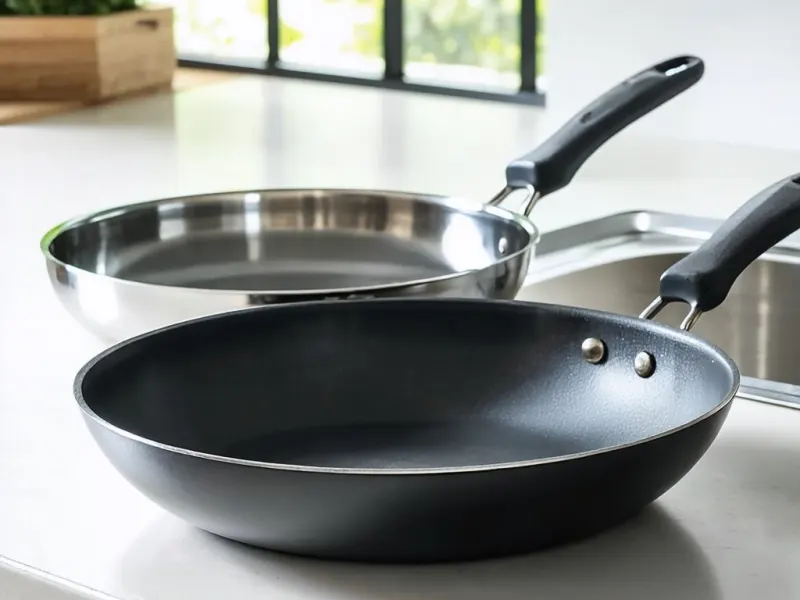
The hard anodized pan in your cart looks like the easy win. Nothing sticks. Cleanup takes thirty seconds.
The stainless pan sitting next to it on the shelf asks for patience you don't have yet: a proper preheat, a water test, food that welds to the surface the first few times you get it wrong.
One of these two pans has a part built to wear out. The other one doesn't have that part at all.
Our stainless steel cookware guide covers the rest of what decides a stainless purchase: construction quality, induction contact, and technique.
Hard anodized cookware's PTFE coating has a real lifespan. Owner reports put that lifespan anywhere from about a year to 4 or 5 years, depending on how you cook and clean it.
A fully-clad stainless pan has no coating at all. There's nothing on it to wear out, no matter how you treat it.
That's the real question this comparison answers. Not "which pan is easier to cook with today," but "which one still has all its original parts in five years." We went looking at what actually determines that, not just which pan looks easier to live with on day one.
What "Hard Anodized" and "Stainless Steel" Actually Describe#
Hard anodized describes the pan body: aluminum that's been electrochemically hardened, then coated on top with PTFE nonstick. The coating gives you effortless food release.
It's also the part with a shelf life. We covered the safety side of hard anodized cookware in a separate piece. The short version: both materials pass as safe for normal home cooking.
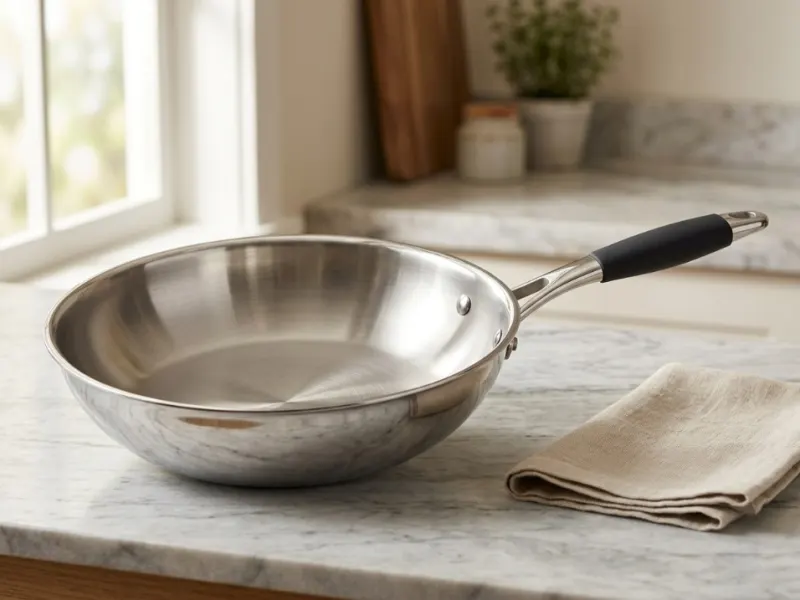
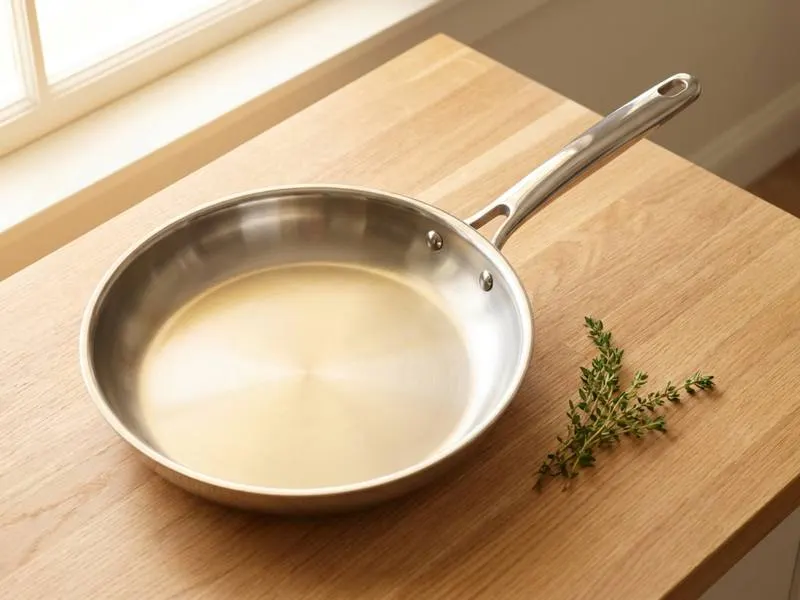
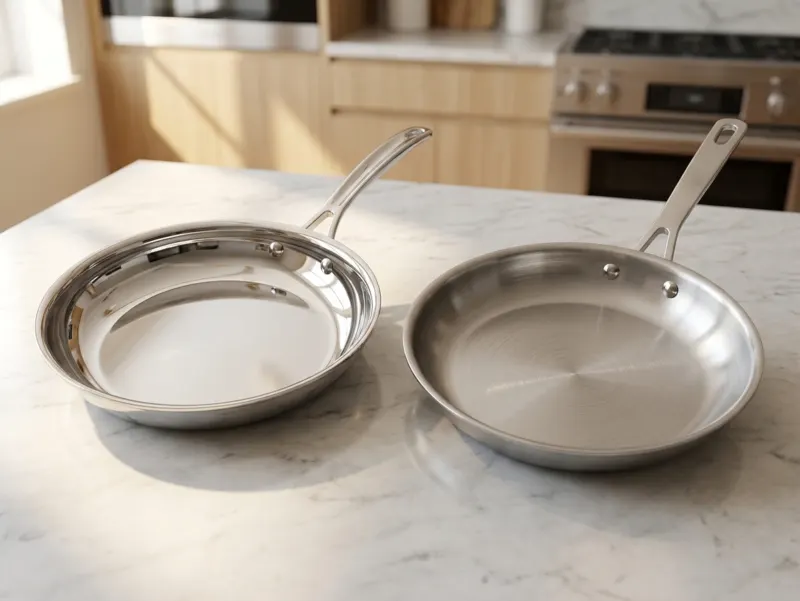
Stainless steel is chromium, nickel, and iron, almost always with an aluminum core for heat distribution in a decent pan. There's no coating on the cooking surface, just the metal itself.
Nothing wears through. If food keeps sticking to your stainless pan, that's a technique problem, not a material flaw. It fixes itself after a few meals of doing the preheat right.
The Coating's Lifespan Is a Range, Not a Date#
Here's what most comparisons get wrong. They quote one number for how long a nonstick coating lasts, as if every kitchen wears a pan down at the same rate. It doesn't work that way.
What actually pushes a pan toward one end or the other comes down to a handful of habits: how often you cook with it, how hot you run the burner, whether metal utensils touch the surface, and whether it goes in the dishwasher instead of the sink.
Medium heat and hand washing are what get an owner to the long end of that range. High heat and a dishwasher habit are what get one to the short end, often without the owner realizing which factor did it.
Either way, the coating eventually needs replacing. The pan body itself may still be structurally fine; the nonstick surface sitting on top of it will not be.
The stainless side of this has no equivalent cycle to plug into. A fully-clad tri-ply pan has no applied coating at all, so there's no surface on it that can wear out the way PTFE does. Running one through the dishwasher for years or scrubbing it with steel wool doesn't put it on the same countdown, because that countdown only exists where a coating exists to start it.
If you want to see what a replacement cycle like this looks like in your own kitchen's numbers, the cookware cost calculator is built for exactly that.
Where Each Pan Actually Wins#
This isn't a case where one material wins outright. When we sorted owner complaints and praise by what people were actually cooking, what you cook most decided it far more than which pan they owned.
Hard anodized wins for eggs, delicate fish like sole or cod, crepes, and anything reheated from the fridge, anywhere food release matters more than a hard sear. We went deeper on how hard anodized relates to nonstick generally if you want the full breakdown of that pairing.
Stainless wins for searing chicken thighs or pork chops, browning for a pan sauce, and cooking anything acidic like tomato sauce or a wine reduction. The browned bits that stick to a stainless pan after a good sear are called fond.

Fond is what turns into a five-minute pan sauce. PTFE blocks that reaction entirely, because nothing is supposed to stick to it in the first place.
Four Things You Can Actually Check Before Buying#
Skip the marketing copy. Check these four things directly on the listing or the pan itself:
- Is there an applied coating on the cooking surface, or is it bare metal? Bare metal cannot degrade the way a coating can.
- Does the care label say hand wash only? That single phrase, printed on the box or the manufacturer's own care page, is the tell. Read it before you buy, not after the dishwasher already ran a cycle.
- Does a magnet grip the base firmly? That's the real induction compatible test, more reliable than a label on either material.
- Can it develop fond? If the answer is no, you're holding a nonstick pan no matter what the body is made of.
The Stainless Learning Curve Is Short#
The honest tradeoff: stainless punishes a cold pan immediately, and hard anodized forgives everything because the coating does the food-release work for you. The fix is mechanical, not mysterious.
Preheat the empty pan on medium until a few drops of water skate across the surface in a single bead instead of scattering, then add oil.
Leave the food alone until a crust forms and the food releases on its own before you try to move it. A few meals of doing that on purpose, and it stops being a conscious step.
What We'd Buy Today#
For the pan you'll use most, the Cooks Standard Multi-Ply Clad 12-Inch removes one entire failure mode: full tri-ply construction, induction-ready by default, oven safe to 500°F, and no applied coating that can degrade the way PTFE does. If you want to know exactly what is in a given coating, the PFAS safety checker gives a sourced verdict by brand and line.
That doesn't mean every possible failure mode disappears with it. One owner reported the pan warping after more than a year of regular use, alongside a handle-design complaint. It's the only failure report we found on file for this specific pan, a single account rather than a documented pattern, and we don't have construction-science evidence to say how common that is or why it happened.
That durability argument only applies if you're using hard anodized as your do-everything pan. If eggs and delicate fish make up a real share of your cooking, the Calphalon Hard-Anodized 12-Inch still earns its place.
It's a genuinely good tool for that specific job. A coating replacement somewhere down the line is a planned part of owning it, not a hidden flaw.
Most kitchens end up running both: a smaller hard anodized pan for eggs, a 12-inch stainless workhorse for everything else. One of those two pans sits on a coating-replacement cycle. The other was never built with a coating to put it on that cycle in the first place.