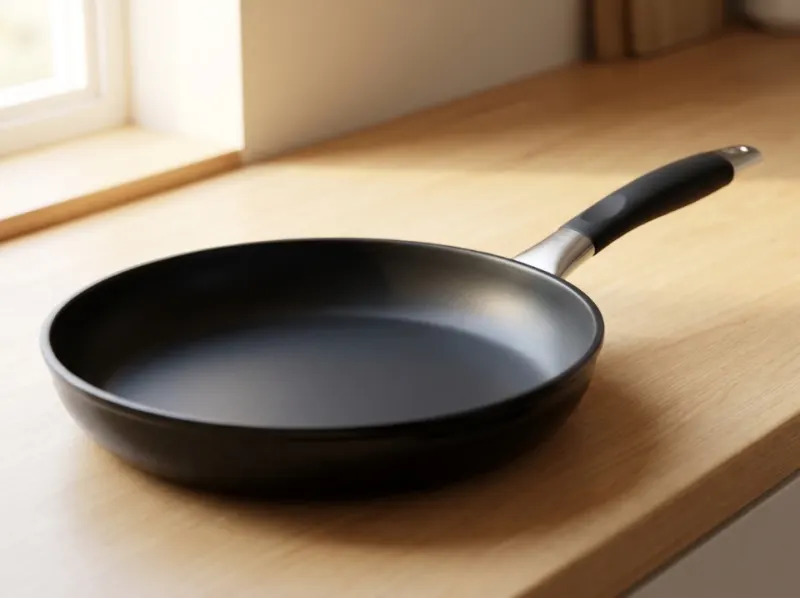
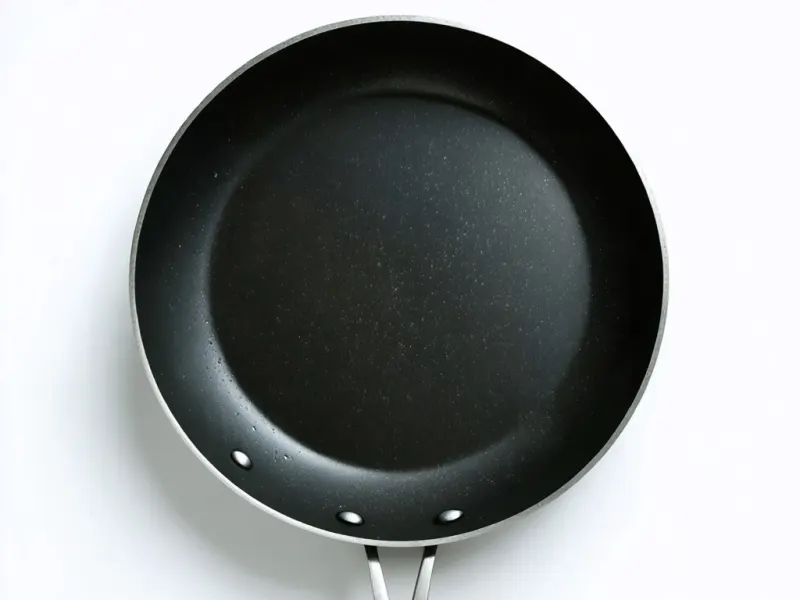
Same brand. Same hard anodized aluminum body. Same PTFE nonstick coating.
One pan works on an induction cooktop. The other won't turn on at all.
Whether a hard anodized nonstick pan works on induction has nothing to do with the words "hard anodized" or "nonstick." Both describe a different, separate spec: the body material and the cooking surface. Induction compatibility depends on a third spec that most listings bury or skip. You can check it yourself in under ten seconds with a refrigerator magnet.
Our nonstick cookware buying guide covers the rest of the buying decision once body material and coating are sorted out.
Two pans built the same way in every sense that matters to your recipes can land on opposite sides of that line. Neither label will warn you.
What "Hard Anodized" and "Nonstick" Actually Describe#
Hard anodized describes the pan body. Aluminum goes through an electrochemical bath that hardens the surface into a dense oxide layer. The result is a body that's far more resistant to warping than the stamped aluminum used in budget pans.
Nonstick describes the cooking surface on top. It's almost always PTFE, the same slick polymer used across every price tier, rated safe for cooking up to 500°F regardless of what body sits underneath it.
Nearly every hard anodized pan sold today has a PTFE coating over it. That's why "hard anodized vs nonstick" trips people up. You're rarely choosing between the two. You're choosing whether to pay more for a tougher body under an identical coating.
The coating doesn't care how much you paid for the body underneath it. A hard anodized pan and a budget stamped aluminum pan use the same PTFE chemistry, and that chemistry wears out on the same general 2 to 4 year schedule either way. The hard anodized body can keep going long after that coating gives out. That doesn't stop the coating from being the part that decides when you actually replace the pan.
The Spec Neither Label Tells You#
Here's the question that actually trips people up, and it has nothing to do with anodizing or nonstick chemistry: will this specific pan work on an induction cooktop?
Aluminum isn't magnetic. Induction cooktops heat a pan by inducing current directly in the metal. That only works if the base contains enough iron to grip a magnet.
A hard anodized body, on its own, does nothing on an induction burner. Manufacturers who want their anodized cookware to work on induction have to bond or embed a magnetic base layer into the pan first, and plenty of them skip it.

Anolon's own lineup makes the point better than any explanation could. A retailer listing for the standard Anolon Advanced hard anodized set states flatly that the line is not induction ready.
Anolon's SmartStack line is built from the same hard anodized aluminum with the same PTFE-family coating. It's different on this one spec: Anolon's own product disclosure page names this exact pan an "Induction Frying Pan." Same brand, same body material, same coating family. Opposite answer on the one spec that decides whether it works on your stove.
Passing that test isn't the end of the story either. Independent multi-brand induction testing found that a hard anodized nonstick pan built with a bonded induction plate can still perform badly, even after it technically qualifies.
One tested pan warped under the rapid heat cycling, buzzed throughout cooking, and occasionally lost contact with the burner mid-sear. Induction compatible answers whether a pan will turn on. It says nothing about how well it cooks once it does.
That question sent us straight to the manufacturers' own spec sheets, since neither "hard anodized" nor "nonstick" answers it. What we found was more contradictory than expected: two pans built by the same brand, out of the same body material, with the same coating, landing on opposite sides of the induction question depending on the exact SKU. It's also one of the most common questions we hear from readers whose rental or new build came with an induction range already installed. Our induction ready cookware guide covers warping risk, coil-size mismatches, and which constructions hold up, in full.
The Magnet Test#
Skip the guessing. Hold a standard kitchen magnet against the cold base of the pan. Drag it from the rim to the center.
A firm, consistent grip the whole way across means the pan is induction compatible, whatever the box says about anodizing or nonstick. A weak pull, a grip only at the edge, or no pull at all means it isn't. That holds no matter how premium the body feels in your hand.
That single test outperforms every marketing claim on the box. It measures the actual physical property that determines whether the cooktop can heat the pan at all. A printed induction symbol is a nice confirmation when it's there. Plenty of older pans that work fine were never stamped with one, so its absence tells you nothing.
Where the Hard Anodized Premium Actually Pays Off#
If induction isn't part of your kitchen, the math is simpler, and it comes down to the body, not the coating. A hard anodized pan resists the warping that eventually ruins a thin stamped aluminum pan. That matters most with repeated fast temperature swings, like cold water hitting a hot pan straight off the stove.
That resistance also protects the coating indirectly. A flat pan heats evenly. A warped one develops hot spots that wear PTFE out early, right where the metal lifts away from the burner.
None of that changes how long the nonstick surface itself survives. It's still a 2 to 4 year coating no matter what's underneath it. What changes is whether you're replacing a pan that still looks and sits like new, or one that's also dented, bowed, and rattling by the time the coating finally gives out. Whether that trade is worth the extra cost for your own cooking habits is a separate question from the induction spec covered here; we break down exactly who benefits from the upgrade based on cooking frequency and heat level.
The SmartStack Trade-Off#

The Anolon SmartStack 12-inch frying pan is a useful example of what a hard anodized nonstick pan looks like when induction compatibility is actually engineered in, rather than assumed. It's the same hard anodized aluminum and PTFE-family coating as the rest of the category. Anolon specifically discloses and markets it as induction ready.
Its patented interlocking handle lets it nest with the rest of the SmartStack line, and Anolon markets that stacking design as saving roughly 62% more storage space than storing the pans unstacked, which matters if cabinet space is already tight. We track which of these are genuinely PFAS-free in our cookware safety checker, with the evidence behind each verdict.
The nesting design isn't free of trade-offs. One owner's review flagged that the matching SmartStack saucepan lid doesn't seal cleanly against this pan's sloped, nesting-optimized sidewall. That's a fit issue specific to the stacking geometry, not a knock against the pan on its own.
The Verdict#
If there's any chance you'll cook on induction, now or after your next move, buy based on the magnet test and the manufacturer's own induction spec for that exact SKU. Never the "hard anodized" or "nonstick" wording on the box. Our induction compatibility checker tells you whether a pan has a truly magnetic base or just a thin disc.
The Anolon SmartStack is the safer buy of the two specifically because Anolon states the induction spec outright on its own product page, instead of leaving buyers to guess or run the magnet test themselves.
If induction genuinely isn't in your future, skip the induction question entirely. Choose based on weight, handle feel, and how much warp resistance you actually need for your cooking habits.
Either way, budget for the coating to need replacing well before the body does. That's true of every hard anodized nonstick pan on the market, not just this one.