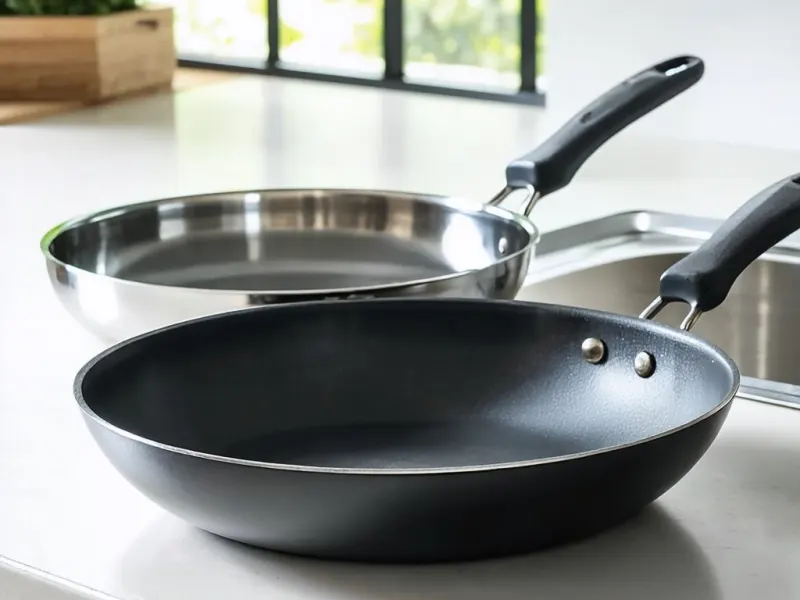
You've probably heard that spending more on a hard anodized pan buys a nonstick coating that lasts longer. It doesn't.
A hard anodized nonstick frying pan is worth buying if you cook at medium-high heat several times a week, or you work on a glass-top stove. The thicker anodized body resists warping and spreads heat evenly. It is not worth paying a premium brand price for. The coating on top is standard PTFE, and PTFE wears out on the same rough timeline no matter which brand's name is on the handle.
Our nonstick cookware buying guide breaks down the same hard-anodized-body-versus-coating distinction across the whole category.
So where does the extra money actually go? And which pan should you buy instead?
Who Actually Needs a Hard Anodized Nonstick Frying Pan#
The body of a hard anodized pan is aluminum that has been electrochemically hardened. That process converts the surface into a dense aluminum oxide layer instead of leaving raw, soft metal underneath the coating. The result resists warping under high heat and holds flatter contact with the burner than thin stamped aluminum manages.
That difference matters in specific situations, not universally. Say you cook eggs and light sautés once or twice a week on a gas burner. A standard stamped nonstick pan performs identically for as long as its coating lasts, and it costs less to replace.
If you cook daily at medium-high heat, sear meat, or work on a glass-top electric stove where flat contact is essential, the sturdier body earns its place. It resists the warping a thin pan develops over time, and even heat means fewer scorched spots while you cook, especially near the edges.
We dug through owner reports across both budget and premium hard anodized lines to see whether price actually changes any of this. It doesn't move the warp-resistance question either. A heavier gauge body performs the same job at nearly every price point once you're past the flimsiest stamped pans.
The Coating Doesn't Know What You Paid For It#
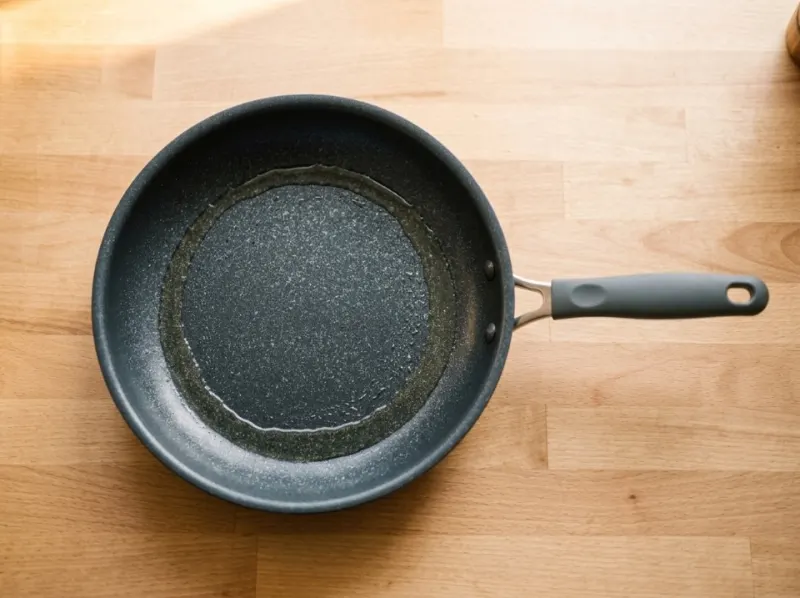
Here's the part the marketing conveniently skips. A hard anodized pan and a plain stamped-aluminum nonstick pan usually wear the exact same PTFE coating. That coating can sit on a premium brand's thick anodized body or a budget line's thinner aluminum. Either way, it degrades the same way, through repeated heat cycling plus mechanical wear on the same polymer.
A peer-reviewed study on PTFE and ceramic pans found that heat itself accelerates coating wear before a single scratch even happens. The researchers used a rotary abrasion machine that simulates the same contact a metal utensil or scouring pad makes. Identical mechanical contact produced 26.02% more material loss at 250°C than at room temperature, and 81.12% more at 450°C. That's a real mechanism, not folklore about "babying" your cookware.
Because the underlying chemistry is identical, coatings on both budget and premium hard anodized pans fall into the same wear-and-care window. Some start failing within about a year of hard daily use. Others hold up for four to five years with gentler care, careful utensils, and hand washing. That window comes from the coating, not the price tag.
That's why an OXO Good Grips Pro hard anodized pan and a premium All-Clad HA1 land in the same coating conversation. Both run plain PTFE, and there's no sourced reason to expect either one to outlast the other, since the coating chemistry doing the work is identical. You can look up any brand's PFAS status in our cookware safety checker to see exactly what coating a given pan uses.
If you're chasing a coating that survives longer, a lower-priced hard anodized pan does the same job as a pricier one. Checking how long nonstick pans last at any tier tells you what to actually expect before you buy.
What You Get for Paying More#
Premium pricing inside this category buys specific, checkable features, not a vague promise of quality. All-Clad's HA1 line reinforces its anodized body with a stainless steel base. That base is also why the HA1 runs on induction cooktops without needing a separate part, and why All-Clad rates the HA1 oven-safe to 500°F. That's a genuinely useful difference if your stove is induction.
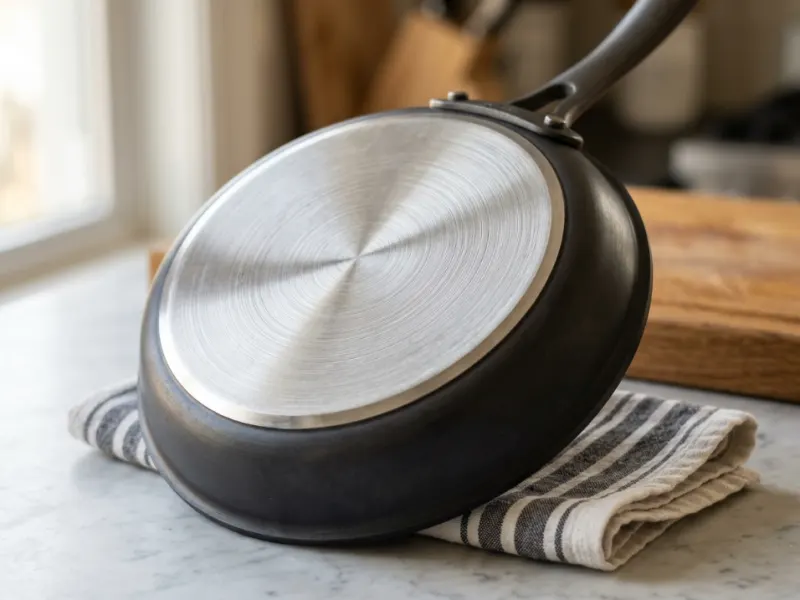
Budget and mid-tier hard anodized lines frequently skip that steel layer entirely. Two pans from the same brand, carrying nearly identical names, can differ on this exact point. One lists 430°F oven safety with no induction claim. The other explicitly says "induction suitable." Confirming induction compatibility before you buy avoids an expensive surprise the first time you try a new stove.
Beyond induction, the rest of what premium pricing buys is handle feel, fit and finish, and brand reputation. None of that changes how long the coating survives. Spend on those things if they matter to you personally, but not because you're expecting a longer-lasting nonstick surface in return.
Getting the Most Life Out of Either One#
We found a few habits that extend coating life regardless of what the pan cost, and they matter more than the brand name.

Cook at medium heat rather than high whenever the recipe allows it. The wear-testing study mentioned earlier showed heat doesn't just damage a coating on its own. It also multiplies ordinary mechanical wear, so a hot pan takes more damage from the same spoon scrape than a cooler one does under identical contact.
Hand wash with a soft sponge instead of running the pan through a dishwasher. Reach for wood or silicone utensils over metal ones, especially for flipping and stirring. None of this is brand-specific advice.
It's the same physics whether the pan in your cabinet cost a little or a lot, and that physics does more for coating lifespan than which logo sits on the handle.
If your cooking habits or your stovetop call for a hard anodized body, buy one that fits your budget and covers the features you actually need. Include induction compatibility on that checklist if it applies to your kitchen.
If your kitchen doesn't need built-in induction, an OXO Good Grips Pro covers the same warp-resistant, even-heating body for less. The name on the handle isn't a sourced reason to expect a coating that outlasts a cheaper one. Paying for the right features is.