Hundreds of five-star GreenPan reviews posted within the first week. Then the updates start rolling in at the four-month mark.
We dug through owner reports across four GreenPan product lines and found an inverted pattern: the most expensive GreenPan (GP5) has owners reporting coating failure in as little as one month, while cheaper lines report anywhere from a few months to about a year and a half. Paying more buys a better pan body, not a longer-lasting coating. The Valencia Pro 12-inch is where we land for anyone committed to PFAS-free cooking and realistic about the tradeoff.
Our nonstick cookware buying guide covers why that pattern holds across ceramic brands generally, not just GreenPan.
That tradeoff is real, and no GreenPan marketing page will frame it this bluntly. Both coatings are safe in normal home cooking, and the "ceramic is safer" narrative markets around a problem (PFOA) that manufacturing solved industry-wide by 2015. The real difference is lifespan and performance: the ceramic coating wears out faster than the PTFE it replaces. This article sorts the two truths apart.
The PFAS-Free Claim Is Legitimate#
GreenPan says Thermolon is made from silicon dioxide (sand), sprayed onto metal without PFAS or PFOA.
The timing matters. GreenPan switched before anyone was forced to. GreenPan spells out what Thermolon is made of, making the PFAS-free claim real rather than a bare label.
The practical significance goes beyond chemistry. PTFE begins releasing fumes at 500°F, though human symptoms generally do not start until 662°F. Normal cooking never reaches those temperatures, but an empty pan on a hot burner can.
Ceramic coatings contain no PTFE, so they produce no polymer fumes. This matters most for households with pet birds. PTFE fumes are a documented hazard to birds, which are far more sensitive to them than humans. Ceramic sidesteps that specific fume mechanism.
We want to be clear: the PFAS concern in modern PTFE cookware is narrow. PFOA was eliminated from manufacturing by 2015 under the EPA's Stewardship Program. PTFE itself is chemically inert, and it is FDA-authorized for food-contact use under 21 CFR 177.1550.
The marketing that calls ceramic "safer" exploits a problem solved years ago. But if you want zero fluorinated compounds on principle, GreenPan delivers.
What GreenPan Reviews Say About Durability#
Here is where the reviews turn honest, and where most competitor coverage stops at generalities. We pulled dated reports across four GreenPan product lines to see whether price tier predicts coating life.

GP5 (most expensive, Infinite8 coating): One owner reports nonstick quality lasting "about one month despite following all care instructions." Another states outright, "I wish I had purchased a cheap teflon coated pan even though it might last just a few years." Four independent GP5 reviews document premature failure in the coating GreenPan markets as its most advanced.
Valencia Pro (mid-range, Thermolon Advanced): Owners of the 12-inch skillet report "Lasted Less Than 5 Months" and "It only last for 4 months." These are the same Valencia Pro pans frequently recommended as the best in GreenPan's lineup.
Budget and mid-range lines (Treviso, Chatham): A Treviso set owner reports "6 month life span." Another GreenPan owner reports the 10-inch pan lasting about 6 months. A separate owner using dishwasher reports about 16 months from an unidentified GreenPan model.
The pattern is clear. Coating life runs from one month to about a year and a half across all lines. Price does not predict how long the coating lasts, as we break down in how long ceramic coating actually lasts.
The GP5's Infinite8, sold as the most advanced coating GreenPan has ever made, shows the worst owner outcomes at the highest price.
Why the Premium Paradox Exists#
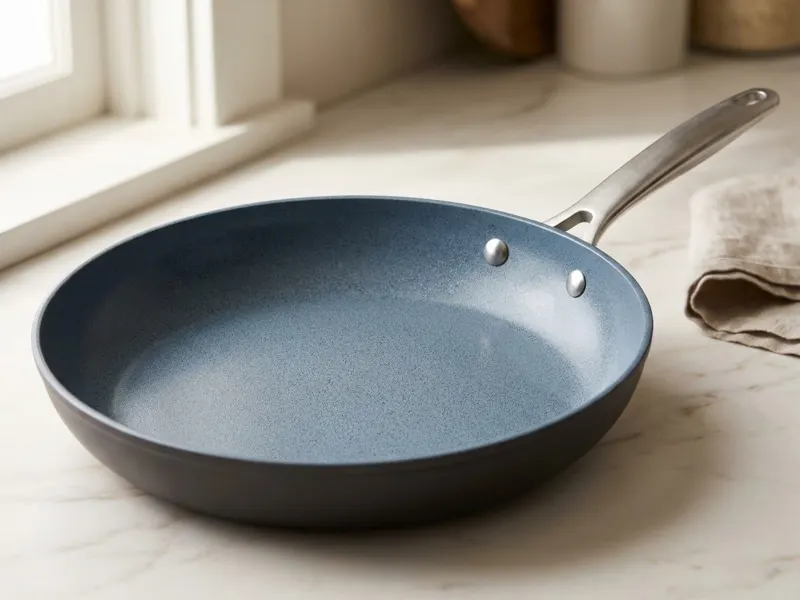
The GreenPan pricing ladder makes sense for the pan body. The Valencia Pro uses hard anodized aluminum that resists warping and conducts heat evenly. Budget lines use standard aluminum, thinner and more prone to warping under thermal cycling.
GP5 adds heavier fully-clad construction. Every step up gets you better metalwork.
But the coating is not the metalwork. Ceramic sol-gel degrades through thermal cycling. Every heat-cool cycle expands and contracts the coating, opening tiny pores in the surface.
This is baked into the chemistry. A thicker pan body and fancy handles do nothing to slow the coating down.
Why GP5 owners report worse outcomes than cheaper lines is not explained by any disclosed difference between Infinite8 and Thermolon Advanced. The owner reports point to a pattern rather than a proven defect. We treat them as dated firsthand direction, not as a mechanism we can explain.
The warranty tells you this. One owner warned others not to trust the coating warranty after watching the surface decline within a year and a half. It promises a lifespan the coating's physics cannot deliver.
Who Should Buy GreenPan (And Who Should Not)#
GreenPan also sells a budget-tier sister line, GreenLife, made by the same parent company at a lower construction tier.
Buy the Valencia Pro if you want zero PFAS in your kitchen and accept replacing the pan within months to about a year and a half. The hard anodized body is solid, induction ready, and oven safe to 600°F with stainless steel handles. You get a good frame with a coating you will throw away.
Buy a mid-range PTFE pan instead if your primary concern is the longest nonstick life per dollar. T-fal owners report 4 to 5 years of effective release. Tramontina owners report around 2 years.
Both cost a fraction of GreenPan at the same size.
The GP5 is hard to justify. It is GreenPan's most expensive line, yet owners report it failing as fast or faster than cheaper GreenPan lines. Several GP5 reviewers say cheaper PTFE pans outlasted it.
The Infinite8 coating marketing does not match the owner experience. Your money buys better metal with worse coating outcomes.
The Honest Verdict#
The GreenPan Valencia Pro 12-inch is what we recommend if you have decided PFAS-free matters more than longevity. Owners report 4 to 5 months of strong release before the surface starts to go.
That is not a long time. Know it going in. Budget for replacement.
The pan body outlasts the coating by years, but you cannot re-coat it. When the nonstick goes, the pan goes.
You can check any pan's PFAS-free status in our database, or compare repeated ceramic pan purchases with one uncoated pan at your own prices in the cost calculator. Our ceramic vs Teflon comparison covers why the two coatings age so differently. If the coating question makes you consider skipping coatings entirely, ceramic vs stainless steel cookware breaks down whether bare metal is the simpler answer.