Every guide about glass top stoves tells you to buy a flat-bottomed pan. What most of them skip is that your cooktop's radiant element is cycling on and off constantly, even cranked to its highest setting, whether your pan is flat or not.
Glass top stove stainless steel cookware needs a base that passes a straight-edge flatness test, fully-clad construction with the aluminum core bonded from base to rim rather than just the bottom, and enough weight to sit stable without tipping into cast-iron territory.
Skip any one of those and you inherit slow, uneven heating no matter how "stainless" the label reads. The three requirements, checkable on any listing page:
- A base that passes a straight-edge flatness test
- Fully-clad construction, aluminum core bonded from base to rim, not just the bottom
- Enough weight to sit stable without tipping into cast-iron territory
Here's the part almost nobody explains: that flatness test isn't really about scratches. It's about whether your pan wastes the heat the cooktop is already working to deliver.
Your Cooktop Cycles On and Off. That's Not the Problem.#
Radiant glass elements cycle on and off during cooking. That's normal design, not malfunction. LG's own support documentation says plainly: "it is normal for the surface elements to cycle on and off during cooking, even on higher settings." KitchenAid says the same thing. The elements "start and stop glowing because the cooktop elements cycle on and off to reach the right temperature." JennAir names the mechanism directly: radiant elements carry "a limiter that allows the element to cycle ON and OFF, even at the HI setting, to prevent damage to the ceramic cooktop."
Three different manufacturers. Same description. That cycling happens regardless of what sits on the burner.
What actually varies by pan is how much of the heat reaches your food during each on-cycle. Some of it leaks into an air gap instead. A pan that sits flush against the glass captures nearly all of it.
A pan with a warped or disc-bottom base loses part of it to the gap underneath, cycle after cycle. That's why two pans on the same setting can heat at noticeably different speeds.
What Glass Top Stove Stainless Steel Cookware Actually Needs#

A radiant cooktop has one job. Heat the glass, then rely on direct contact to move that heat into the pan. There is no flame.
No coil physically touches the base. Contact quality is the entire transfer path.
Cooktop manufacturers publish a simple test for exactly this. Whirlpool's own maintenance guidance recommends laying "the straight edge of a ruler across the bottom of the cookware," rotating it, and checking that "no space or light should be visible between it and the cookware." The same page warns that "cookware with rounded, warped, ribbed or dented bottoms could cause uneven heating and poor cooking results." That test comes straight from the appliance side, not the cookware side. It's the fastest way to know whether a pan you already own is part of the problem.
Weight matters too, though less than construction. Fully-clad pans stay light because they're a stamped, bonded sheet, not a solid casting. A 14-inch 5-ply stainless skillet weighs 4.7 lbs.
Cast iron scales far more steeply over the same size range. You want enough mass to sit stable and resist warping, without climbing into the range where a dropped pan could crack the glass.
Fully-Clad vs Disc-Bottom: A Label Trick Worth Knowing#
Here's where shopping for stainless gets genuinely confusing. You can catch it yourself in thirty seconds on a listing page. Tramontina, one brand, sells a "Tri-Ply Base" line described as "impact-bonded aluminum core" for "even heating."
It separately sells a "Tri-Ply Clad" line where the construction spec reads "aluminum core runs from base to rim." Same company, same base metal. One of those two phrases describes a disc-bottom pan. The other describes fully clad.
"Base" and "clad" are doing all the work in those product names. Disc-bottom construction bonds aluminum only into the bottom. The sidewalls stay pure stainless with poor heat conductivity. Fully-clad construction runs that aluminum core through the entire wall instead, so the pan heats evenly from center to rim rather than running hot in the middle and cool at the edges.
Warping tends to follow the same split. Tramontina's own use-and-care instructions for its Tri-Ply Clad line state the fix directly: "To prevent warping, avoid sudden temperature changes such as immersing hot cookware in cold water." Thermal shock, not the stovetop itself, is the documented trigger. Thinner disc-bottom construction has less structural margin to absorb it.
Three Tests for Cookware You Already Own#
You don't need to buy anything to find out whether your current pans are the problem.
Run the straight-edge test described above. Flip the pan, lay a ruler across the base, rotate it 90 degrees, and look for daylight.
Then run your fingertip across the bottom. Ridges, seams, or rough spots where a disc meets the body catch on glass and leave marks. A clean, dry base matters too. Residue left on either surface can bake into deposits that look like scratches.
Finally, watch where bubbles form the next time you boil water. This is a rougher kitchen tell, not a lab measurement. Fairly even bubbling across the base suggests decent contact. Bubbles clustering only in the center or only at the edges is worth a second look with the ruler.
None of these require a new pan. They just tell you, honestly, whether the one you have is working against you.
The Set We'd Point You To#
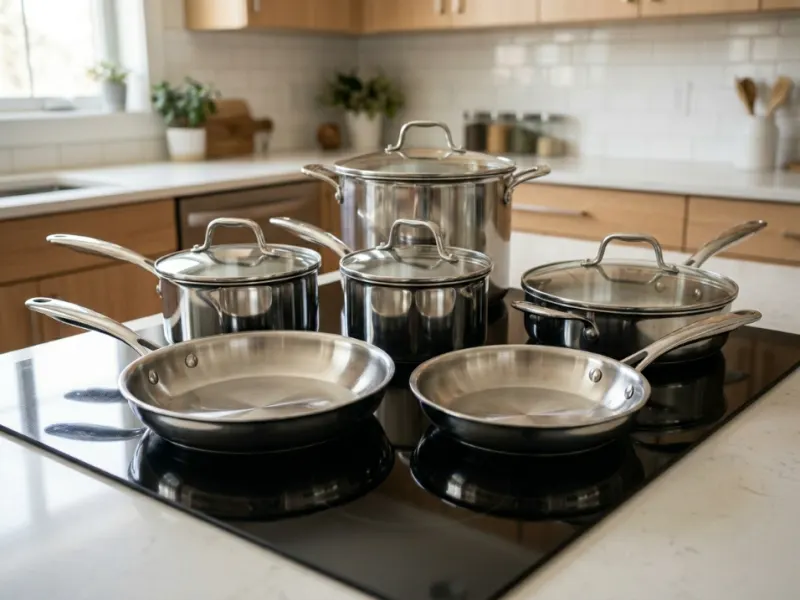
The Cooks Standard Multi-Ply Clad 10-Piece Stainless Steel Cookware Set is the one we'd point you to. It passes the straight-edge test out of the box, without premium pricing. It uses fully-clad tri-ply construction across every piece, aluminum core base to rim, not disc-bottom.
The exterior is 430 ferritic stainless, which works on induction by default (worth confirming with the induction compatibility checker if you're shopping for a dual-purpose cooktop), over an 18/10 stainless interior. It's oven safe to 500°F.
We picked it over pricier tri-ply competitors like All-Clad D3 for one reason: the same fully-clad physics, verifiable on the spec sheet rather than the price tag. Both brands run an aluminum core from base to rim, the exact construction distinction this article opened with.
Once two pans clear that same bar, the extra cost buys handle finishing and warranty coverage, not a better sear, a documented pattern across fully-clad stainless lines.
It isn't flawless. One verified long-term Amazon buyer reported the 12-inch skillet developing a warp after more than a year of regular use, alongside a handle-design complaint. That's a single documented report, not a pattern we found repeated elsewhere. And like any all-stainless set, there's no nonstick piece here for eggs or delicate fish, a category tradeoff rather than something specific to this brand.
If you already understand why pans warp and want the deeper mechanics of layer count, our breakdown of 3-ply vs 5-ply construction covers where the extra layers actually help, and where they don't.
If You Want to Spend More#
The Misen 5-Ply Stainless Steel Frying Pan is worth the step up if you sear often. Misen's own product page describes its construction as "bonded at 3.0mm thickness for even heat." The Misen pan is oven-safe to 800°F, well past what most home cooking needs. You can check the oven rating a brand publishes for a given line in our oven-safe temperature lookup.
The extra aluminum in a 5-ply core spreads heat further across the surface than tri-ply. That matters more on a slower radiant element than it would on gas. Misen's product page also markets the pan with "no hot spots, no warping," a manufacturer claim rather than a tested finding, and we can't independently verify it the way we can the Cooks Standard warp report disclosed above. Treat it as marketing language, not evidence.
Two Habits That Protect the Cooktop and the Cookware#
Construction solves most of the problem. Two habits close the rest of the gap.
Lift and place instead of sliding. Whirlpool's own cooktop maintenance guidance is direct about this: "To avoid scratches, do not slide cookware or bakeware across the cooktop." That's a manufacturer statement about the cooktop, not a cookware-brand talking point. It applies no matter what material sits in the pan.
Keep both surfaces clean and dry between uses. The same guidance notes that bottoms should be "clean and dry before using," since "residue and water can leave deposits when heated." A friction point you can't see is still a friction point.
Pair those two habits with fully-clad, flat-tested cookware. The wobble, the grey marks, and the slow, uneven heat that make people give up on stainless entirely on a glass top mostly disappear. If you're building out a full set rather than replacing one pan at a time, our cooks cookware reviews breakdown covers where the rest of the savings versus premium brands actually show up.