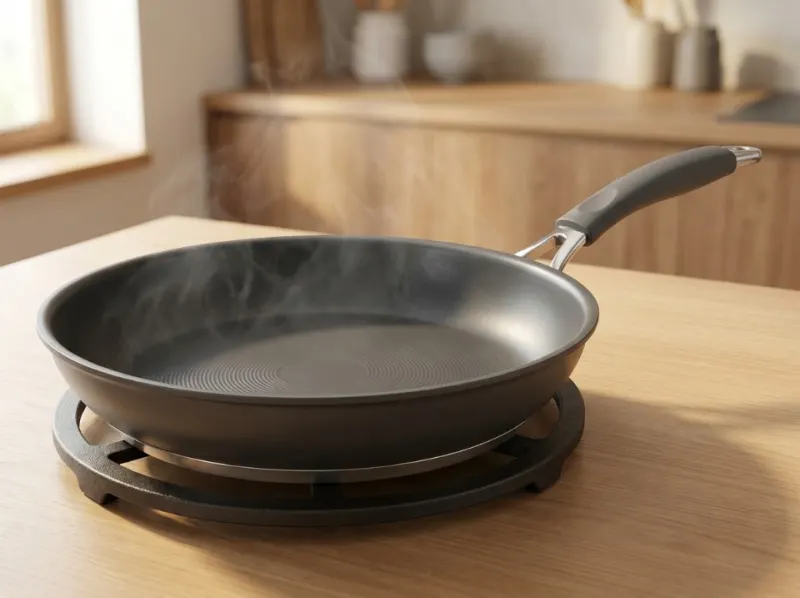
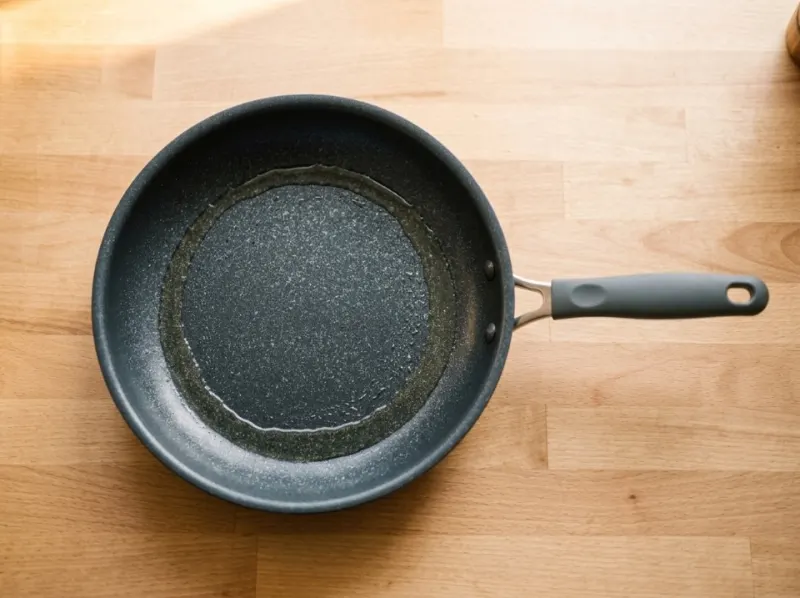
You upgrade to a pricier non-stick pan assuming the extra spend buys a coating that outlasts the one you're replacing.
It mostly doesn't. Most PTFE pans perform well for 2 to 3 years regardless of price, and reinforced multi-layer coatings, the feature premium tiers are built around, hold up longest within that 1 to 5 year range. Premium costs 2 to 3 times more for a durability edge that construction buys, not a different coating.
Our nonstick cookware buying guide covers the axes that actually decide durability, since price alone isn't one of them.
Under heavy daily use, the gap narrows to almost nothing. Switching to a "healthier" ceramic coating doesn't rescue the math either, and in one documented case, makes it worse.
That leaves a real question: if paying more barely helps, what actually does?
Why Price Barely Touches Coating Life#
Every PTFE non-stick pan, cheap or expensive, uses some version of the same coating chemistry. Manufacturers dress it up as "diamond-infused" or "triple-layer professional grade," but those are marketing variations on the same polymer, not meaningfully different chemistry.
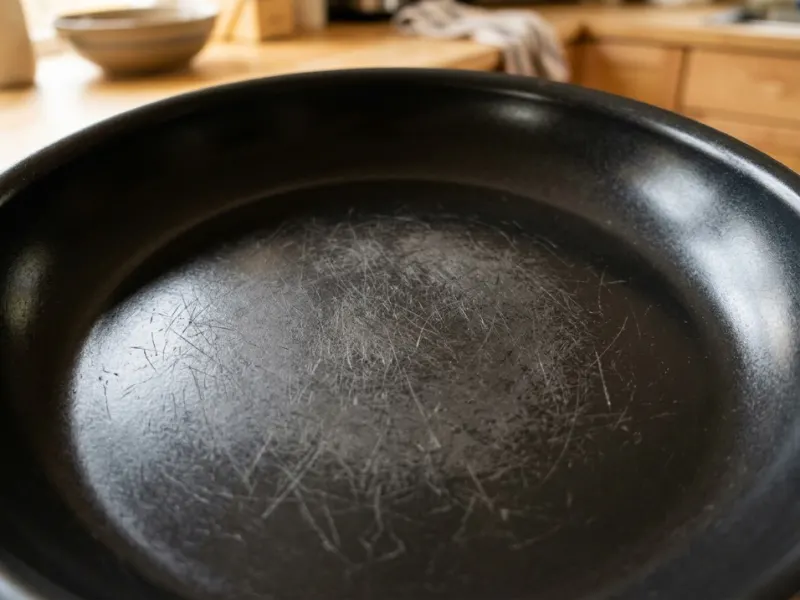
PTFE degrades through physics that don't care about price. Every heating cycle expands the coating; every cooling cycle contracts it. Utensil contact adds tiny scratches that accumulate over months of use.
A thicker aluminum body or a nicer handle changes how a pan feels in your hand. Neither slows what happens to the coating itself.
What the Data Actually Shows: Coating Type, Not Price Tier#
Published reporting on nonstick lifespan does not break out precise month bands by price tier, and neither do we. What actually separates a pan that reaches the top of its lifespan window from one that reaches the bottom is construction, specifically whether the coating is a single thin layer or a reinforced multi-layer build. That construction detail clusters at the premium end of the market, but it is not exclusive to it, and it is the variable doing the real work, not the price tag.
Coating chemistry matters more than construction. Published reporting puts ceramic coatings at an average of about 2 years of effective release, with some failing in as little as 1 to 3, while PTFE generally holds on for 3 years or more on the same measure, regardless of how much either pan cost or how well it was built. That gap between coating types is bigger than anything price buys within PTFE alone.
For a direct comparison of PTFE and ceramic lifespan, see our ceramic versus Teflon guide.
The All-Clad HA1 Pattern: Premium Coating, Same Failure Point#
The All-Clad HA1 feels premium from the first fry. Heavy enough to sit flat without wobbling, even heat across the whole surface, a handle that feels overbuilt in a good way. The coating performs beautifully through the first year.
That tracks with the chemistry, not against it. All-Clad HA1 runs on the same PTFE chemistry as a budget pan, degrading by the same physics. Its multi-layer, reinforced construction, part of what the premium price buys, holds up longest per published reporting, but that edge is not proportional to the 2 to 3 times price gap.
Applied to this specific pan under regular use, the reinforced build buys it some room, but not enough to clear the 2 to 3 year window most PTFE pans share. Same physics, a smaller gap than the price implies.
After that, the pan doesn't become useless. The hard-anodized body is genuinely well-built. What's gone is the reason to have paid more than a mid-range pan in the first place.
Switching to Ceramic Doesn't Fix It Either#
Some buyers try to sidestep the whole PTFE question by moving to a ceramic-coated pan, reasoning that a different chemistry might solve what price couldn't. It doesn't, and some lines run faster than the published ceramic average rather than slower. OXO's Enhanced line, a PFAS-free ceramic coating on a hard-anodized body, gives a dated, specific look at that broader pattern rather than standing on its own as the evidence.
Two separate Amazon owner reviews, dated 2022 and 2024, both report the same trajectory: sticking beginning within 1 month to a few months of daily use, then progressively worsening until the pan was unusable, even with full cleaning and oil. That's well below the published 1-to-3-year floor for ceramic as a category, a documented case running dramatically faster than the published average.
Both describe a shorter functional life than mid-range PTFE, not a longer one. Ceramic coatings are physically harder than PTFE but lose their release faster once thermal cycling breaks down the surface treatment.
That mechanism doesn't disappear because the marketing says "healthier." PTFE cookware sold today is PFOA-free under the EPA's 2010/2015 Stewardship Program, the manufacturing chemical that drove most PFAS health concerns in cookware. If you still prefer avoiding fluoropolymers on principle, that's a values-based choice you're free to make. Longevity isn't a reason to make it.

The 30-Second Test Before You Spend More#
Here's the test, based on how often the pan actually gets used:
- Cooking 4 to 5+ times a week? Any coating, premium PTFE or ceramic, tends to fail around the same point under that kind of load. Buy mid-range PTFE and replace it on schedule rather than paying more for a gap that heavy use erases anyway.
- Cooking 2 to 3 times a week? Premium PTFE may genuinely stretch further, per the typical-range data above, but check whether the cost per year still beats mid-range before deciding the extra spend earns its keep.
- Considering a coating switch instead of a price switch? Don't assume ceramic is the shortcut. Check what a coating is actually made of before betting on it lasting longer than PTFE. The cookware cost calculator compares repeat nonstick purchases with one uncoated pan at the prices you enter.
What Actually Extends Coating Life#
None of this comes down to how much you paid. It comes down to four habits:
- Heat management. Medium heat, always. High heat is the single fastest way to shorten coating life, because it amplifies the stress of every heating cycle. A pan with a built-in heat indicator, like the T-fal Professional VX3's Thermo-Spot, gives you a visible cue instead of guessing.
- No metal utensils. Silicone, wood, or nylon only. One careless scrape does more damage than months of careful cooking.
- Hand washing. Dishwashers combine high heat with harsh detergent, both of which attack the coating bond.
- No aerosol cooking sprays. The lecithin in sprays like PAM bakes into a sticky residue that mimics coating failure long before the coating itself is actually done.
If You Want a Material That Rewards Spending More#
Non-stick pans are consumables by design. If you'd rather own cookware that improves instead of degrading, stainless steel has a real learning curve but a good pan lasts decades.
Cast iron gets better with age once you've got the seasoning routine down. Both trade convenience for a coating you never have to think about again.
For more on how PTFE and ceramic wear over time, our full look at nonstick pan lifespan covers the replacement-habit variables that matter most.
So, Are Expensive Non-Stick Pans Worth It?#
Barely, and only if you're buying the handle, the weight, and the brand rather than the coating. The coating itself runs on physics that don't check the receipt.
It doesn't care whether the pan cost several times more, and it doesn't care whether you switched to ceramic hoping for a different answer. If you want the honest value pick, buy a mid-range PTFE pan with a real heat-management feature, treat it well, and replace it without guilt when it's done.
That's the whole strategy, and it costs a fraction of what chasing "premium" does.