You already own a pot big enough for soup. Does a dutch oven actually do a different job, or is it the same metal wearing a different shape?
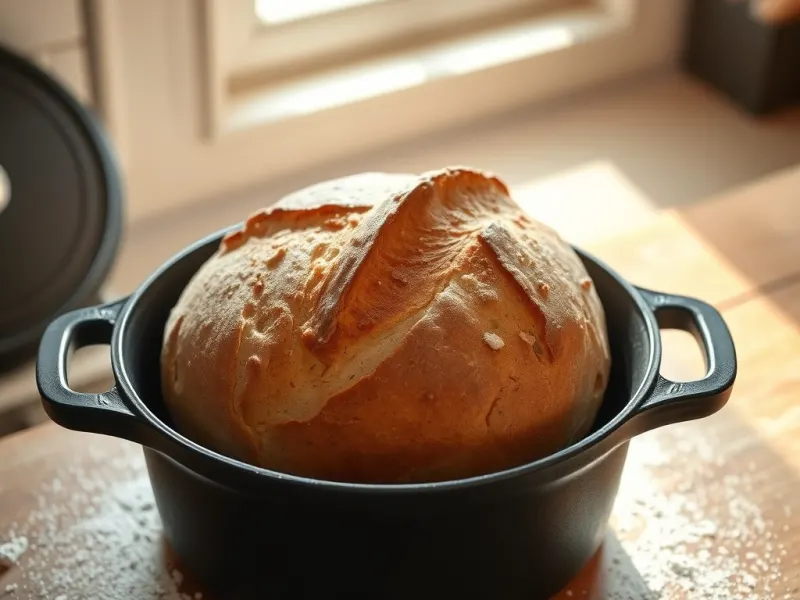
Buy a Dutch oven if you braise, bake bread, or move food from stovetop to oven. Buy a stock pot if you mainly make stock, cook pasta, or boil in bulk. A Dutch oven's enameled cast iron holds heat through a long braise. A stock pot's lighter stainless body heats water fast, but its glass lid caps out well below its own body's oven rating.
The surprising difference is the lid.
Below are the maker specs and owner reports for a Lodge Dutch oven and a Cook N Home stock pot, plus the weight and heat math most dutch oven vs stockpot guides skip.
What Makes a Dutch Oven a Dutch Oven#
Walk down a cookware aisle and the labels get slippery. Some retailers call a tall stainless pot with a lid a "stock pot." Others put "dutch oven" on anything round with handles, enameled or not.
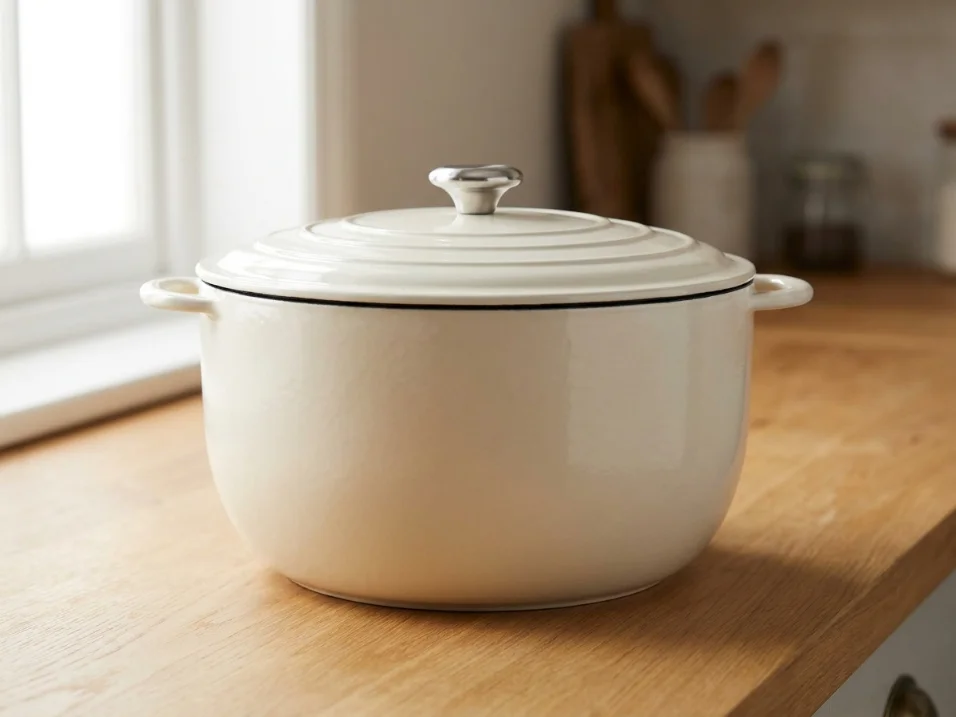
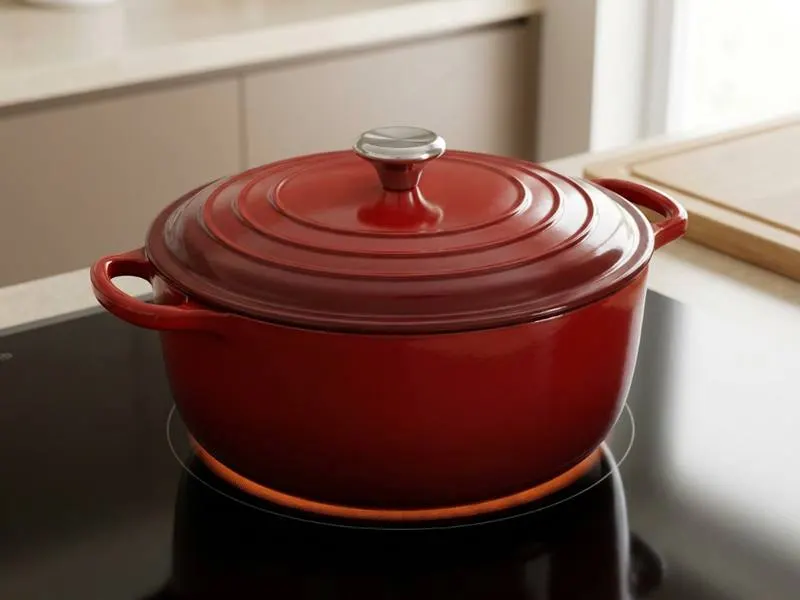
A dutch oven is a thick-walled cast iron pot with a heavy lid, sold bare or enameled. The one compared here is enameled, finished with a glass-based enamel coating. That enamel is why a Lodge 6-quart enameled Dutch oven needs no seasoning. It also handles acidic sauces, wine, and tomatoes without reacting the way bare cast iron can.
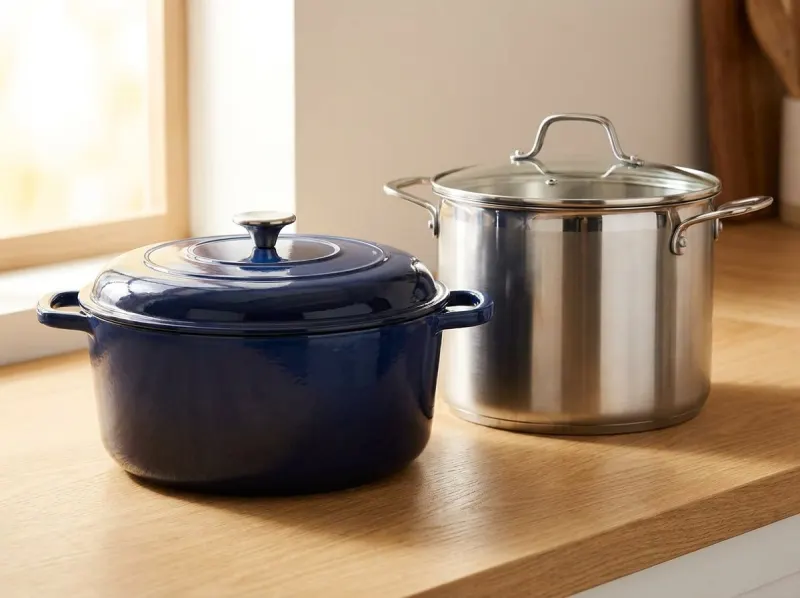
A stock pot, like the Cook N Home 8-quart model, is a straight-sided 18/10 stainless pot. It has an aluminum disc bonded only to its base. With aluminum confined to the bottom, the base heats fast while the upper walls warm more slowly.
Naming on retail listings doesn't sort this out reliably. Some stainless pots marketed as "dutch ovens" are really stock pots wearing a borrowed label. Cast iron walls, bare or enameled, versus stainless with a disc base, is the tell that holds up.
Weight, Heat, and Why Mass Wins#
The weight gap is not close. The Lodge 6-quart Dutch oven weighs 13 lbs, according to Consumer Reports. The Cook N Home 8-quart stock pot weighs 4.9 lbs empty, for two more quarts of capacity.
That gap explains why one pot heats stock quickly and the other holds a braise steady for hours. The mechanism is counterintuitive, because stainless steel actually conducts heat worse than cast iron. Gray cast iron measures roughly 52 to 53 W/(m-K), while 304 stainless comes in around 14.9 W/(m-K), per NIST and engineering-reference data. So the steel itself is not why the stock pot heats faster.
How long a pot holds its temperature depends on specific heat, the energy a given weight of metal stores per degree, times how much metal there is. Specific heat is nearly identical between the two metals, about 0.46 kJ per kg-K for cast iron against 0.477 for 304 stainless, within roughly 4 percent of each other.
By our arithmetic, applying that near-equal rate to each pot's weight, the 13-pound Dutch oven stores about two and a half times as much heat as the 4.9-pound stock pot. The stock pot heats fast because it carries roughly a third of the metal. Its aluminum disc base also spreads heat far better than either iron or steel, since cookware-grade aluminum typically runs around 190 W/(m-K). Pound for pound the two metals hold about the same heat, and the stock pot simply carries less metal.
The Dutch oven's 13 lbs is the price of the heat it holds.
The Oven Test#
Both pots claim 500°F oven safety, on paper. Lodge's own manual says to use it on the stove and in the oven up to 500°F. The Cook N Home stock pot's body carries an identical 500°F rating.
That's where the similarity ends. The stock pot's tempered glass lid is rated to only 350°F, a full 150 degrees below its own body. Lodge's own braising recipe, a 5-pound pork roast cooked at 325°F for 3 hours, sits squarely in the range the stock pot's lid cannot survive with the lid on.
Check a second stainless stock pot line and the same pattern shows up again. Tramontina's 8-quart tri-ply clad stock pot carries the identical split, with 500°F for the body and 350°F once its glass lid goes on. Two independent brands show the same gap, which points to a pattern across the category.

Pulling the lid or swapping in foil gets the stock pot into a hotter oven anyway. That turns a one-pot job into extra steps.
Shape and Capacity#
Side by side, the shapes read differently before you touch a tape measure. The Lodge Dutch oven's own listing gives it a width of 10.93 inches, yet it holds two fewer quarts than the Cook N Home stock pot.
Flip that around and the stock pot is doing more with less footprint. The stock pot's listing puts it at 9.4 inches across. By our comparison, more capacity on a narrower base means its walls run taller and straighter relative to its width. That is the shape a tall column of pasta water or simmering stock actually needs, without spreading wide across the burner.
The Dutch oven's wider base trades that vertical capacity for surface area. That suits a braise, where food needs to sit low and mostly submerged.
Which Jobs Each Pot Wins#
If a thin broth needs to feed a crowd fast, the stock pot does more of that job. Our stock pot sizing guide covers how to match capacity to batch size once you've picked the stock pot side of this decision. If your week leans toward braises, pot roasts, or weekend bread, the Dutch oven earns the counter space instead.

Handling and care split the same way. On the stock pot side, the edge beyond volume is handling. The Cook N Home listing calls it oven and dishwasher safe. Its lighter stainless body is also easier to lift, drain, and carry to the sink full.
On the Dutch oven side, the trade is care. Lodge's own care page notes the enamel is technically dishwasher safe but recommends hand washing to protect the finish. That extra care buys a pot that holds a braise at temperature far longer.

Do You Need Both?#
In an r/Cooking thread asking exactly this, six of the eleven answers we transcribed leaned toward the Dutch oven, mostly for its versatility, and the original poster bought one for bread and pot roasts. One reply put the Dutch oven case plainly, "if I had to get one, I'd get Dutch oven." A YouTube cookware walkthrough, a separate source, also named a cast iron Dutch oven as one of the few pieces worth buying again from scratch.
That lean holds up against what each pot actually does. A Dutch oven handles a smaller batch of soup too, just not eight quarts at once. A stock pot's one real advantage is volume, the thing a Dutch oven genuinely can't match. It holds eight quarts of pasta water or stock in a single, lighter-to-carry pot.
Own both if your cooking regularly swings between big-batch stock or pasta and long braises or bread. Our Dutch oven sizing guide can help you pick the right capacity once you know you need one.
If the enamel-versus-bare-metal choice itself is still unclear, our enameled vs bare cast iron breakdown walks through that separate decision. Not sure which material fits how you cook across your whole kitchen, not just this one pot? The material selector quiz can narrow that down too.
Our Picks#
For most home cooks, the Lodge Essential Enamel 6-Quart Dutch Oven is the pot to buy first.
Owner reports of rim chipping vary widely. Reports across the Essential Enamel line range from about a year on an 8-quart unit, chipped despite wood utensils and hand washing, to six years with no visible wear on this same 6-quart size.
If stock, pasta, or big-batch boiling is the bulk of your cooking instead, the Cook N Home 8-Quart Stainless Steel Stockpot is the lighter, dishwasher-safe answer built for volume. Skip it as an oven braiser because of the lid limit covered in the oven test above.