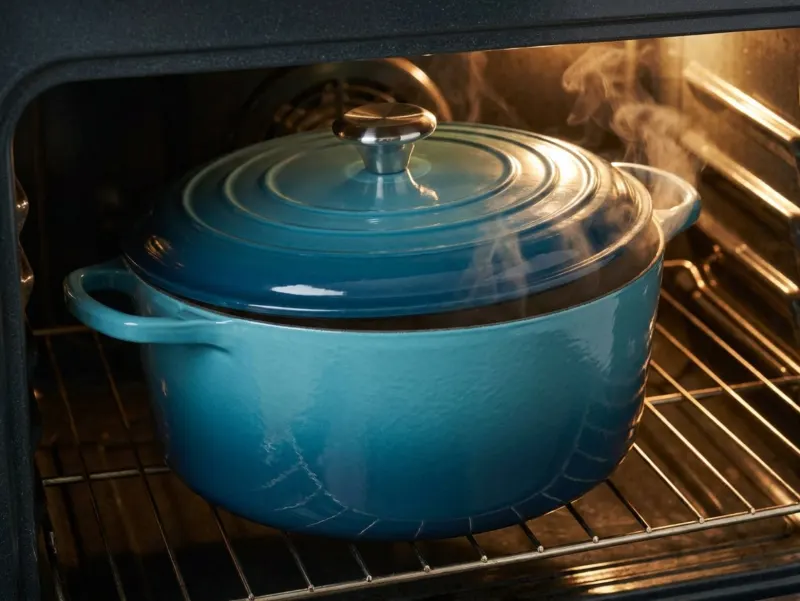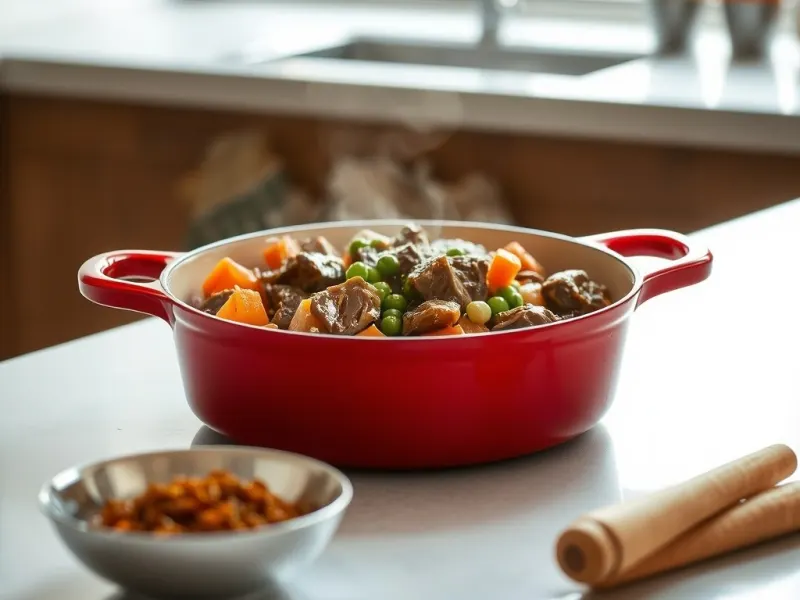
Both promise a tender roast without babysitting the stove all afternoon. Only one of them can put an actual crust on the meat first.
A dutch oven and a slow cooker braise at almost the same ceiling temperature. Both are capped by boiling liquid, not by the appliance. The dutch oven's real advantage sits entirely in the step before that: a hard sear on the stovetop. A slow cooker's own dial physically cannot deliver that.
That single difference decides more about flavor than capacity, price, or how many quarts you buy. We compared both against manufacturer data and a university extension chart to find out how much.
Dutch Oven vs Slow Cooker: The Ceiling Neither One Can Cross#
Here's the part most comparisons skip. A slow cooker runs low and steady, generally between 170°F and 280°F, according to USDA food safety guidance. That sounds hot enough to brown something eventually. It never does.
It isn't. Not close. The reason has nothing to do with the dial.
Once meat and liquid are in the pot, the food itself can never get hotter than water's boiling point. That's 212°F. It doesn't matter whether the pot is a slow cooker or a covered dutch oven.
The Exploratorium explains that the Maillard reaction, the browning that creates crust and flavor, starts at 140°C, or 280°F. Liquid can't carry heat past 212°F. A braise sitting in stock or wine never gets close, no matter which vessel holds it or how long it runs.
Here's a myth worth retiring too: a hard sear does not seal moisture inside meat. The Exploratorium traces the idea back to publications dating to 1850, including writing from organic chemist Justus von Liebig and chef Auguste Escoffier.
Modern food science doesn't back it. Proteins are far larger than water molecules.
The gaps between them in cooked muscle stay big enough for water to keep passing through as the sizzle continues. What searing buys is flavor, from the crust and the fond it leaves behind. It isn't a moisture barrier.
So the dutch oven's edge isn't a hotter braise. It's that the meat touches a dry, screaming-hot pan surface before any liquid goes in. That's the one phase where either vessel's food can cross 280°F at all. A slow cooker skips that phase by design.
How Much Time You're Actually Trading#
Lodge's own recipe blog runs a 5-pound pork roast two ways: seared on the stovetop, then finished at 325°F in the oven. Total time: 3 hours, in the 6-quart enameled dutch oven.
Utah State University Extension's cooking chart lists a comparably sized beef roast, 3 to 4 pounds, at 8 hours on low in a slow cooker. On high, that drops to 5.75 hours.
That's the real trade we found. Not a made-up conversion formula, just two sourced numbers side by side: roughly 3 hours of active cooking against roughly 8 hours of walk-away time, for a similarly sized cut.
Extension guidance is blunt about the floor, too. It doesn't recommend converting any recipe that normally runs under 7 to 8 hours on low, or 3 to 4 hours on high. The math falls apart below that.
One habit costs more time than people expect. Lifting the lid to check on a slow cooker mid-cook adds another 20 to 30 minutes to the total, even for one quick peek. The heat that escapes takes that long to rebuild.
The Risk Nobody Mentions When You Leave the House#
The usual framing says a dutch oven "needs someone home" while a slow cooker doesn't. True, but it undersells what leaving actually risks.
USDA guidance is specific here. If nobody is home for the entire cooking window and the power goes out, the food gets thrown away. Even if it looks completely done. There's no way to confirm how long it sat below a safe temperature.
If someone is home when the power drops, and the food had already finished cooking, USDA's food-safety fact sheet on slow cookers says it stays safe for up to two hours with the power off. Being away removes that safety net entirely.
Leaving a slow cooker running all day is a real, specific way to lose the entire meal you spent all day cooking, through no fault of the food itself, not just an inconvenience.
The same guidance recommends never reheating leftovers directly in a slow cooker. Its low operating range keeps food in the bacterial danger zone too long during the reheat itself.
Leftovers should hit 165°F on the stove or in a microwave first. Only then should they move to a preheated slow cooker, and only to hold at a serving temperature of at least 140°F.
What Actually Wears Out or Annoys You#
Owner reports on the Lodge line show real variance in enamel chip timing. It tracks handling care more than manufacturing luck.
One long-term owner reports six years with no visible wear. Another reports chipping within about a year, despite careful hand-washing and wooden or silicone utensils only. Lodge's Limited Lifetime Warranty covers enamel damage from normal cooking, which softens that risk on either end of the range.

The Crock-Pot 7-Quart manual slow cooker has a smaller, but real, annoyance. One verified-purchase owner reports its dial has no power-on indicator light, they noticed only after an outlet developed a short circuit.
The unit looked switched on by its dial position, but nothing was actually running. That's a single account, not a pattern across owners. Still, it's worth knowing on a manual-dial appliance you're trusting to run unattended for 8 hours.
The Verdict#
If you cook at home regularly, buy the dutch oven first. It sears, braises, bakes, fries, and makes soup in the same pot. That's versatility a slow cooker can't touch.
Lodge's warranty backs the one real long-term risk. The Lodge vs Le Creuset comparison covers whether the premium version is worth the jump. Both are enameled cast iron, so they braise the same way.
Keep or buy a slow cooker for the specific situations where being away actually matters. A large-batch pulled pork you can't tend all day. An overnight broth. A summer stretch where running the oven for hours isn't appealing.
Our guide to using a dutch oven in the oven covers temperature and timing mistakes on the other side of this comparison. If speed matters more than browning, the pressure cooker vs dutch oven comparison is the more useful matchup to read next.
Neither appliance is universally better. One browns. The other lets you leave. Knowing which one your Tuesday night actually needs is the whole decision.