Most people assume a sticky nonstick pan has a dead coating. Usually, it does not.
Cooking spray ruins nonstick pans by depositing soy lecithin residue that polymerizes into a sticky film over months of use.
For the bigger picture on what actually shortens, and extends, a nonstick coating's life, see our nonstick cookware buying guide.
The PTFE coating underneath usually stays intact the whole time. The film on top just traps food and mimics coating failure closely enough that almost nobody suspects the real cause. We dug through manufacturer care pages, owner reports, and the actual chemistry of what is in the can to figure out why.
Why Cooking Spray Ruins Nonstick Pans#
A can of cooking spray is not oil in a pressurized bottle. It is oil, a propellant, and an emulsifier, almost always soy lecithin. That third ingredient is the one that causes the problem.
Lecithin has low thermal stability. Cooking sprays burn at lower temperatures than butter or oil alone, which is why cookware makers warn against them specifically on nonstick surfaces. The lecithin fraction discolors and forms a dark, sticky residue before the oil in the same can would reach its own smoke point.
It also helps the spray settle into an ultra-thin film instead of a pooled layer, which is exactly what makes spray feel more convenient than pouring. That same thinness works against the pan. A thin film heats through and carbonizes faster than a small pool of oil ever would, so the very feature that sells the can is what turns against a nonstick coating first.
We keep seeing the same pattern in owner threads: a mid-range pan that looked fine for months, then started rejecting eggs with no scratches or peeling in sight. On a stainless steel pan, none of this registers the same way.
KitchenAid's own nonstick care guidance explicitly warns against aerosol cooking sprays for this reason. The residue bonds onto PTFE in a way it does not bond onto bare metal, which is why the same spray washes off stainless with normal soap and water. On PTFE, each spray-and-cook cycle leaves one more layer dish soap cannot touch.
Plain oil polymerizes too, eventually. That is the same mechanism behind seasoning cast iron on purpose, just far slower and more even. Wipe a fresh thin layer before each cook, and there is nothing left to accumulate between uses.
Residue or Real Coating Failure?#
A pan that sticks despite oil and proper heat is not automatically dying. Run this test first.
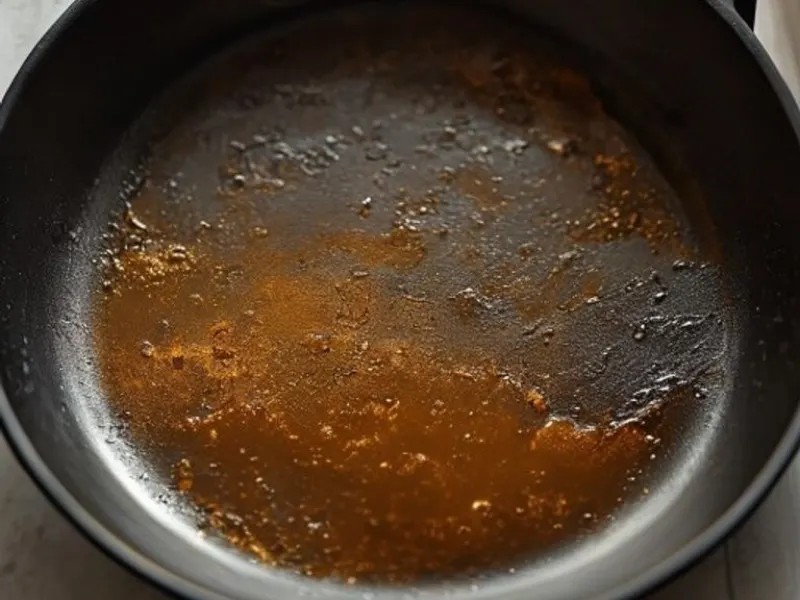
Residue shows up as a faint brownish or amber tint, usually starting at the edges. Drag a fingernail across it and you will feel slight resistance where the surface used to glide.
Real failure looks different: grey or silver metal patches, or the coating flaking off outright (the guide on when a scratched nonstick pan actually becomes unsafe covers that case on its own). No grey patches, no flaking, food still sticks. That combination means residue, not a dead pan.
Ceramic coatings (GreenPan, Caraway) pick up the same lecithin residue, but ceramic already runs on its own clock. Owners frequently report ceramic losing release within months to about a year and a half. PTFE owners with proper care commonly report 4 to 5 years before replacement, so on ceramic the two causes blur together faster than they do on PTFE. The fix below still works either way; the odds that some of the stickiness is genuine wear go up.
How to Get Rid of It#
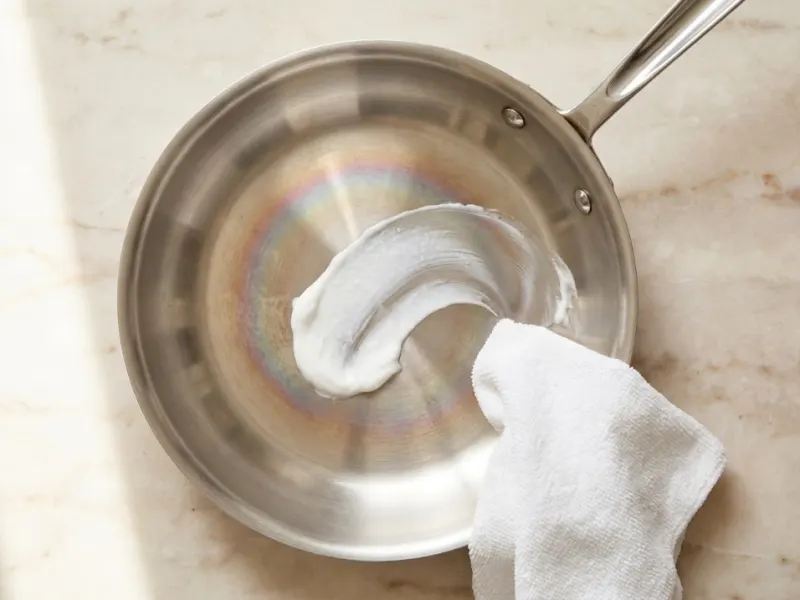
Mix baking soda with enough water to form a thick paste and spread it across the residue. Leave it to sit, up to 24 hours for heavy buildup. Work it in with a soft sponge in small circles and rinse. One pass usually lifts most of the tint, and a second clears the rest.
For buildup that has had months to set in, heat a mixture of water and white vinegar in the pan until it just starts to simmer, then let it cool before scrubbing with a soft sponge. That loosens what the baking soda paste alone does not fully lift on the first try.
Skip steel wool here, and skip Bar Keeper's Friend specifically. Both use harder abrasives than a polymerized-lecithin film needs, and both will scratch through the PTFE underneath while they work. If eggs still stick after cleaning, the problem was never residue. If you want to know exactly what is in a given coating, our PFAS safety checker gives a sourced verdict by brand and line.
One caveat we think is worth stating plainly: a pan that has carried spray residue for months on end, especially one that has also seen a scrub brush, may have real damage underneath the film by the time anyone notices. At that point the coating starts peeling on its own schedule, independent of the residue. Clean it, cook a test egg in a thin layer of oil, and if it still sticks badly, replacement time has arrived regardless of what the cleaning fixed.
What To Use Instead#

Manufacturer care pages do not hedge on this. KitchenAid's own nonstick cookware guidance states plainly that aerosol sprays "can build up and cause the cookware to lose its nonstick properties," and recommends a manual misting or spray bottle as the aerosol-free alternative. That is precisely the fix that costs the least to adopt.
A folded paper towel with a small pour of oil wiped across the surface takes about five seconds and leaves nothing behind to polymerize. For the exact spray-can convenience without the emulsifier, we recommend a refillable oil mister with a 16oz/470ml refillable glass reservoir. Its pump delivers a thin, even mist from whatever cooking oil is already in the pantry, with no propellant and no lecithin building up behind it.
That convenience does carry one small maintenance habit. At least one owner review of this exact bottle reports the pump losing pressure and dripping instead of misting after regular use, which points back to oil residue sitting in the nozzle rather than a manufacturing flaw. A warm-water rinse every couple of weeks heads that off, and it is a far smaller chore than scraping a pan every few months.
The Part the Can Never Mentions#
Cooking spray manufacturers market these products specifically for nonstick pans. "Nonstick cooking spray" is a labeled product category, and some cans even show a skillet in the packaging art. Nothing on that label warns that the emulsifier making the spray convenient is the same thing that builds up on the exact surface it is being sprayed onto.
Because the damage shows up gradually over weeks instead of after one bad cook, the blame lands on the pan. Nonstick coatings are consumable and eventually wear out on their own, so "the coating finally failed" sounds plausible enough that most people never check for the real cause. We think that is backwards. A baking soda paste and twenty minutes settle the question either way.
A pan that looked ready for the trash more often than not just needed the wash it was never getting. The refillable oil mister is what stops the buildup from starting again.