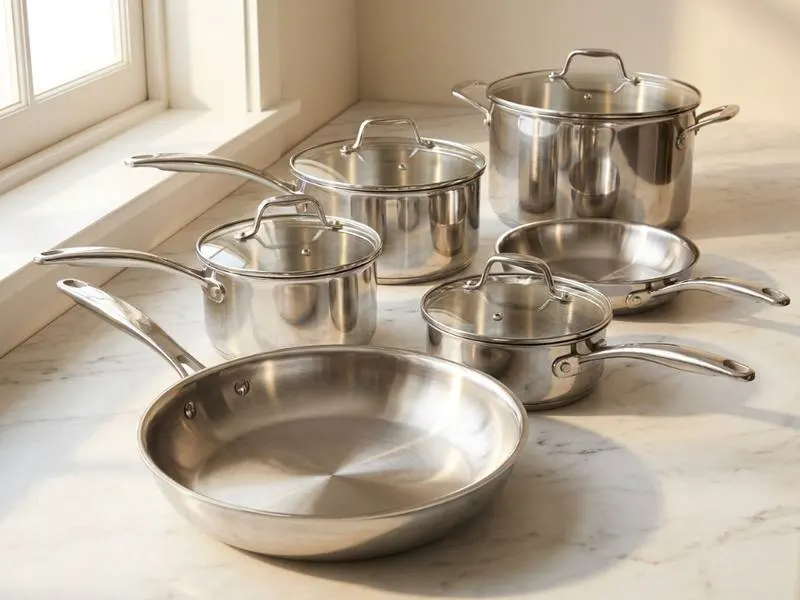
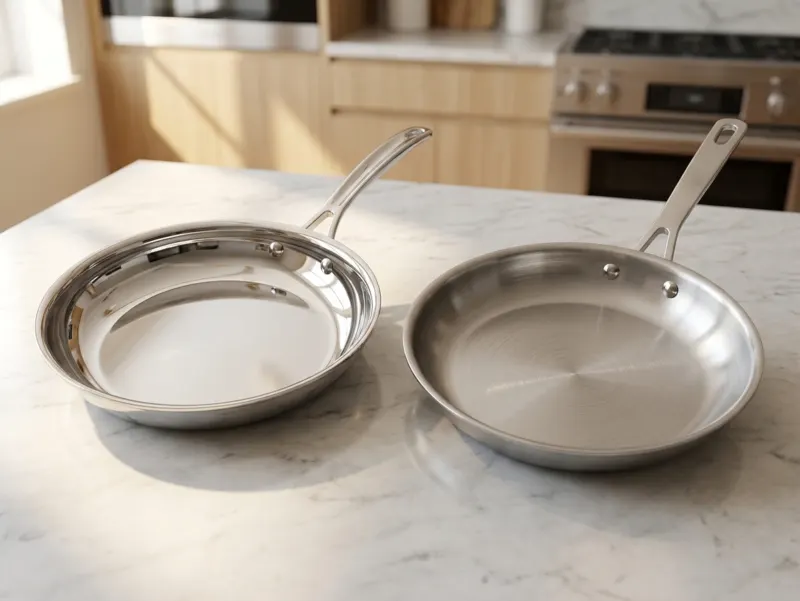
How does a ten-piece set that costs a small fraction of All-Clad D3's price use the exact same construction method All-Clad does? That should not be possible if price tracked quality the way most cooks cookware reviews assume it does. Either the premium price is buying something real, or budget tri-ply cookware has quietly caught up while reviews kept comparing price tags instead of specs. Here is what we found once we checked each brand's own listing, side by side.
The Cooks Standard 10-Piece Multi-Ply Clad Set uses full tri-ply clad construction. An aluminum core runs base to rim instead of stopping at the base, confirmed directly on the brand's own listing.
Our stainless steel cookware guide covers how to confirm that same construction claim on any brand's listing, plus induction compatibility and care.
That is the same full-clad tri-ply method premium brands use to justify their price.
Every cooks cookware reviews page we checked settles for a price comparison, an unverifiable testimonial, or a stale price multiple. None of them points at the one construction method that separates a full-clad pan from a disc-bottom one, or puts the three brands' own construction claims side by side.

Cooks Cookware Reviews Compare Price. We Compared the Spec.#
Price tells you what a set costs. It does not tell you the one thing that separates a full-clad pan from a disc-bottom one: whether the aluminum core runs to the rim, or stops at the base.
Cooks Standard's own listing confirms base-to-rim construction on this set. That means an 18/10 stainless interior, an aluminum core, and a 430 ferritic stainless exterior for induction compatibility. That is a full tri-ply build, not a disc-bottom pan wearing a "clad" label.
When we compared all three listings side by side, the pattern was exact. All-Clad's own listing makes the identical claim about D3: tri-ply, fully clad, aluminum core base to rim. Cuisinart's own listing makes the same claim about MultiClad Pro. On that construction method, all three brands match, each confirmed independently on its own product page.
Matching method does not settle every performance variable on its own, since gauge and alloy grade can still differ and none of the three brands publish those figures.
Want to check this on cookware you already own? 3-ply vs 5-ply cookware covers the rim-check trick: look at the edge where metal meets the lid seat. Distinct layers mean fully clad. A single sheet of steel means disc-bottom, whatever the label says.

The Price Step-Up Buys Refinements. Not a Different Way to Cook.#
Stepping up from this set to All-Clad D3 does buy something. It is not a different cooking mechanism, since both brands confirm the identical full-clad construction method. It buys refinements elsewhere: a higher 600°F oven ceiling instead of this set's 500°F, a helper handle on the saute pan in Cuisinart's case, a longer brand track record, and a different warranty. It also buys a metal gauge that neither brand publishes and we have not independently measured.
Most cooks cookware reviews imply the opposite. They treat a lower price as a compromise on how the pan actually cooks, but the construction spec each brand confirms on its own listing says otherwise.
The One Report Worth Knowing Before You Buy#
This section covers a real limitation we found while researching this set. It is not the reason to skip this set, and it does not change the construction-spec answer above.
One verified Amazon buyer reported this line's individually-sold 12-inch skillet warping after more than a year of regular use, alongside a handle-design complaint. That skillet is not one of the 8-inch or 10-inch pieces included in this set, but it shares the same Multi-Ply Clad construction. It is a single, individually attributed report, not a documented pattern, and we have no independent measurement that explains why it happened. A set that warps for every owner shows up across hundreds of reviews, not one report from 2016.
The pattern we saw across owner reports and comparative roundups points to a thin public track record for this brand. It rarely appears in roundups that cover close competitors like Tramontina and Henckels Clad H3, so there is little beyond the single owner report above to check any of this against.
That thin footprint is common in this price tier. Our Philippe Richard investigation found a private-label brand whose own marketing obscured the actual manufacturer until court filings surfaced it. Once we checked the construction claims, a Tramontina set ended up the better-documented buy.
Individual pieces in this set are also heavy. One owner unboxing the 10-piece set called every piece "heavy," adding that it is "not for the faint of heart." That weight is part of what a solid, fully-clad build feels like. It also means more to lift and store than a lighter budget set.
Ask This Before You Buy Any Budget "Fully Clad" Set#
Here is the practical test, built from the spec comparison above.
First, confirm the construction spec. Does the brand's own listing say "fully clad" or "tri-ply clad"? Does the rim show distinct metal layers rather than one sheet? Yes to both, and you have confirmed the one construction method that separates a full-clad pan from a disc-bottom one, regardless of price.
Second, decide whether the one documented report above changes anything for you. If you regularly load a fully loaded pan with a lid, or a budget pan has warped on you before, weigh a helper-handle set instead.
The Preheat Habit That Matters More Than Either Number#
Regardless of construction spec or gauge, stainless steel needs the same preheat habit to sear without sticking. Place the empty pan on medium heat, then flick a few drops of water onto the surface every so often to check it.
Water that evaporates flat means the pan is not hot enough yet. Water that forms a single ball and rolls means the surface reached the Leidenfrost temperature. That is roughly 200°C, per a peer-reviewed physics paper measuring the Leidenfrost temperature. Add oil once you see the ball, let it shimmer, then add food and leave it alone until it releases on its own.
Skipping this step is the most common reason budget stainless pans, this set included, get blamed for sticking that is really a technique problem.
What the Set Includes, and Whether You Should Buy the Whole Thing#
The 10-piece set covers 8-inch and 10-inch fry pans, plus two saucepans in different sizes with lids. It also includes a stockpot with lid and a steamer insert sized to fit multiple pots in the set.
No disc-bottom filler pieces hide inside the box. Every piece uses the same base-to-rim construction confirmed above. That is the same spec as the line's individually-sold 12-inch skillet discussed in the caveat section.
Whether a full set makes sense for you, versus buying pieces as you need them, comes down to how much of your current cookware already works. We broke down that trade-off in cookware sets vs individual pieces. A mismatched collection gets solved in one purchase. A stockpot you already like means skipping the duplicate.
For the durability picture across the wider stainless category, not just this one line, see how long does stainless steel cookware last. It covers what actually ends a pan's useful life beyond warping.
The Honest Verdict#
What is proven, directly on each brand's own listing: the Cooks Standard 10-piece set uses the identical full-clad construction method as All-Clad D3 and Cuisinart MultiClad Pro. That method, not the price tag, is what decides even heat distribution and searing, and Cooks Standard delivers it for a small fraction of a full All-Clad D3 set's price.
What is not proven: this line has a thinner public durability record than an established brand. Gauge, alloy grade, and bonding quality beyond the shared method are not published or independently measured on any of the three sets.
That makes this set a value pick for cooking, not a buy-it-for-life guarantee. If day-to-day cooking performance is what you are paying for, the confirmed construction method already gets you there for a fraction of the cost. Pay up for an established brand only if a longer, more documented track record matters more to you than that upfront value, since that gap is the one this set has not closed.