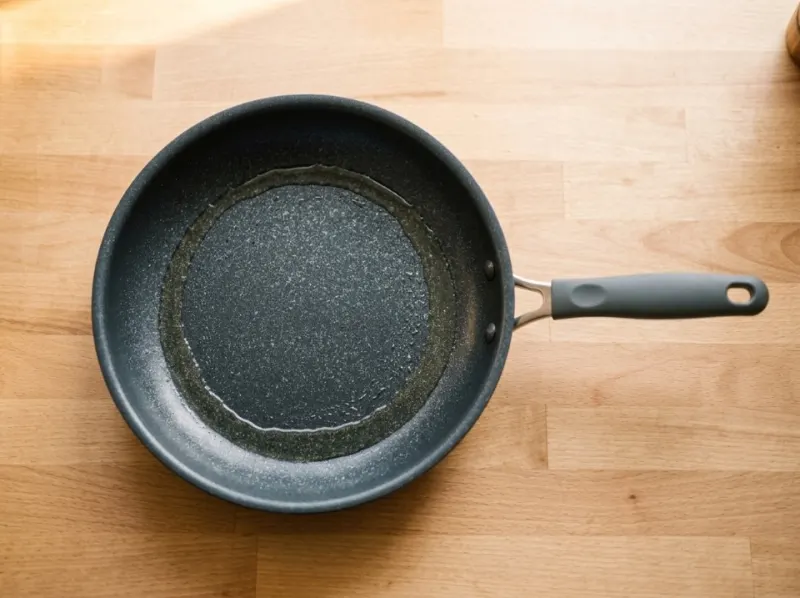
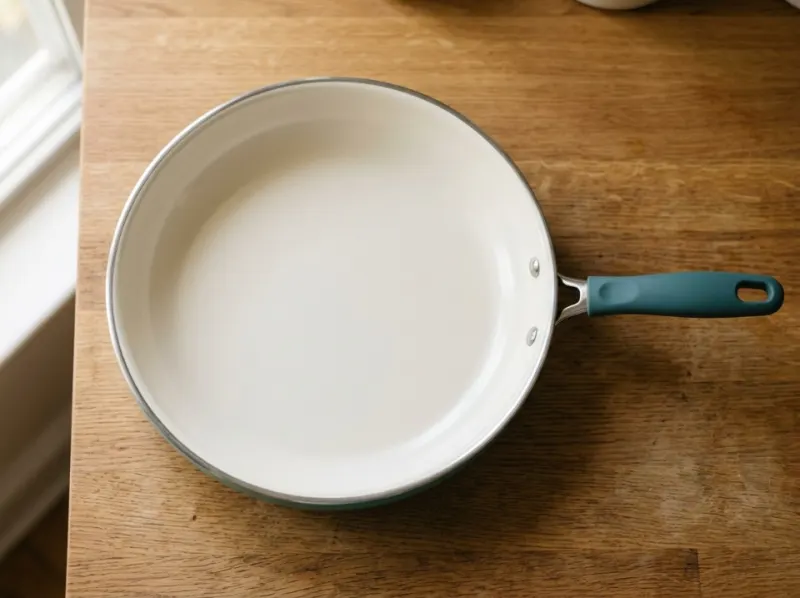
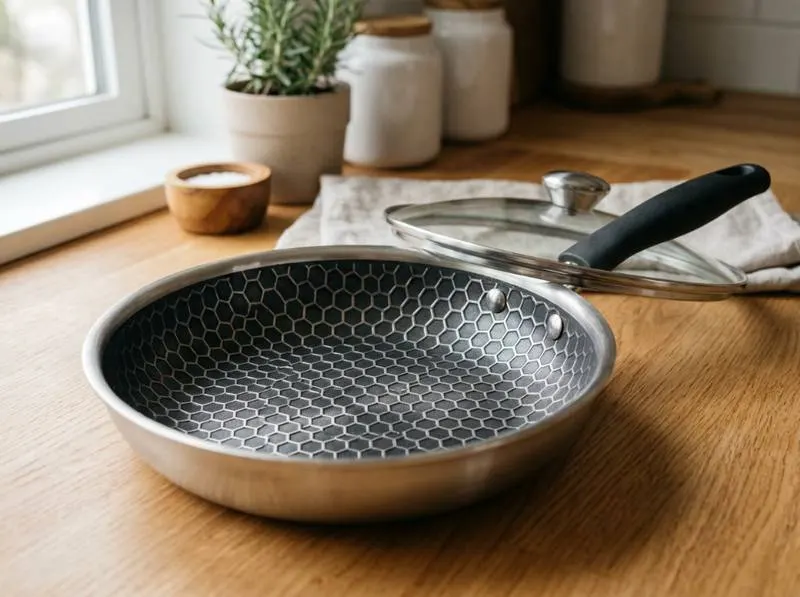
A year ago, eggs slid off that new ceramic pan without a fight. Now they grip the surface like it's bare metal. There's no chip, no scratch, nothing that explains why.
The coating looks fine. It just stopped working.
Ceramic coatings average about two years of effective non-stick release, sometimes failing in as little as one. A mid-range Teflon (PTFE) pan generally holds that same release for three years or more.
Our nonstick cookware buying guide covers the rest of the buying decision beyond coating chemistry: verified PFAS status, oven limits, and induction compatibility.
Both coatings are equally safe at normal cooking temperatures. The gap between them is durability, and it's bigger than most buyers realize.
There's a reason ceramic fails first. It has nothing to do with scratches or dishwashers. It's about how each coating handles heat, and most cooks never find out until the pan is already sticking.
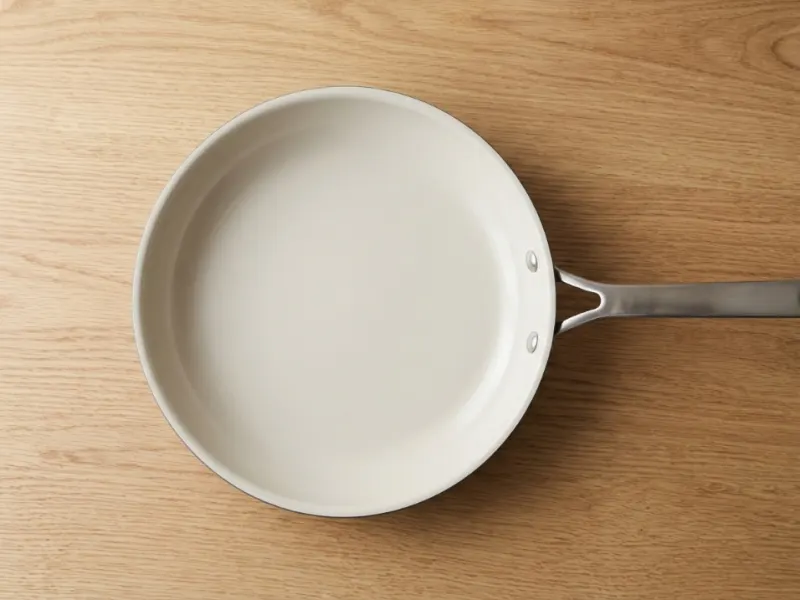
Ceramic vs Teflon: What Each Coating Actually Is#
Teflon is the brand name for PTFE (polytetrafluoroethylene). It's a synthetic polymer, used as a cookware coating since the 1960s. Fluorine atoms create a near-frictionless barrier at the molecular level.
Ceramic coating isn't ceramic like a dinner plate. It's a sol-gel process: silicon dioxide, essentially liquid sand, sprayed onto a metal pan and cured at high heat. GreenPan, Caraway, and similar brands built entire product lines on this technology, all marketed around being PFOA-free. Granite-speckled pans are covered separately in whether granite stone pans are worth it.
Both coatings release food without PTFE-specific chemistry. From there, the physics diverge.
Why Ceramic Pans Run Hotter (And Why That Matters)#
Here's the part the marketing skips. PTFE conducts heat poorly. Lab thermal testing puts its conductivity at roughly 0.32 W/(m·K). That's low enough that the coating itself acts as a thin insulating layer between the metal pan body and your food.
Ceramic's silica-based coating doesn't share that property. It transmits heat to food faster. Published side-by-side cooking tests found the ceramic surface running measurably hotter than a PTFE surface at the exact same stovetop setting, and traced the cause to this conductivity gap.
That matters in practice. A cook switching from Teflon to ceramic almost never turns the dial down. You keep the setting that ran cool under PTFE. On ceramic, that same setting now runs hotter.
Every time a pan heats and cools, the coating expands and contracts against the metal underneath. This is called thermal cycling. Ceramic is physically harder than PTFE, but that doesn't make it more durable.
Its thin surface treatment breaks down under repeated heat exposure, leaving invisible micro-abrasions food can grip. Run it hotter than it needs to be, cycle after cycle, and those micro-abrasions build up faster. That's the real mechanism behind ceramic's shorter lifespan.
Unlike PTFE, which stays slick right up until it visibly peels, ceramic gives no such warning. It just drags a little more each week until the eggs stop sliding.
The Safety Question, With the Actual Dates#
Most people switch to ceramic over health fears. Those fears usually point at a real problem that's already been solved for over a decade.
Before manufacturers changed their process, PFOA (a chemical used in making PTFE, not present in the finished coating) was linked to health issues in factory workers exposed at industrial concentrations. Under the EPA's PFOA Stewardship Program, major manufacturers committed to eliminating PFOA. They hit a 95% reduction by 2010 and full elimination by 2015. Every PFOA-free PTFE pan sold today is made after that deadline.
The overheating risk is real, but it takes real effort to reach. PTFE starts releasing fumes at 500°F, but according to NCBI/StatPearls, human symptoms generally don't start until roughly 662°F. Pyrolysis, where the coating itself starts breaking down, begins around 752°F.
Reaching that means leaving an empty pan on high heat for several minutes straight, well past anything a recipe calls for. Fumes at far lower temperatures are still dangerous to pet birds. That's the one scenario where we'd lean toward ceramic regardless of the durability tradeoff.
Ceramic never used PFOA or PTFE in the first place. Both coatings are safe under normal use. The safety argument behind an entire market of PFOA-free ceramic pans was solved industry-wide before most of those pans existed. Our PFAS safety checker tracks which specific lines are genuinely PFAS-free by brand, with the evidence behind each verdict, if you want to check a pan beyond the two here.
The Replacement Cost Math#
This is where the safety-driven switch becomes a financial mistake nobody notices until years later.
A mid-range PTFE pan's non-stick coating lifespan generally runs three years or more, which works out to a fraction of what a similarly-priced ceramic pan costs when it needs replacing every six months to about a year and a half, per ceramic owner reports. Ceramic often sells at a premium on top of that shorter life, not a discount.
You're paying more upfront for something that needs replacing two to three times as often. That's the actual tradeoff, once safety stops being the deciding factor.
Where GreenPan Specifically Falls Short#
GreenPan's Valencia Pro line, available here, is a reasonable ceramic pick if you want one anyway. It's still worth knowing exactly where it disappoints. Owners report the effortless egg-release fading well inside that same one-to-three-year window ceramic coatings typically span. GreenPan's own warranty claims for coating wear frequently get denied, citing user error.
Independent stress testing on GreenPan's newer GP5 Infinite8 coating found it underperforming the older Valencia Pro line it was meant to replace, despite marketing it as the more advanced option. Even GreenPan's better-performing line still loses the durability contest to PTFE. Newer isn't automatically better here.
What We'd Actually Buy#

For most kitchens, a mid-range PTFE pan like Calphalon's Classic Nonstick is the sensible default. Treat it right: medium heat max, no metal utensils, hand wash only, never preheat empty. You'll get three years or more of reliable release before it's time to replace it.
Stepping up to a premium PTFE pan like All-Clad's HA1 line buys sturdier construction, not a safer or fundamentally longer-lived coating. It's the same PTFE chemistry underneath.
If PFAS-free matters more to you than durability, or you have pet birds in the house, ceramic is a legitimate choice. Just budget to replace it annually. That's the deal you're making, not a bonus.
For cooks tired of replacing coatings on any schedule, carbon steel and cast iron build a natural non-stick surface that improves with age instead of degrading. More technique upfront. Decades of use after that.
The real question isn't which coating is safer. Both already cleared that bar years ago. It's which one you're willing to keep replacing, and how often.
Related Reading#
If you've already committed to the PTFE replacement cycle, our guide to non-stick pans that actually last covers which lines offer the best lifespan for the money. For anyone assuming a pricier PTFE pan buys extra years, whether expensive non-stick pans are worth it has the verdict. If build quality and handle comfort matter more to you than price, our All-Clad HA1 breakdown covers what that extra cost actually buys. And if bare metal feels like the safer long-term bet altogether, nonstick vs stainless steel breaks down which one actually belongs in your kitchen.