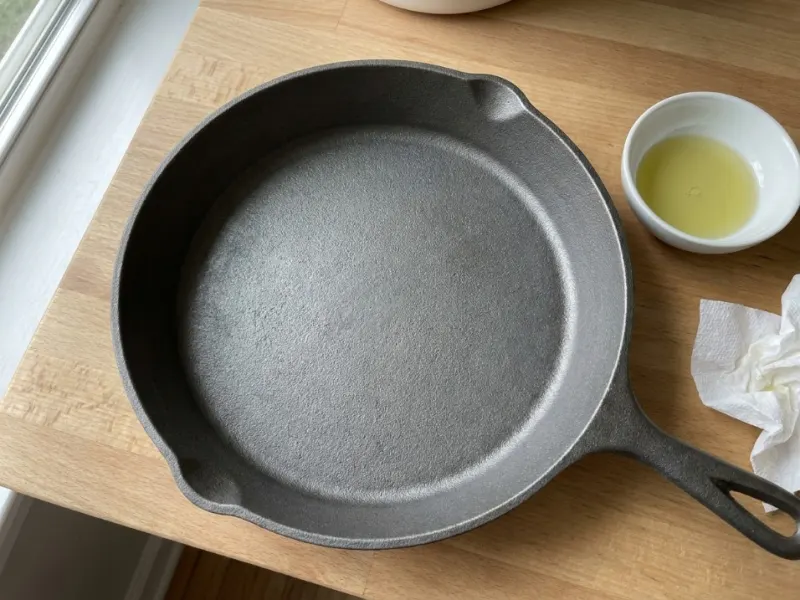
Three coats of oil. Three hours in the oven. And the pan still feels like packing tape when you run your thumb across it. What does that actually mean?
If your cast iron skillet is sticky after seasoning, the cause is almost always oil applied slightly too thick to cure through completely. The outer surface hardens while raw oil stays trapped underneath. The fix is scrubbing off the failed layer, applying oil thin enough that the pan looks dry after wiping, and baking at 450°F for one hour. Three thin coats built this way produces a smooth, non-tacky surface.
Our cast iron cookware guide covers seasoning alongside the rest of cast iron ownership, including rust and storage.
That explanation covers most cases. If your pan has a rough-cast surface, the pebbly texture on Lodge and most budget cast iron, thinning the oil alone might not fully solve it. Here is what we found after comparing failure patterns across owner discussions and Lodge's own care guidance.
Why Your Cast Iron Skillet Is Sticky After Seasoning#
Stickiness is not a single problem. The way it looks tells you what went wrong.
Uniformly tacky everywhere#
The whole surface feels like the back of a sticky note. This is the classic over-application failure. The outer shell hardened before the layer beneath could cure through. The fix is fully removing the failed layer and rebuilding thinner.
Patchy stickiness concentrated in low spots#
Some areas feel fine while others catch your thumb. This pattern usually appears near the handle juncture, along the rim, or in clusters across the cooking surface.
This is oil pooling in the valleys. On Lodge skillets, the rough sand-cast texture creates hundreds of low points. Liquid oil runs into those low points during the wipe-down and again as the pan heats. Scrubbing and reapplying liquid oil can reproduce the same pattern on the same surface because the pooling mechanism has not changed.
Dark brown or varnish-like with a faint rancid smell#
The surface looks amber or orange-tinted rather than a clean matte black. This is not a thickness problem. The oven was not hot enough.
Grapeseed oil needs to push past its smoke point to fully polymerize, and a 450°F oven clears that comfortably. At lower temperatures the oil starts to break down but never hardens all the way. The fix here is a hotter oven, not a thinner coat.
How to Fix It#
Scrub the failed layer off. Hot water, a chainmail scrubber, and firm pressure. You are removing what did not work, not preserving it. Hitting bare metal in patches is fine, you will rebuild from there.
Dry the pan completely. Towel dry first, then heat on a burner over medium for two minutes. Water trapped under new seasoning creates steam bubbles that lift the coating.
Apply oil correctly this time. A few drops of grapeseed oil on a paper towel, rubbed across every surface including the exterior and handle. Then wipe with a clean dry paper towel until the pan looks completely dry with zero visible sheen. That invisible residue is the correct amount.
Bake at 450°F for one hour. Above grapeseed's smoke point, the oil fully polymerizes rather than stopping partway. Place the pan upside down on the center rack with foil beneath it. Let it cool inside the oven completely, then assess texture only once the pan reaches room temperature.
Repeat two more times. Three to four coats establish a working baseline. Jump to the stripping section and rebuild from bare metal.
When a Solid Puck Beats Liquid Oil#
If your pan has a rough-cast surface and patchy stickiness keeps coming back even after applying thinner coats, the pooling mechanism is the issue, not technique error. Liquid oil cannot stop flowing into low spots before the bake starts. A solid wax-and-oil blend can.
The Crisbee puck resists pooling because it does not flow at room temperature the way a liquid does. You rub it on, then wipe it off the same way you would liquid oil. One useful detail about temperature: Crisbee's own instructions specify 400°F for the bake, slightly lower than the 450°F used for grapeseed oil. That reflects how the wax-oil blend cures differently than a pure liquid oil.
The same wipe-dry standard applies. Crisbee's instructions explicitly warn that skipping the wipe-off step still causes stickiness even with the puck.
If you have a smooth-surfaced pan, such as vintage Griswold, Stargazer, or any machined cast iron, liquid grapeseed oil works fine. The pooling problem is specific to rough-textured modern castings.
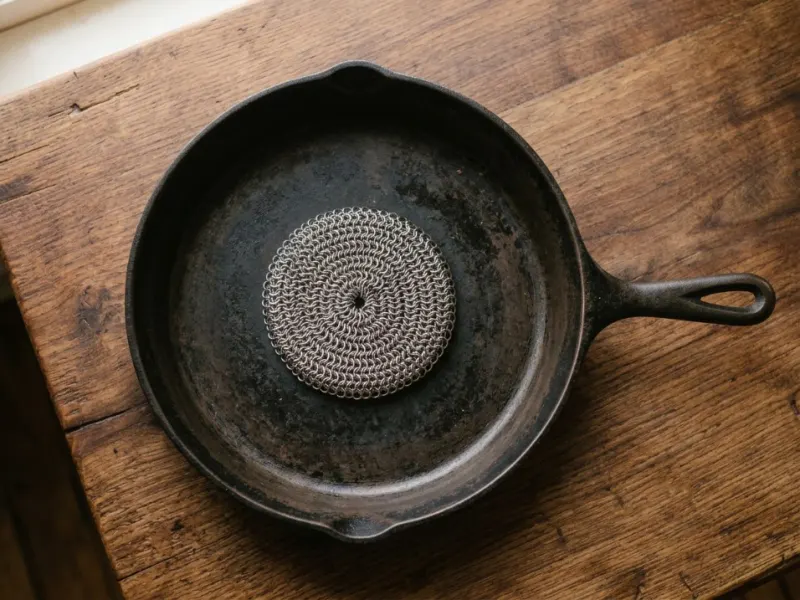
The Lodge chainmail scrubber rates 4.7 out of 5 stars across nearly 5,000 owner reviews. The interlocking rings flex into a skillet's curved rim and sides, somewhere a flat sponge or brush cannot reach. Paired with a stiff-bristle brush for lighter sessions, it covers what cast iron cleaning requires on most nights.

If you cook on a Lodge or another rough-cast pan and keep fighting the same patchy stickiness in the same spots, the puck is the single change worth trying before assuming technique error.
The Flaxseed Trap#
If you seasoned with flaxseed oil hoping for a harder cure, your stickiness may eventually turn into flaking instead. Flaxseed creates an extremely rigid polymer layer. Cast iron expands and contracts with every heating cycle, and a rigid coating cracks under that movement rather than flexing with it.
Flaking shows up after several weeks of high-heat cooking, and it is the most common complaint in cast iron forums about this specific oil. A full comparison of which oil actually builds durable seasoning is in our oil-for-seasoning guide. If you seasoned with flaxseed and the surface is sticky or starting to flake, scrub it off entirely and switch to grapeseed.
When to Strip to Bare Metal#
If stickiness persists across four or five attempts, layers of partially cured oil have likely created a bad foundation. A full strip is faster than trying to repair it incrementally.
Two methods work. The oven self-clean cycle runs at very high temperatures that burn all seasoning to ash. Use it only on thick Lodge-style skillets.
The alternative is a lye bath. Use Easy-Off Heavy Duty Oven Cleaner, not the Fume Free version. That distinction matters.
Easy-Off Heavy Duty contains sodium hydroxide, listed on the product's own label as a DANGER: CORROSIVE ingredient. The Fume Free version is an ethanolamine-based formula that contains no sodium hydroxide and will not strip polymerized seasoning. Reach for Heavy Duty by name.
Use it in a heavy garbage bag, 24 to 72 hours, in a ventilated area with gloves and eye protection. After stripping by either method, rinse thoroughly, dry immediately on a hot burner to prevent flash rust, and begin three thin coats from scratch.
Preventing It Going Forward#
After each cook, rinse the pan while still warm, scrub with a stiff brush if needed, heat on the burner for 60 seconds to drive out moisture, then one thin wipe of grapeseed oil followed by one dry wipe. Two minutes total.
The key principle is that maintenance happens through cooking, not dedicated oven sessions. Every time you cook with oil at medium-high heat, you add another bonded layer naturally. The oven sessions are the bootstrap. Actual use does the rest.
If your fixed pan smokes on the next cook, that is leftover excess burning off, not damage. For choosing a first cast iron pan, our beginner's cast iron guide covers what actually matters at the point of purchase. If you are deciding between cast iron and carbon steel, our cast iron vs carbon steel comparison covers the weight and seasoning differences.
For building seasoning from bare metal after a strip, our full seasoning guide walks through the process step by step. For a quick personalized recommendation, try the material selector quiz.