Every guide to cast iron rust treats the fixes as interchangeable: grab a rust eraser, a vinegar soak, or a chemical remover, and the pan comes back either way. We dug into the chemistry behind each one, and that's not quite right.
Surface rust on cast iron comes off in under an hour with a rust eraser, steel wool, or a short vinegar soak, and even heavier rust responds to an overnight soak in a chemical remover like Evapo-Rust.
Our cast iron cookware guide covers the storage habit that keeps rust from coming back in the first place.
Which one to reach for depends on how much seasoning is worth protecting and how bad the rust actually is, because two of these methods behave very differently once the orange color disappears.
One of them stops reacting the moment the rust is gone. The other keeps going.
Why Cast Iron Rusts (And Why It Looks Worse Than It Is)#
Cast iron skillet rust comes down to one fact: cast iron is bare metal. Stainless steel doesn't rust, and a non-stick pan has a coating standing between food and the metal underneath. Cast iron has neither.
It relies entirely on its seasoning, a baked-on oil layer, to keep moisture off the iron, and once that layer has a gap or a thin spot, iron oxide forms fast. There's nothing else protecting the surface once seasoning breaks down.
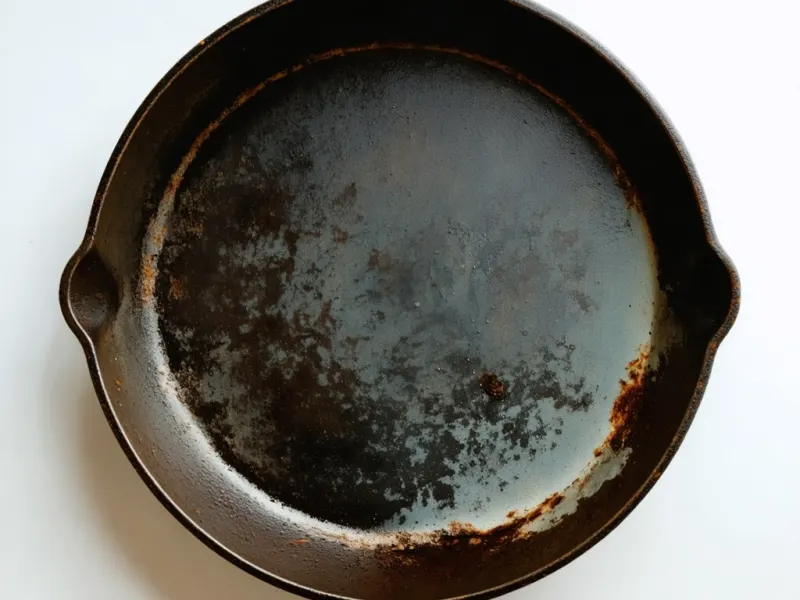
What looks catastrophic is usually a thin film of rust sitting on top of perfectly good metal. Surface rust doesn't pit or weaken the pan. It just needs to come off before the seasoning gets rebuilt.
Three situations cause almost all of it: soaking the pan in water, air-drying instead of drying with heat, or storing it in a humid cabinet with no oil film. The first is the most common, and the easiest to avoid once you know about it. A dishwasher cycle manages to combine all three at once, prolonged water, alkaline detergent stripping seasoning, then damp storage, which is why it produces such dramatic rust so fast.
How to Tell If Your Pan Is Salvageable#
Before scrubbing anything, run a finger across the rusty area. Smooth underneath the orange? That's surface rust, and a rust eraser plus about 30 minutes clears it.
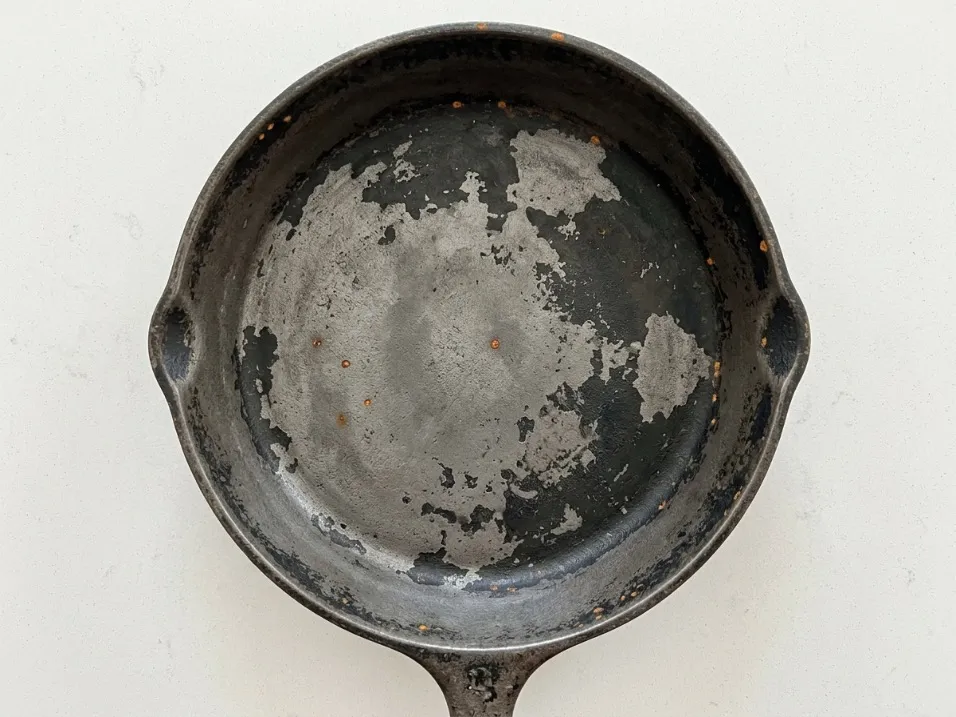
Actual pits or craters under your finger mean deeper corrosion, usually from a pan that sat in a garage or storage for years. Even pitted pans come back, they just won't ever feel quite as smooth as before. An overnight Evapo-Rust soak followed by aggressive steel wool work gets a pitted pan back to cookable.
Cracks or warping are the only real reasons to consider replacing a cast iron pan. Rust alone, no matter how dramatic it looks, never is.
The Rust Removal Process (Under an Hour)#
For Surface Rust (Orange Film, Smooth Underneath)#
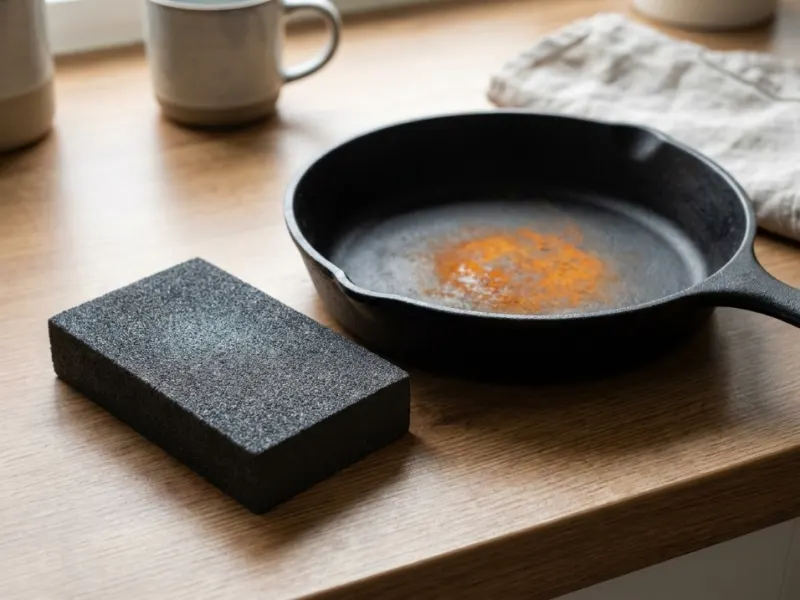
A Lodge Rust Eraser run under warm water is what most owners reach for here. It isn't a novel invention. It's a rubber block loaded with silicon carbide abrasive grit, the same abrasive category knife collectors have used on carbon steel blades for years, sized and branded for cast iron.
That combination is what makes it targeted rather than indiscriminate. Steel wool works too, but the common complaint we kept seeing in owner threads is that it scratches through good seasoning around the rusty spots, not just the rust itself, wherever it happens to touch. The rust eraser is more selective, but it isn't seasoning-proof either.
A hands-on video review of the product found it lifts some seasoning right at the treated spot while it removes rust. Lodge's own product page confirms this, noting it "removes rust down to the bare iron, requiring reseasoning." That corrects a common overclaim in cast iron guides. It's still a better trade than steel wool across an entire seasoned surface, just not a zero-damage tool. On a brand-new or already-stripped pan with no seasoning worth protecting, steel wool works fine.
Scrub the rusty areas with moderate pressure and the orange color comes off in seconds. Rinse, check for remaining spots, repeat until the surface shows grey metal instead of orange.
After scrubbing, wash with dish soap and hot water to clear the grit and rust particles. Set the pan back on the burner over low to medium heat and let it evaporate the water rather than air-drying, since air-drying with no heat is exactly what caused this in the first place.

For Heavy Rust (Thick Orange Layer, Rough Texture)#
When the rust eraser alone isn't cutting through, a chemical soak saves the scrubbing. A jug of Evapo-Rust works through selective chelation: its active ingredient bonds specifically to the iron in loose rust, and it's too weak to pull iron out of the base metal itself once the oxide layer is gone. That mechanism is the actual reason the metal itself is not at risk from an overnight soak, unlike an acid that keeps eating at bare iron the longer it sits. Rinse thoroughly after any soak either way, the same as the manufacturer instructs, before scrubbing and reseasoning.
Pour enough into a basin to fully submerge the pan, soak for 30 minutes or more, then scrub with steel wool. It rinses off completely afterward.
One real caveat worth knowing: a soak that runs for days rather than hours can leave a black film behind. Evapo-Rust's own manufacturer FAQ explains this as carbon migration, a cosmetic effect where carbon already in the metal concentrates near the surface as iron is pulled away, not actual metal loss. Wipe it off and move on.
Vinegar does the same basic job for less money. A 50/50 white vinegar and water soak dissolves light rust well enough. But vinegar's acetic acid has no equivalent stopping point.
It keeps reacting with the iron itself once the oxide is consumed. That is why cleaning guides disagree wildly on a "safe" soak time. The figures we found while researching vinegar ranged from 30 minutes to 8 hours, both stated as settled fact. Since there's no real ceiling, the safer habit is to keep any vinegar soak under 30 minutes and check every 10-15 minutes rather than trust a specific number someone else picked.
Reseasoning After Rust Removal#
Once the rust is off, that bare grey iron needs new seasoning fast, or it can rust again in a humid kitchen before you get back to it.
The process itself stays simple. Apply a thin coat of grapeseed oil over the entire pan: cooking surface, sides, bottom, handle. Grapeseed bonds into the pan without flaking off the way flaxseed tends to. Wipe with a clean paper towel until the pan looks completely dry; what remains, that invisible film, is exactly the right amount.
Place upside-down in a 450-degree oven for an hour. Yes, that's above grapeseed's smoke point, and that's the point: the oil needs to break down and bond to the metal rather than just sit there. Put a sheet of foil on the rack below to catch drips, and let the pan cool inside the oven with the door closed. Repeat until the pan holds a uniform matte brown layer rather than showing bare grey patches.
After those initial coats, the pan won't look like it did before. It comes out matte brown rather than the deep black it had, and that color builds back over weeks of regular cooking with oil. Water beading up instead of sitting flat, and food releasing without sticking, are the signs it's working, usually after a few oven cycles and some nights of regular cooking.
For the full breakdown on seasoning oils and why grapeseed is the default, our oil comparison covers the alternatives and where each one falls short. Curious how closely we check a claim like a rust eraser's actual material composition before it goes in an article? Our review process walks through it.
Preventing Rust Going Forward (The 2-Minute Routine)#
Rust is almost never bad luck or a defective pan. It comes from skipping the one step that matters after washing. Here's the routine that prevents it, every time:
- Rinse while the pan is still warm (hot water, stiff brush, soap if needed).
- Set it back on the burner over medium heat until bone dry. On a glass top, set it down gently and let the residual element heat finish the job.
- While it's still warm, wipe one thin layer of oil over the cooking surface with a paper towel.
That third step is the real insurance. The oil fills microscopic pores in the seasoning and blocks moisture from reaching bare iron underneath. It takes 15 seconds, and the pan can sit in the cabinet for weeks without a single orange spot.
In a humid climate, or with pans stacked together, a paper towel tucked between them absorbs condensation before it ever touches the surface.
When Rust Keeps Coming Back#
Following the drying routine and still seeing rust within days usually means one of two things. Either the seasoning has thin spots, common if acidic foods like tomatoes get cooked in it often, or the storage environment is too humid.
Thin seasoning calls for a full oven reseasoning cycle, the same process described above. Humidity calls for the paper towel trick or a drier storage spot. We covered the full climate-based storage approach in how to store cast iron skillet for anyone dealing with recurring rust rather than a one-off.
A pan that keeps feeling sticky after seasoning is often a symptom of the same root mistake: oil applied too thick. That leaves uneven coverage that eventually lets moisture through in thin spots, which is the same setup that produces rust. Fixing the application technique solves both problems at once.
Should You Just Buy a New Pan Instead?#
For a pan with only surface rust, no. A cheap rust eraser and an hour of your time restores it completely. Cast iron doesn't wear out the way a coated pan does. The iron underneath is the same whether the pan is six months old or sixty years old; what makes it non-stick is the accumulated seasoning, and that rebuilds with use.
For a heavily pitted pan inherited from a relative's garage, it comes down to how much effort feels worth it. An overnight Evapo-Rust soak plus aggressive scrubbing and a few oven seasoning cycles can bring back even a genuinely neglected pan, sometimes repeated once more if the first round still looks patchy. If the goal is something that works tomorrow with less effort, a new Lodge sits at the budget end and arrives pre-seasoned. Our beginner's guide covers how to pick a first pan or a straightforward replacement.
Once rust gets fixed the first time and the process turns out to be this straightforward, it stops feeling like a fragile object that needs babying. It's a chunk of metal. Cook with it, clean it simply, keep it dry. Doesn't ask for much.
If maintenance still feels like too much overhead, a carbon steel pan is a lighter weeknight complement worth adding once you have the cabinet space for a second large skillet, not a replacement for the one you already have. It sears just as well and weighs noticeably less than cast iron.