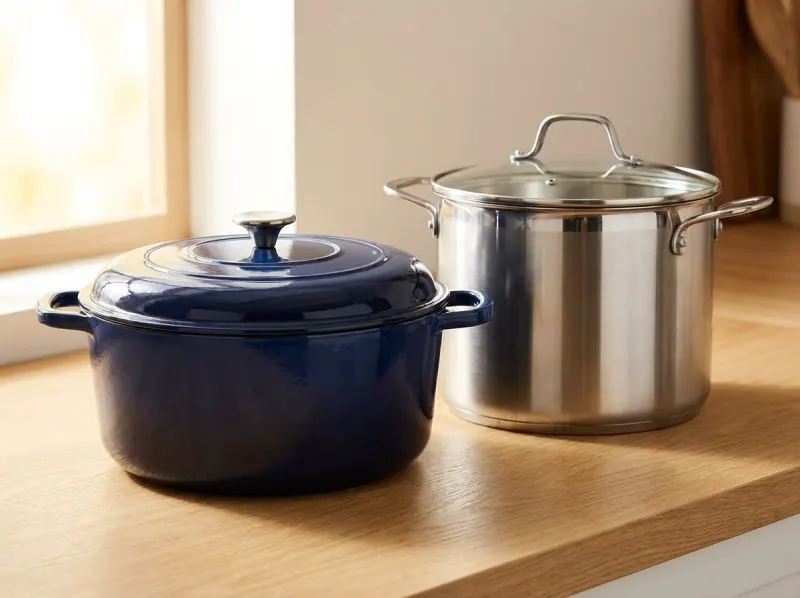
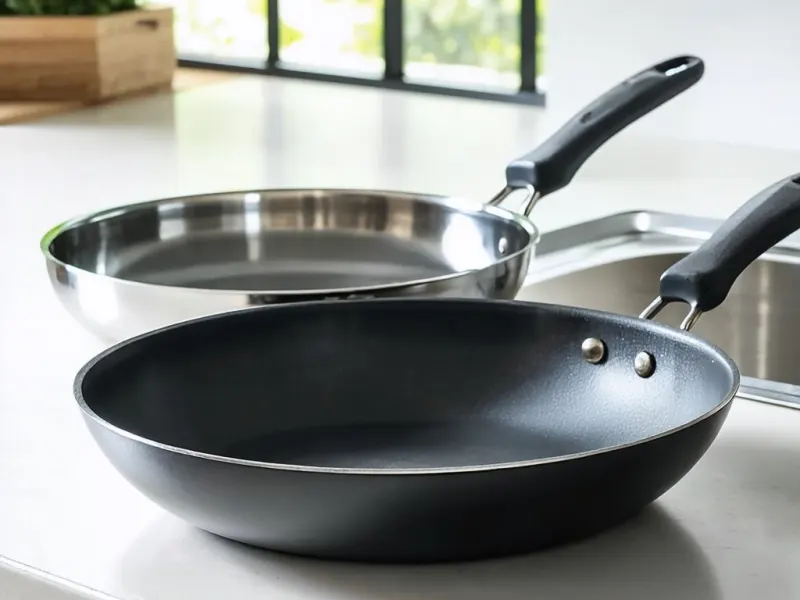
We went looking for the real answer on carbon steel versus stainless steel expecting the usual line: stainless is the safer, more forgiving metal on a glass-top or induction stove. Then we read de Buyer's own product pages for its carbon steel line, and the brand was pointing at something else entirely.
Buy carbon steel for eggs, fish, and high-heat searing.
Buy stainless for sauces, acid, and a pan you can ignore in the dishwasher. If your stove has a glass or ceramic surface, though, don't decide by metal at all. Decide by gauge.
A thicker, heavier pan of either material holds its shape under heat-cycling stress better than a thin one does, and the manufacturer we checked says so in its own words.
Here's the part almost every carbon-steel-vs-stainless guide skips.
What Carbon Steel Does That Stainless Steel Cannot#
Carbon steel feels thin and light next to cast iron, and that's the point. It preheats fast enough that you'll notice, and it drops in temperature the moment you turn the dial down, which matters on an element that cycles between full blast and nothing.
Once the pan builds up seasoning, the layer of baked-on oil that bonds to the surface, it releases eggs and fish like a worn-in cast iron. Nothing flakes into your food.
It also shrugs off heat that would scare a nonstick pan. Get it screaming hot for a steak crust or a quick batch of blistered vegetables, and nothing degrades. For how the two seasoned metals differ, carbon steel vs cast iron breaks it down.
One heads-up specific to the de Buyer Mineral B: the steel handle gets hot on the stovetop. Keep a folded towel within reach.
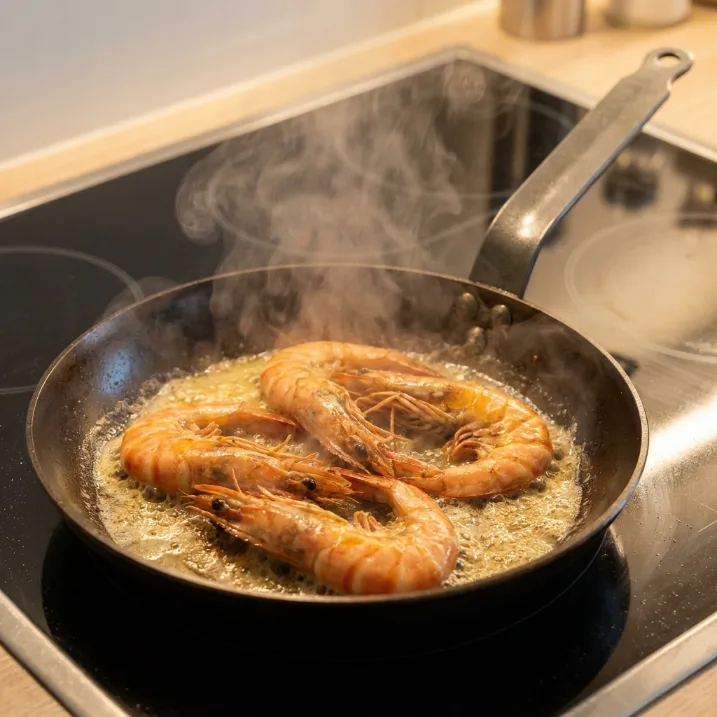
What Stainless Steel Does That Carbon Steel Cannot#
Stainless is the opposite personality. There's no seasoning to strip, so a tomato sauce, a wine reduction, or a squeeze of lemon won't ruin the surface the way it can on a young carbon steel pan. That's exactly where carbon steel punishes you.
Fully-clad construction is what makes a good stainless pan even across the whole surface. Aluminum runs from base to rim, instead of scorching food in a hot ring the way a cheap disc-bottom pan does. Made In's own 5-ply Stainless Clad line is built this way, with an aluminum and aluminum-alloy core wrapped in stainless inside and out.
Stainless also builds fond, the browned bits that turn into a two-minute pan sauce with a splash of wine or stock. Carbon steel can build fond too, but the dark surface hides it, and on a young pan a splash of wine can set the seasoning back.
If you already suspect food sticks to stainless more than it should, that's a technique problem, not a pan problem. Why everything sticks to stainless steel pans walks through the fix. For most people, the right preheat becomes second nature after a handful of tries.

Carbon Steel and Stainless Steel Maintenance#
de Buyer's own instructions for the Mineral B Classic are stovetop-only. Wash off the beeswax coating with hot soapy water, heat the pan with a little oil for about 10 minutes, let it cool, wipe, then heat again for about 2 minutes. de Buyer says that single pass is enough to start cooking.
Owners report the beeswax step takes more effort than the instructions imply. Two separate reviewers needed either a slow bake upside down in the oven or a Bar Keeper's Friend and salt scrub to fully strip it before that first seasoning round.
Stainless has a gentler quirk. It often turns a faint rainbow color in the first month: heat tint, the thin oxide layer thickening from heat. Plenty of owners scrub at it before learning it's purely cosmetic.
Bar Keeper's Friend clears it in seconds. Stainless steel pan discoloration covers the other four types you might see. Made In's own care page prefers hand wash for its Stainless Clad line, even though the line is technically dishwasher-safe.
The Glass Top and Induction Warp Question#
Here's where the manufacturers disagree with the folk wisdom. de Buyer's own product pages for the Mineral B line all carry the same phrase in the description, across four sizes we checked from the omelette pan up to the largest fry pan: "Undeformable thick skirt."
That's de Buyer's own explanation for why the pan holds its shape under heat. It points at gauge, not at carbon steel as a material.
That lines up with what we already knew was true across the category once we checked the weights ourselves. de Buyer's own Blue Carbon Steel line runs a thinner 2mm wall and weighs 4.8 lbs at 12.5 inches, lighter than the Mineral B's 5.2 lbs at that same size. Thickness costs weight, and the manufacturer's own position is that the trade buys a pan that won't warp.
Lodge's thin-gauge carbon steel skillet runs lighter still, at 4.15 lbs. That's nowhere near the roughly 7.9 lbs a comparable 12-inch cast iron skillet carries, but it's a different balance of the same trade-off.
We'd extend the same logic to stainless. A fully-clad pan resists the uneven expansion that warps a cheap disc-bottom pan, where the aluminum sits only in the base and the sidewalls heat differently than the middle. That's our own inference, not a separately tested claim. It rests on the same mechanism de Buyer describes for its own line: enough metal, distributed evenly, resists stress that thin metal cannot.
A glass-top element makes this matter more than a gas burner does. Radiant elements cycle on and off even at the highest setting, and the surface stays hot after the element clicks off to keep the heat "uniform and consistent." That sounds calm until you remember a thin pan bottom rides those swings the whole time a thick one barely notices.
If you're shopping specifically for a glass-top or induction range, skip the material debate. Pick the heavier-gauge carbon steel pan, or the fully-clad stainless pan, in your size. Gauge decides whether either one stays flat.
Carbon steel's other advantage here has nothing to do with warping. It's flat-out ferromagnetic, so any carbon steel pan grips an induction element without a second thought. Made In's own 12-inch Stainless Clad page confirms compatibility with every stovetop type including induction, so neither material locks you out.
Not every stainless pan is built the same way, though. If you're unsure whether a specific model works on your cooktop, run it through the induction compatibility checker before you buy.
Carbon Steel or Stainless Steel for Eggs and Steak?#
For eggs, carbon steel wins once it's seasoned. A well-used pan slides an omelette out like a nonstick. Stainless won't do that without more fat and better timing.
For steak, it's closer than you'd think. Carbon steel comes up to temperature fast and takes a hard sear at heat that would wreck a nonstick pan. But a well-preheated, heavy stainless pan earns just as good a crust. If searing is the main event, cast iron vs stainless steel compares the heavier options.
Both pans go straight into the oven too. Just remember a towel for the handle. de Buyer caps the Mineral B's oven use at a "Flash oven" 392°F specifically because of its epoxy-coated riveted handle, stricter than the brand's own Pro and Blue Carbon Steel lines.
For a quick personalized read on which material fits your kitchen, the material selector quiz walks through it in under a minute.
Which One Should You Buy First?#
Match the pan to what fills your week. Eggs, fish, and quick high-heat cooking point to carbon steel. Sauces, acid, and dinners you'd rather not babysit point to stainless.
If you're buying with a glass-top or induction range specifically in mind, buy on gauge first and worry about the metal second.
For carbon steel, the de Buyer Mineral B earns the recommendation. It's heavy for its category, grips induction on its own, and honest about the one place it falls short: that low oven ceiling on the standard line.
For stainless, the Made In 10-inch Stainless Clad is the pick. It's built on the same 5-ply construction as the rest of the line, with hand-wash preferred over the dishwasher despite being rated for it. That's a small ask for a pan built to outlast plenty of dishwasher cycles either way.
The honest version of this debate isn't carbon steel against stainless. It's whether the pan in your hand is built heavy enough for the stove you actually have. Buy the second material once you catch yourself wishing the first could do the other job. For most cooks, that takes a few months.