Most home cooks start with exactly one good pan, a nonstick skillet babied like it's made of glass. Then they read about carbon steel and assume it will let them throw the nonstick away. But is that actually the right call, or is the nonstick already covering everything that matters?
Carbon steel and nonstick are partners, not substitutes. Carbon steel handles browning, fond, stir fry, and decades of use. Nonstick stays the low-effort pan for eggs and delicate fish, though owners commonly report replacing it within 2-3 years. If you only cook low-heat breakfasts, buy nonstick first; if you sear or stir-fry, add carbon steel.
The carbon steel vs nonstick pan question isn't about which one replaces the other. It's about which jobs each one handles without fighting you. Once you've cooked on both, the split turns out to be cleaner than expected.
A carbon steel pan like the de Buyer Mineral B and a nonstick pan like the T-fal Experience make a useful side-by-side for this, because they sit at opposite ends of nearly every tradeoff that matters. After reconciling the material pages, product specs, and lifespan sources, we think the answer for an electric glass-top kitchen is less dramatic than either camp makes it sound: each type earns its spot, and the real mistake is spending twice for the same job.
What Carbon Steel Does That Nonstick Cannot#
The defining feature of carbon steel is that it takes real heat. Manufacturers tell you to keep a nonstick pan under about 500°F because PTFE begins releasing fumes past that point. That means it can never deliver a genuine sear.
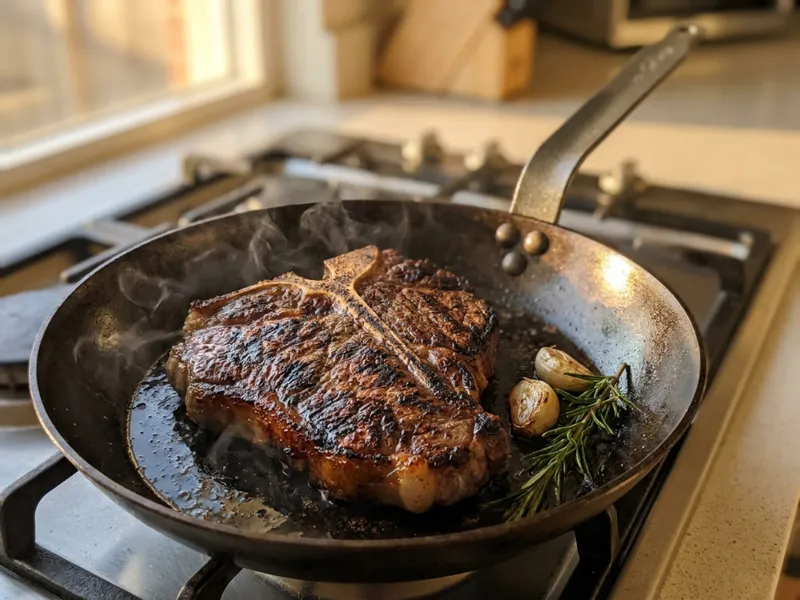
Carbon steel doesn't care. Preheat it screaming hot, drop in a steak, and you get a dark crust in two minutes. Weeknight steaks come off carbon steel with a sear no nonstick pan can manage.
It also builds fond, those browned bits that stick to the bottom after something sears. Splash in a little stock or wine, scrape, and you have a pan sauce in two minutes. Nonstick can't do this by design, because nothing sticks long enough to brown. Turning a plain chicken thigh into something worth eating starts with that fond.
Then there's lifespan. Carbon steel has no coating to wear out.
The cooking surface is a layer of seasoning, baked-on oil that hardens into a slick film and actually improves the more it's used.
A carbon steel pan can have a rough start, but once it's stripped of its factory coating and re-seasoned with grapeseed oil, it only gets better. It's a decades-long tool. Whether the upkeep is worth it gets covered in is a carbon steel pan worth it.
One more practical point for anyone on a glass top or induction: carbon steel has a flat bottom, easy to lift on and off without dragging and scratching. It's iron, so it works on induction without a second thought.
How much lighter it is than cast iron depends on the specific pan. Thinner-gauge lines like Lodge's carbon steel run close to half the weight of a comparable cast iron skillet.
De Buyer's Mineral B uses a thicker gauge chosen for heat retention. It runs only around 25% lighter than a comparable cast iron skillet, a real difference you'll feel but nowhere near "half." Gauge choice matters as much as material choice here. Check the specific pan's gauge before assuming a universal weight ratio.
What Nonstick Does That Carbon Steel Cannot#
There's a reason most carbon steel owners keep a nonstick pan around too.
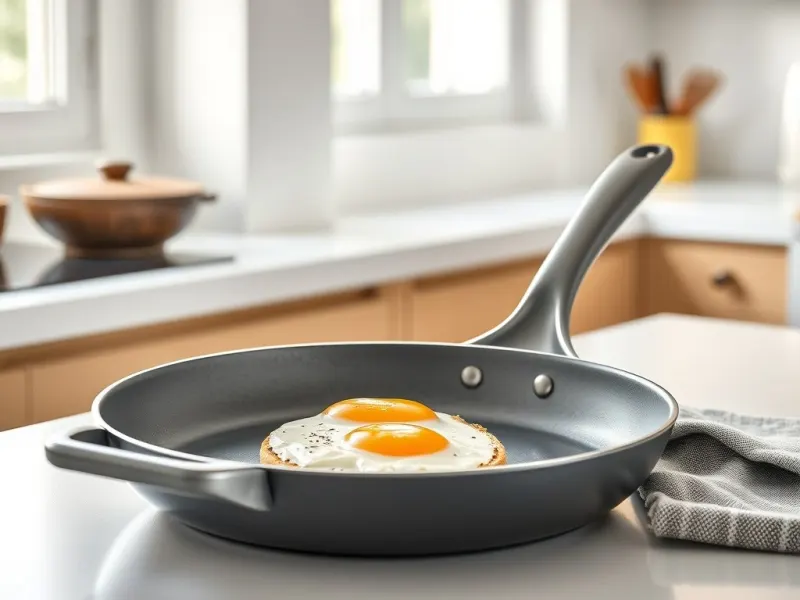
Nonstick has zero learning curve. An egg slides out the first time it's used, with barely any butter, on day one, with no seasoning, no preheating ritual, no technique. Carbon steel will eventually cook a decent egg, but only after weeks of building seasoning, and even then it's fussier than a coated pan. For anyone cooking eggs almost every morning, nonstick is the pan that gets reached for every time.

It's also the right tool for anything delicate. Fish fillets that would tear apart sticking to bare metal release clean from nonstick. Crepes, omelettes, pancakes, reheating last night's rice without it welding to the pan: this is the low-effort, low-fat lane, and letting food slide out with barely any oil is the whole point of a coating. Carbon steel simply isn't as good at it.
The catch is that nonstick is a consumable. The coating breaks down a little every time it heats up and cools down, no matter how careful anyone is. Crank the heat or run it through the dishwasher and it fades even faster.
A nonstick pan isn't a permanent tool. It's a few good years of effortless eggs.
The Lifespan Tradeoff#
This is the part that reframes the whole comparison. Carbon steel is a one-time purchase that outlives the person who bought it. Nonstick is a recurring cost. Once it's viewed as a monthly expense rather than a single purchase, the buying decision gets simple.
Owner reports set the planning window. Amazon reviewers across multiple PTFE brands commonly report 2-3 years of effective release with normal daily use. Careful owners who stick to medium heat and hand washing report 4-5 years; heavy or careless use shortens that to under a year. Reinforced multi-layer coatings hold up longest within the same PTFE chemistry.
That is long enough for a mid-range pan to make sense as the price of effortless eggs. It is too short for a premium body to become a buy-once surface.
Where people go wrong is spending several times more on a premium nonstick expecting it to last proportionally longer. It won't. Reinforced coatings can hold up better inside the same chemistry, but they do not change the buying rule, which is exactly why expensive nonstick pans aren't worth it.
Enter your nonstick and carbon steel pan prices in the cookware cost calculator to compare replacement spending across the years you select. That's part of how we approach our review methodology generally, cost per year rather than sticker price alone.
Is Carbon Steel Safer Than Nonstick?#
Many people land here because they want out of Teflon. To be clear: modern PTFE coatings have been free of PFOA since the EPA's stewardship program phased it out of manufacturing by 2015.
Research on polymer fume fever says PTFE releases fumes at temperatures as low as 500°F. Human symptoms generally do not start until the pan is heated to 662°F.
Pet birds are different. VCA Animal Hospitals says most PTFE poisoning cases occur when nonstick cookware is overheated or burned. It also says cases have been reported from PTFE products used at recommended temperatures.
A veterinary case report describes bird PTFE toxicosis as pulmonary hemorrhage and edema. The same report puts the PTFE surface-degradation threshold at 280°C (536°F).
But if avoiding coatings entirely is the goal, the useful insight is that in this matchup, carbon steel already is the coating-free pan. A nitrided hybrid pan that tries to split the difference gets a full look in our Misen Carbon Nonstick review; it's worth a look if the seasoning ritual itself is the sticking point. Otherwise, carbon steel is iron and seasoning, nothing sprayed on, nothing to scratch into food.
There's no need to chase a ceramic pan to escape PTFE. Ceramic owners frequently report losing nonstick release within months to about a year and a half, while careful PTFE owners commonly report 4-5 years. That makes ceramic a safety choice for people who want PTFE-free cookware, not a durability upgrade. For more on the safety details specifically, is ceramic cookware safe goes deep on that comparison.
Carbon Steel vs Nonstick Pan: Where Each One Wins#
Here's the decision pass, stripped to the job each pan should own.
Eggs and crepes: nonstick.
Searing steak and chops: carbon steel.
Stir fry and high-heat vegetables: carbon steel, especially on an electric stove where lifting the thin pan gives you faster temperature control. For a practical use-case breakdown, see best pan for cooking vegetables.
Fish fillets: nonstick for flaky white fish; seasoned carbon steel for skin-on fish.
Acidic cooking with tomato or wine: neither. Use stainless steel.
Which One Should You Buy?#
If there's room for only one pan and the cooking is mostly eggs and quick weeknight dinners, get a good nonstick and don't feel bad about it. A budget T-fal nonstick holds up fine for daily eggs, and that's exactly the lane to shop in. For a sturdier body in that same tier, a hard-anodized pan resists the warping that kills flimsy stamped nonstick on an electric coil.
The Anolon Advanced Home 2-Piece Skillet Set fits the brief: a hard-anodized body with an extra-thick base plate for even heat, oven-safe to 400°F. It comes as a matched 10.25-inch and 12.75-inch pair, so there's no need to choose a size.
One official-page owner review called it a workhorse after 2 years while noting the finish was not as slick as new, which matches the usual PTFE caveat. For more on choosing a coated pan that lasts, see the best nonstick pan that actually lasts.
For anyone cooking with real heat (searing, stir fry, anything where flavor comes from browning) carbon steel is the better long-term buy. Upkeep is lighter than people fear: rinse it hot, dry it over the element, wipe a little oil in, done. The most common way to strip a partially-seasoned pan is deglazing with wine before the seasoning is established, a beginner mistake, not a daily chore.
The de Buyer Mineral B is excellent but runs at the pricier end of carbon steel and ships with a factory beeswax coating that needs scrubbing off before the first seasoning, so it needs prep before it earns its keep. The Merten & Storck Pre-Seasoned Carbon Steel 12 inch is the softer landing: it ships already seasoned, costs a fraction of the de Buyer, and carries thousands of ratings with the thin-gauge caveat below.
One thing worth knowing before buying it for a glass-top stove specifically: it's thin-gauge construction, part of why it's light enough to lift comfortably. That same thin gauge carries some warping risk on glass cooktops if it's ever left on high heat empty, and the metal handle runs hot during extended stovetop use. Keep the heat moderate and it holds up fine.
A premium pan like the Matfer Bourgeat costs more and still arrives needing seasoning from scratch. Carbon steel in general is easier to handle on a glass top than cast iron thanks to the smoother stamped bottom, it works on induction, and like any carbon steel pan, it outlives the person who bought it.
The right answer for most kitchens is one of each. One carbon steel pan plus one nonstick pan covers nearly everything, and the matched Anolon pair earns its place if the cabinet has room for both sizes. If space is tight, a single nonstick pan in whichever size gets used most does the eggs-and-delicate-food job just as well as a matched pair.
A carbon steel pan bought once costs less over a decade than premium nonstick replaced repeatedly, even accounting for a cheap nonstick replaced every couple of years for eggs. With a deep enough seasoning, a carbon steel pan will eventually handle eggs well enough to skip nonstick entirely, and plenty of cooks do exactly that.
For most people, the two-pan split is the path of least frustration. For anyone still weighing options beyond these two, our cookware material selector covers all six common materials and matches them to cooking style. The mistake isn't picking the wrong one. It's buying two pans that do the same job.