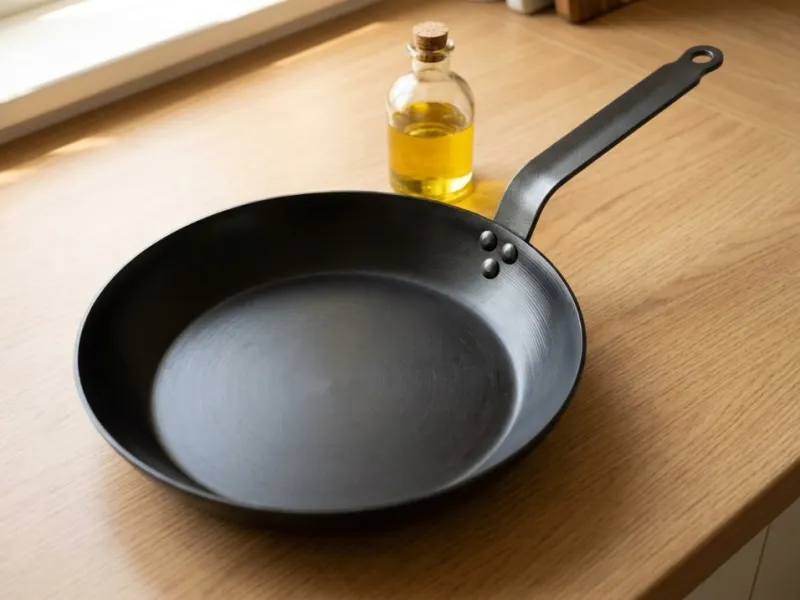
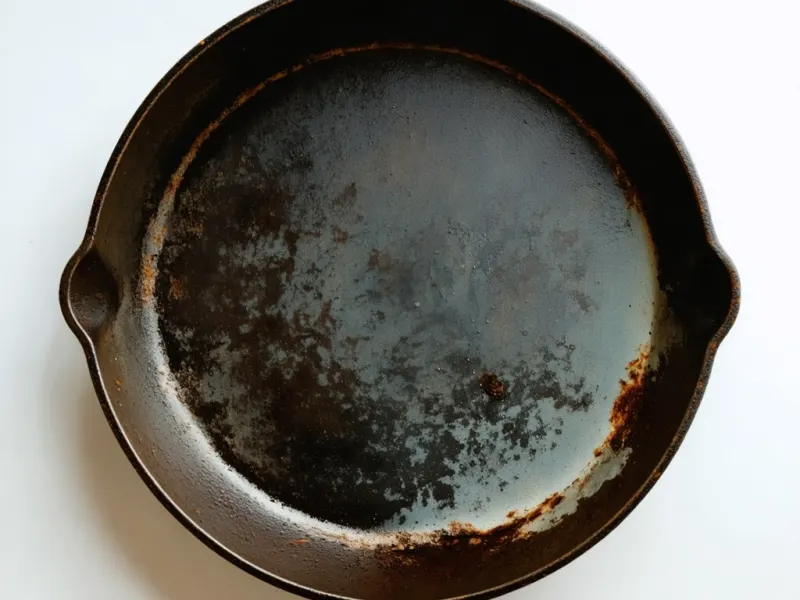
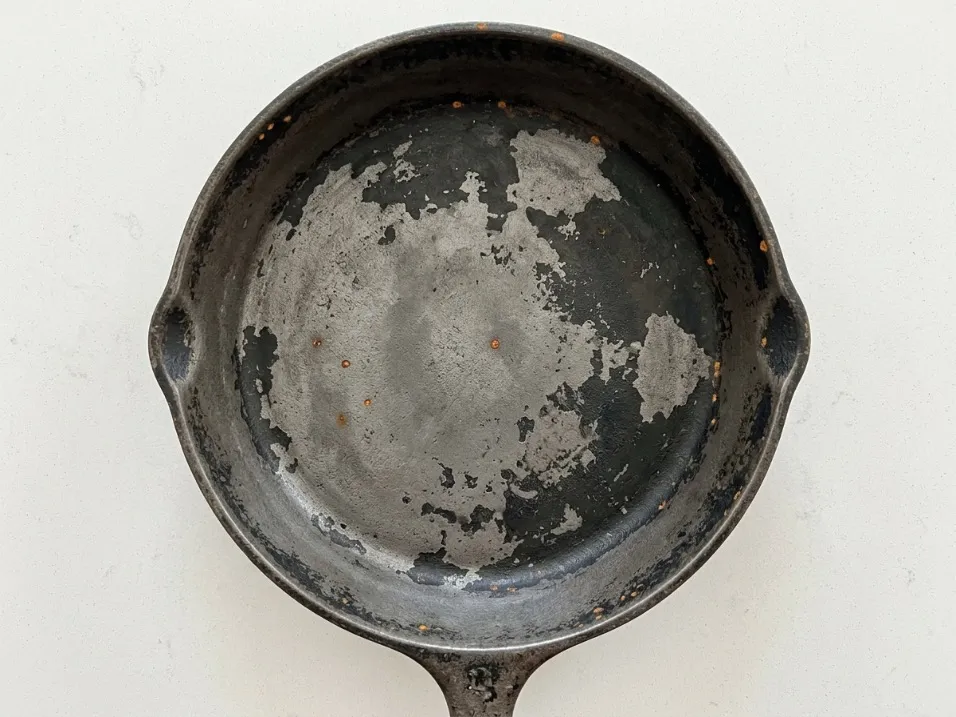
You did everything right. Thin layers, high heat, patience. Weeks later, flakes are showing up in your food anyway, and every guide you find points straight at your choice of oil.
Carbon steel pan seasoning coming off shows up in three different ways, and each one traces to a different cause. A sticky, gummy surface means a coat went on too thick and never fully cured. Flaking that appears fast, often during the very first wash, usually traces to flaxseed oil specifically. Coming apart even though you applied it thin points to a heat problem, not the oil sitting in your cabinet.
The advice to switch oils only fixes one of those three problems. That's exactly why so many people re-season with a "better" oil and watch the same flaking come back a few weeks later.
What's Really Behind Carbon Steel Pan Seasoning Coming Off#
Sticky or gummy, and it never fully hardens. Seasoning starts as a thin film of oil. Heat pushes it past its smoke point, and the fat breaks apart into smaller pieces that rejoin into much longer chains bonded to the metal.
That reaction is also what makes the layer protective once it's finished curing. De Buyer describes its own factory beeswax coating in the same terms, a "protective finish against oxidation," and the cured seasoning takes over that same job once the beeswax is gone. Care guides like the University of Maine Cooperative Extension's cast iron instructions treat that layer as something to protect, not scrub or soak away.
A thin layer finishes that reaction all the way through. A thick layer hardens on top before the oil underneath ever gets there. The surface looks done. The inside stays liquid, and cooking in it a few times turns that trapped oil sticky and gummy, no matter which oil you used.
We see the same mechanism on cast iron skillets. The same thickness problem shows up there too. Carbon steel just shows it faster, because thinner metal heats and cools with every burner adjustment, and that constant movement stresses whatever coating happens to be sitting on top.
Flaking that showed up fast, often during the very first wash. This one has a named cause. Flaxseed oil cures into the hardest, most rigid polymer of any common seasoning oil. A rigid coating can't flex as the metal expands and contracts on the stove, a repeated stress called thermal cycling, and it fails even when applied correctly thin.
A Smoking Meat Forums thread walks through one cook's experience: a fresh flaxseed layer lost roughly 70 percent of its coating during the very first hot-water cleaning after the first meal. Years earlier, in 2019, a cooking.stackexchange.com commenter had already warned that flaxseed seasoning is "notorious for flaking later." Different site, different year, same specific oil singled out for the same specific problem.
Coming apart even though you're confident you applied it thin. This points to heat, not thickness. The oil has to clear its smoke point to fully polymerize. Stop short of that and the layer stays partly liquid underneath, the same trapped-oil problem as a too-thick coat, just caused by too little heat instead of too much oil.
Two different cookware makers agree on which oils sidestep the flaxseed problem, and neither is talking about the other's pan. de Buyer's own seasoning instructions for the Mineral B name grapeseed oil first among a short list of acceptable high-smoke-point oils, alongside avocado, canola, and sunflower.
Lodge's Test Kitchen guidance for cast iron names a different, overlapping list: vegetable oil, melted shortening, or canola oil. Different makers, different pans, same class of oil. Grapeseed is de Buyer's named pick for this specific pan, not the only correct answer, and any ordinary high-smoke-point oil in that shared class does the job. Flaxseed, the oil with the documented case above, is the one no manufacturer's instructions mention, and nothing comparable turned up for the oils they do recommend.
De Buyer Mineral B's Beeswax Problem#
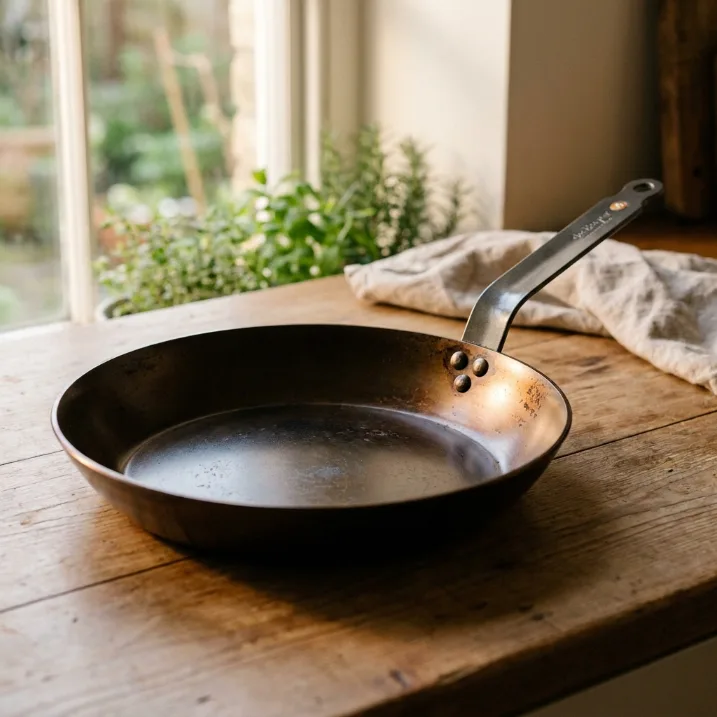
If you're working with the de Buyer Mineral B, there's a step before seasoning even starts. de Buyer's own instructions say hot soapy water removes the factory beeswax coating. Owner reports tell a messier story. One 2019 review says hot soapy water "does not seem to be effective," and a separate 2017 review needed Bar Keeper's Friend plus a salt scrub to get the wax off completely.
Budget for the stronger cleaner before your first seasoning session, not after you've already burned a layer of oil onto half-removed wax. Mineral B also runs on the heavier end of carbon steel, about 5.2 lbs at 12.5 inches versus roughly 7.9 lbs for a comparable cast iron skillet, a real but modest weight savings rather than the "half the weight" some carbon steel marketing implies.
Diagnose Your Specific Failure Before You Fix It#
We keep seeing three different problems lumped under "seasoning coming off," and the right fix depends on which one you actually have.
- A small bare spot showed up right after cooking something acidic (tomato sauce, wine, citrus, vinegar), with no cracking or stickiness anywhere else on the pan.
- A small bare spot appeared, but nothing acidic was involved and the rest of the surface looks fine.
- Flaking is spreading, the surface feels sticky all over, or you seasoned with flaxseed and it's coming apart in sheets.
The first two look almost identical from across the kitchen. The fix could not be more different.
Match the Fix to the Failure#
An acid-exposure spot needs patience, not a strip. Cooking your normal high-fat, high-heat routine fills the gap back in on its own. Chasing it with more oil or a scrub just restarts the same young-coverage problem you're already fixing by cooking.
An isolated spot with no acid involved is the easiest failure to fix. Scrub just that patch with a chainmail scrubber down to bare metal or stable seasoning, then re-season only that area using the same stovetop method you'd use on a new pan, repeating until the spot darkens to match the surrounding seasoning. Leave the rest of the pan alone.
Widespread flaking, all-over stickiness, or a flaxseed layer coming apart calls for a full reset. Heat the pan on high until any loose flaking burns off and releases, then scrub to bare metal with coarse salt or steel wool. A stubborn case gets a lye bath instead, an extended soak in a lye-based cleaner rather than a quick wipe.
Skip the oven's self-clean cycle if you're resetting a Mineral B specifically. A manufacturer's own self-clean documentation describes the cycle burning built-up soil "to a powdery ash," a process that runs well past anything a stovetop reaches, and Mineral B's own oven rating tops out at 392°F for brief use, limited by its epoxy-coated handle. de Buyer's own instructions call for seasoning the Mineral B Classic "on the stovetop only." That makes the stovetop route the safer strip method too.
Once you're back to bare metal, re-season with grapeseed oil using de Buyer's own method for this pan. Spread a thin coat over the whole surface, heat for about 10 minutes, then let it cool. Drain and wipe off the excess, then heat one more time for about 2 minutes.
de Buyer says that single pass is enough to start cooking. Regular use builds further layers on its own.
Why "Avoid Acid" Advice Exists (And When It Stops Mattering)#
Every seasoning guide says the same thing. Don't cook anything acidic until the seasoning is established. Almost none of them explain why.
The cured polymer itself doesn't dissolve in tomato sauce or wine. A fully cured layer is the same protective barrier that keeps the pan from rusting in the first place, not a liquid fat that acid can break down. What acid actually reaches is bare iron, and young seasoning is thin enough to still have microscopic gaps in coverage.
Acid corrodes the exposed iron right at those gaps and lifts the seasoning around the edge outward. That's the bare spot you're looking at, not proof the oil failed.
This is also why the advice has an expiration date. A pan with only two or three layers has more of those gaps. A pan cooked in several times a week over the following months builds up enough overlapping coverage that there's no exposed metal left for acid to reach.
Getting Seasoning That Actually Holds#
If switching oils never actually fixed your flaking, check your symptom again. A sticky, gummy surface and a coat that keeps coming apart despite thin application both point at thickness or heat, not the bottle. Watch how thin you're applying each layer, and confirm you're actually reaching smoke point, before you touch your oil shelf.
Ordinary kitchen oils in that shared class carry no comparable failure reports in what we reviewed. If you want the boring, drama-free answer, that's it. Flaxseed is different: a Smoking Meat Forums thread documents a fast layer failure, and a separate cooking.stackexchange comment calls it notorious for flaking, one documented account and one reputation, not two reports of the same event. That combination is why we'd reach for grapeseed or another high-smoke-point oil first, even on a pan you don't mind stripping and redoing.
For a de Buyer Mineral B specifically, plan on the stronger beeswax cleanup up front, respect its 392°F oven ceiling, and re-season with grapeseed on the stovetop rather than in the oven. Do that, and the flaking that sent you looking for a new bottle of oil mostly stops coming back.

Every carbon steel pan behaves a little differently depending on gauge and how you cook with it. If you're still weighing whether carbon steel is the right material for your stove at all, our material selector quiz walks through the tradeoffs in a couple of questions, and carbon steel vs cast iron covers when each one actually wins. The right oil for a cast iron skillet covers the same symptom-first diagnosis for cast iron's thicker walls.