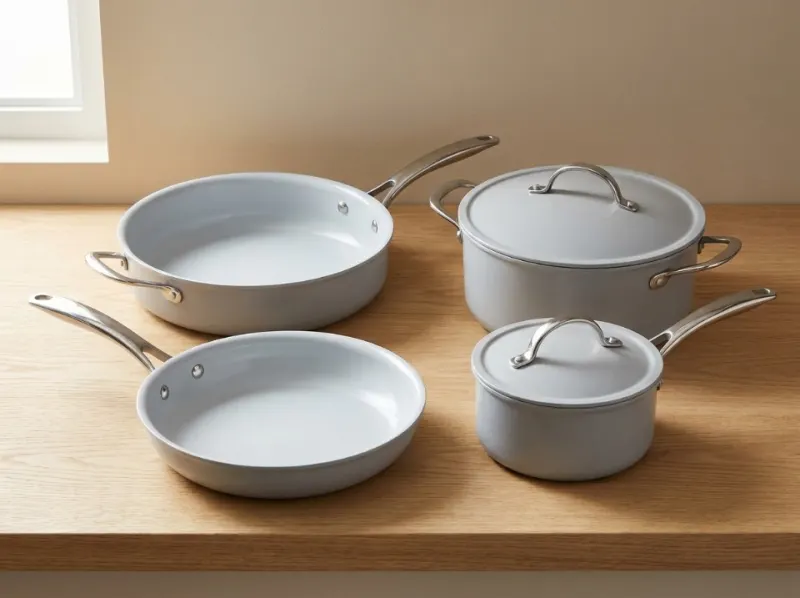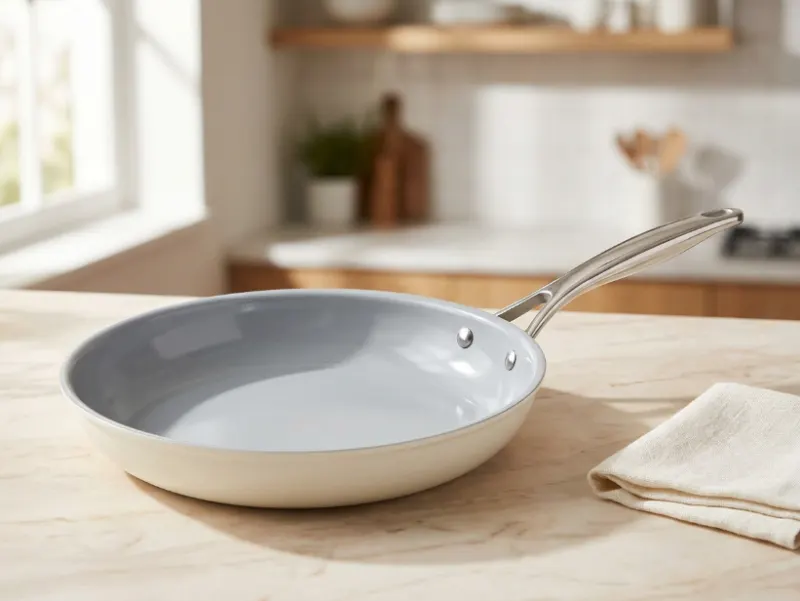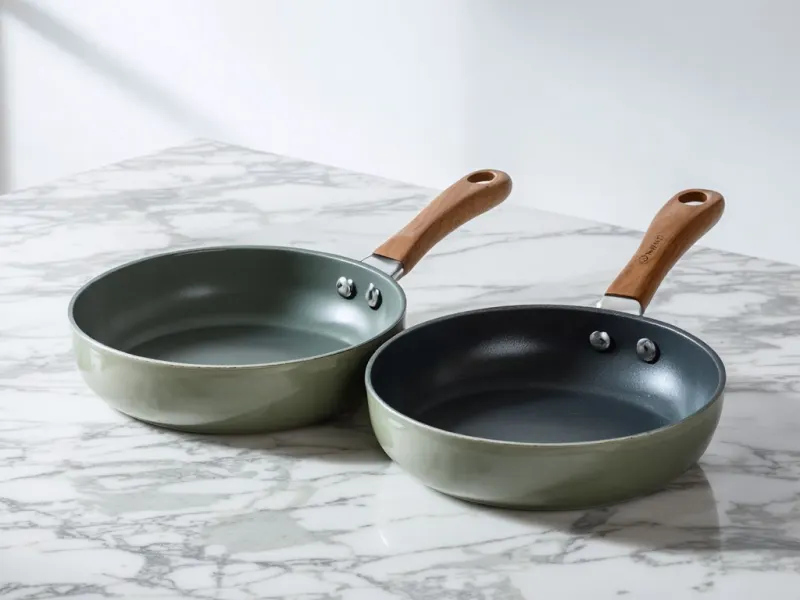
You want to know which ceramic coating holds up longer, Caraway's or GreenPan's, before you spend on either one. Real owner reports do not answer that the way you would expect.
Amazon owner reports do not show GreenPan's Valencia Pro outlasting Caraway's coating. If anything, the reports tilt the other way: Valencia Pro's own complaints cluster around 4 to 5 months, while some Caraway owners report closer to a year before problems start.
Both brands run the same underlying ceramic chemistry covered in our nonstick cookware buying guide, which explains why neither one reliably outlasts the other.
That does not make Caraway the pick. Valencia Pro still makes sense for a lot of readers, just not because of the coating. Its hard-anodized body is sturdier, its oven-safe ceiling is higher, and it costs less per pan than Caraway.
So why does Valencia Pro remain the more sensible default anyway? Construction. Warranty terms. What a pan is like to live with once the ceramic gives out, which the evidence says tends to happen sooner on Valencia Pro specifically, not later.
Caraway vs GreenPan: What the Coating Data Actually Shows#
We went looking for a real answer the same way we check every durability question. Real owner reports, not one lab's simulated stress test.
Caraway owners on Amazon report coating problems across a wide spread. One reviewer flagged failing nonstick performance about a month into daily use. Another titled their review around the 10-month mark. A third lost patience "after a year of use." Some Caraway owners, in other words, get close to a year of good use before problems start.
Valencia Pro tells a tighter story. Amazon owners we found report coating loss clustering around 4 to 5 months of regular use, and none in our sample reported a longer stretch for this specific line. That is earlier than the later end of Caraway's spread.
GreenPan's costlier GP5 line fails even faster: owners report losing release as fast as one month, on par with Caraway's earliest complaints. A separate, unidentified GreenPan line drew complaints out to about 16 months, longer than anything we found for Valencia Pro specifically, though that figure does not belong to Valencia Pro.
On the narrow point of coating durability, this does not favor Valencia Pro over Caraway. Our owner-report sample is small and skewed toward complaints, so treat this as a direction rather than a hard verdict either way. But it does mean you should not buy Valencia Pro expecting its coating to outlast Caraway's. The evidence points the other direction.

Construction: Where the Real Difference Sits#
Strip the coating question away and you are comparing two aluminum pan bodies with different treatments.
Caraway uses heavy-gauge aluminum with a magnetic steel plate bonded to the base, so it works on induction. One material. One build. One collection.
GreenPan's Valencia Pro line uses hard-anodized aluminum. That process hardens the metal's surface. It makes the body more scratch-resistant and more rigid than Caraway's standard aluminum.
The ceramic coating wears out on either pan eventually. When it does, the Valencia Pro's body is more likely to survive in one piece for a second life.
Caraway's one genuinely unique feature is coating the exterior as well as the interior. That keeps the outside looking uniform. It also means the exterior coating can chip on gas grates or with stacking, per owner reports. GreenPan's interior-only coating does not carry that tradeoff.
Oven Temperature and Everyday Specs#
Caraway's ceramic collection is rated oven-safe to 550°F. GreenPan's Valencia Pro pan body, with stainless handles and no silicone insert, is rated to 600°F. That 600°F figure covers the pan body only.
Use Valencia Pro's own glass lid and the lid's separate rating of 425°F governs instead, not the pan body's 600°F. Neither figure matters for stovetop cooking, but the gap matters if you regularly finish dishes under a broiler.
Both brands are genuinely PTFE-free and PFOA-free. Both publish their sol-gel makeup instead of leaning on a bare "non-toxic" claim, which you can cross-check yourself in our PFAS safety checker. The industry stopped using PFOA by 2015 under the EPA's Stewardship Program. That fact matters more than the marketing suggests.
The FDA clears PTFE for food contact under 21 CFR 177.1550. We covered the full safety comparison in our ceramic vs Teflon breakdown.
A Practical Way to Check Which Pan Is Actually Failing#
Check what is actually happening on the surface before you write off either pan as "done." A faint brownish film, usually starting at the edges, with a fingernail meeting slight resistance where the surface used to be slick, is cooking-spray residue. It is not coating failure. It comes off with a baking-soda paste.
Real coating failure looks different: grey or silver metal patches, or physical flaking on the surface itself. A pan that sticks with neither sign present is dirty, not dying. We go deeper on both failure modes in why nonstick pans stop working.
What Owners Actually Complain About#
The complaint patterns for both brands trace back to the category-wide weakness we covered in are expensive non-stick pans worth it. Sol-gel ceramic coatings are actually harder than PTFE, but they still lose their slick release faster.
The mechanism is different: ceramic relies on a thin surface layer that breaks down under heat and thermal cycling. Once that layer goes, food touches bare ceramic and sticks. No ceramic brand, including these two, has solved that chemistry.
Caraway's pattern skews toward exterior chipping. A subset of owners also hit real interior sticking within the first year, despite the highest price tag here. GreenPan's Valencia Pro pattern skews toward earlier-than-expected coating loss on a subset of pans.
GreenPan's warranty does not always back that up in practice. One Amazon owner had a chipping claim denied about 4 months after purchase, quoting GreenPan's own reply that its expert-review decisions are final. A separate Amazon owner warns other buyers outright not to trust the 2-year coating warranty. Either way, a warranty that excludes normal coating wear will not save you from a mid-cycle replacement on either brand.
The Real Decision#
The real tradeoff is not a ranking of one ceramic coating over the other. Our Amazon samples are too small and too skewed toward complaints to rank Caraway against Valencia Pro on coating life.
Valencia Pro's reports cluster at 4 to 5 months. Caraway's reports span about a month to over a year. That is owner-to-owner variance within each line, not proof either brand's chemistry beats the other's.
Want the interior-and-exterior coating and matching storage accessories, and don't mind paying the highest price point here? Caraway makes sense on those grounds, not because its coating is proven to last longer.
Want a sturdier body, a higher oven-safe ceiling, and a lower price per pan? GreenPan's Valencia Pro gets you there on those grounds instead.
If coating lifespan specifically is your top priority, neither ceramic pan is the answer. Careful PTFE owners commonly report 4 to 5 years of service, while ceramic owners across brands frequently report losing release within months to about a year and a half. A mid-range PTFE pan, or stepping off the replacement cycle with carbon steel or cast iron, serves a lifespan-first reader better than either ceramic pan here.
Either way, the coating is a consumable on both brands. Use only silicone or wood utensils, hand wash, and skip cooking sprays. Keep the heat at medium or below.
Ceramic does not reward high heat on any brand. Budgeting for eventual replacement is part of owning either pan. Our cookware cost calculator runs that replacement math for your own usage pattern instead of an assumed average.