A stainless pot that simmers acidic tomato sauce for 20 hours can leach enough nickel to approach half a person's daily tolerable limit. That number comes from a peer-reviewed food-chemistry study. It has nothing to do with which spoon was stirring the pot.
Metal utensils are safe to use on stainless steel. Stainless steel is a solid alloy all the way through, not a thin coating over a different metal. A spatula has nothing separate to breach, so any scratches that show up are cosmetic.
Once that worry is off the table, our stainless steel cookware guide covers the buying decisions that actually matter: construction, induction compatibility, and value.
That contradiction sent us digging into the actual leaching research, not just the usual scratch advice, and what we found explains the scratch question too.
Why Metal Utensils Don't Damage Stainless Steel#
A nonstick pan is a base metal with a coating sprayed on top. Scratch through that coating, and the pan loses the one feature it was bought for, which is exactly why the "no metal" rule exists for nonstick and is the correct rule there.
Stainless steel works differently. The International Stainless Steel Forum, the industry's own technical reference body, puts it plainly. Stainless steel "is a solid material and not a special coating applied to ordinary steel." There is nothing separate to protect, because the cooking surface and the pan wall are the same piece of metal.
What actually makes stainless steel "stainless" is a chromium oxide layer. It forms on the surface and, per the same primer, "continuously regenerates when exposed to oxygen." A utensil scratch disturbs that layer along one narrow line, and air reaches the disturbed spot the moment the film rebuilds itself there.
That self-repairing behavior explains a lot. Stainless steel never needed a "protect the finish" rule the way nonstick does. There is no separate finish to protect in the first place. If you are shopping a mixed set of cookware, our induction compatibility checker tests each pan the same practical way.
What a Year of Metal Utensils Actually Looks Like#
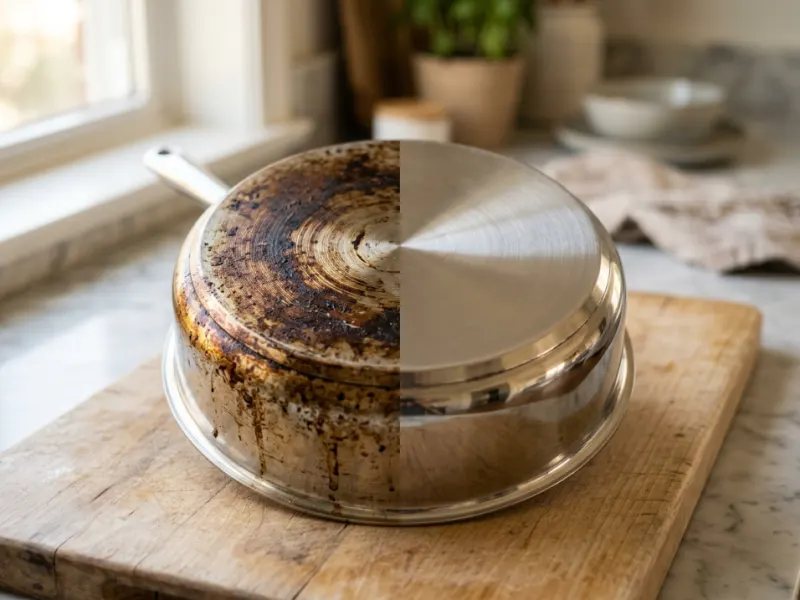
A mirror-polished pan changes appearance fast under regular use. Owners who put a year of metal spatulas, tongs, and scraped-up browned bits on a stainless pan describe the same shift every time: a brushed, satin texture across the cooking surface. We read through cookware forums looking for anyone reporting a real functional problem from this, and the same pattern repeated instead: appearance changes, performance does not.
What stays the same matters more than what changes. Once you learn the heat and preheating habits stainless steel actually needs, the pan sears, browns, and releases food exactly the way it always did. The scratches are visual. Cooking performance runs on heat management, not surface polish.

Friction marks are exactly that: marks in the surface, not gouges cut into a softer material underneath. Compare that to a hard tool cutting into a soft nonstick coating, which is the actual failure mode this whole worry gets borrowed from.
The Nonstick Comparison That Actually Explains the Difference#
Numbers make the contrast concrete. Cookware-grade stainless steel runs solid through the entire pan wall, the same alloy from the cooking surface to the outer wall. One major PTFE coatings supplier's own spec sheet, for a professional cookware system, lists a coating thickness of 35 to 45 microns, about 0.035 to 0.045 mm.
That gap is not small. It is the difference between a solid slab of one material and a layer thinner than a sheet of paper, bonded onto a different metal underneath. Scratch through the thin layer, and there is nothing left doing its job. Scratch the thick slab, and you are still standing on the same alloy.
Our breakdown of why nonstick pans stop working covers what actually kills that thin layer over time. Utensil choice is usually not the main culprit there either.
What the Metal-Leaching Research Actually Found#
Here is the part we kept finding missing from every guide that waves this off as a non-issue. It is also the genuinely useful information in this whole topic.
A 2013 study in the Journal of Agricultural and Food Chemistry measured how much nickel and chromium stainless steel actually releases during cooking. The answer is not zero. Cooking acidic tomato sauce in a brand-new, unseasoned pan for 6 hours increased nickel and chromium levels by up to 26-fold and 7-fold, respectively, over sauce cooked with no stainless steel present.
The most extreme test the researchers ran was a 20-hour simmer in a new pan. That single test pushed nickel exposure to nearly half of a person's daily tolerable intake limit for the day. That is the number behind this article's opening line, and it is real, sourced, peer-reviewed research, not a scare headline.
Two details matter more than that headline number. First, leaching dropped fast with repeated use. By the third cooking cycle, nickel release had already fallen by about 65%, and it leveled off entirely by the sixth cycle.
Second, the researchers pointed to the same chromium oxide layer described above as the reason why. As it matures with use, it measurably slows further metal release, the exact mechanism that also heals a utensil scratch.
The study's own authors frame their finding around allergic sensitivity to nickel and chromium during long, acidic cooking. They are not making a general food-safety claim, and they never tested scratched pans against unscratched ones.
So Should You Actually Worry About This?#
Three quick answers cover almost everyone reading this.
If your only concern is scratching the pan, use metal utensils freely. The marks are cosmetic, full stop, because there is no coating underneath to breach.
If you have a known nickel or chromium sensitivity, change one habit. Cut back on long, acidic cooking in a brand-new pan, not your choice of spoon or spatula. Seasoning a pan through normal use measurably lowers that leaching over the first several cooks.
If appearance matters to you more than either concern, silicone or wood utensils prevent surface marks entirely. That is a legitimate aesthetic choice, never a safety requirement.
The Best Utensils for Stainless Steel#
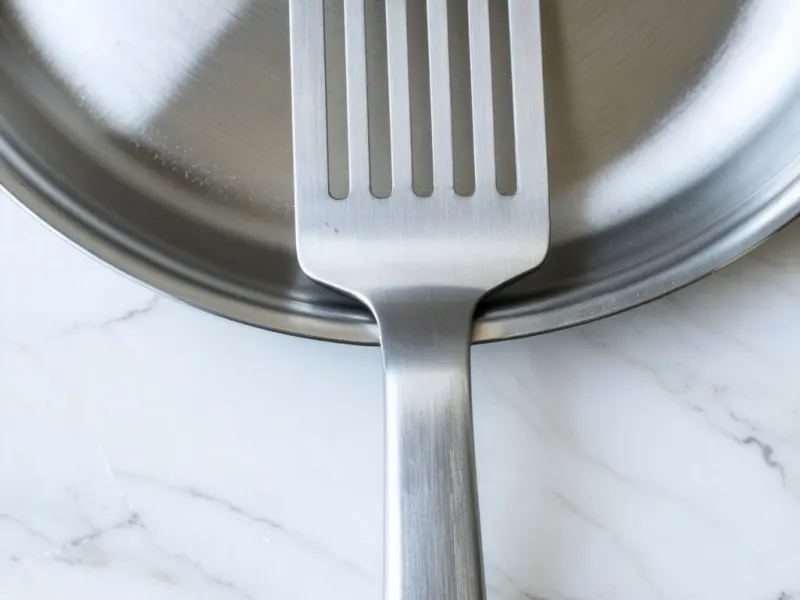
Metal is a fine default choice for stainless steel. The specific tool you want depends on the job.
For delicate work like fish fillets and fried eggs, a Victorinox Slotted Fish Turner has a thin, flexible blade. It slides under food without tearing it, and the slots drain oil as you lift. That flex is a design tradeoff.
The same thinness that makes it gentle with delicate food also makes it a poor choice for pressing. It is not the tool for smash burgers or flattening a quesadilla.
For jobs that need rigidity instead of flex, a Lamson Chef's Slotted Turner works the opposite way. It has a riveted handle and a blade that holds its shape under pressure, made in the United States, and its own design tradeoff runs opposite to the Victorinox's. A rigid blade is less forgiving when you try to slide gently under a delicate fillet.
Most kitchens end up wanting both rather than either alone. One handles delicate food, the other handles pressure work.
Silicone and Wood Still Have a Place#
If keeping the pan's original finish matters to you, silicone and wood utensils avoid surface marks entirely. That is a completely valid choice. The tradeoff is precision at the edge, since thicker silicone tools cannot slide as cleanly under a fried egg as a thin metal blade can.
Plenty of kitchens run metal on the stainless pan and silicone on anything nonstick. Splitting tools that way removes the question entirely. Our material selector quiz matches cooking habits to the right material in under a minute. Our nonstick versus stainless steel comparison covers when each material earns its spot.
The Verdict#
Metal utensils on stainless steel were never really the safety question people treat them as. The scratches are cosmetic. A solid alloy has no coating to breach, and a chromium oxide layer heals itself.
The real, evidence-backed caution around stainless steel is about cook time and acidity in new, unseasoned pans, not the tool in your hand. Know that distinction, and you can stop worrying about the spatula. Start paying attention to the thing that actually moves the number.