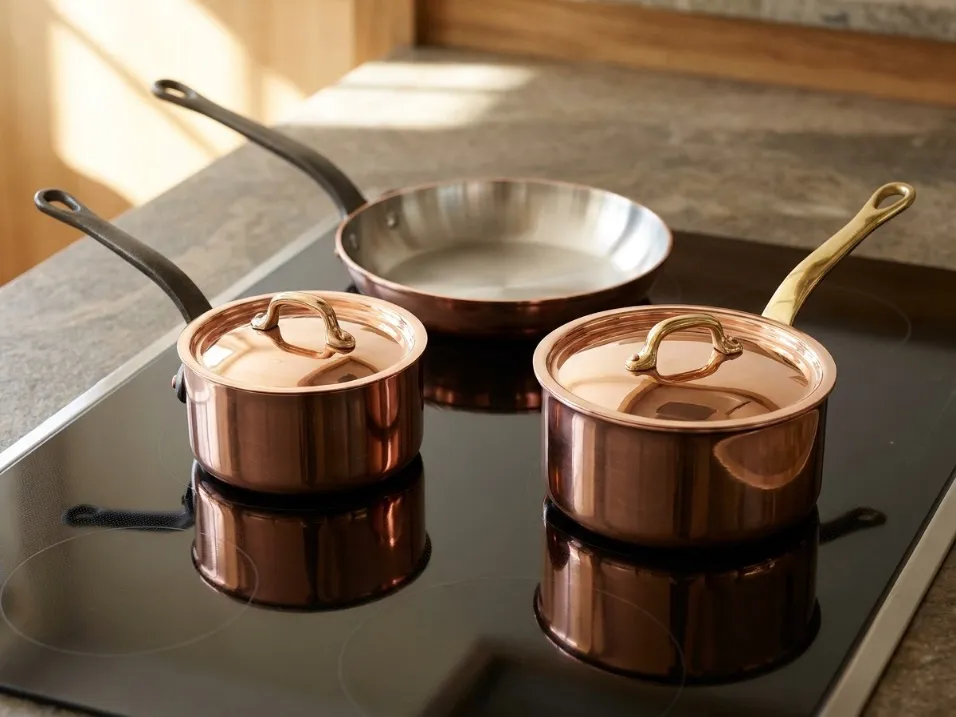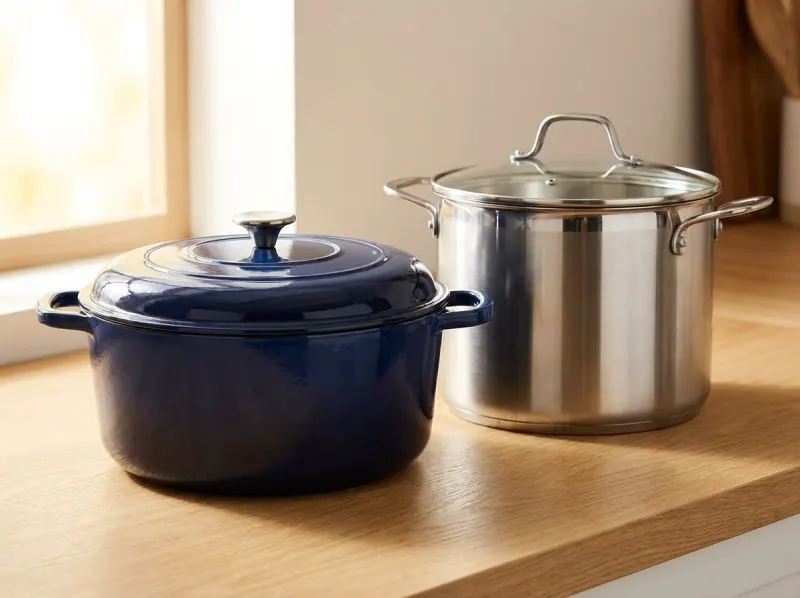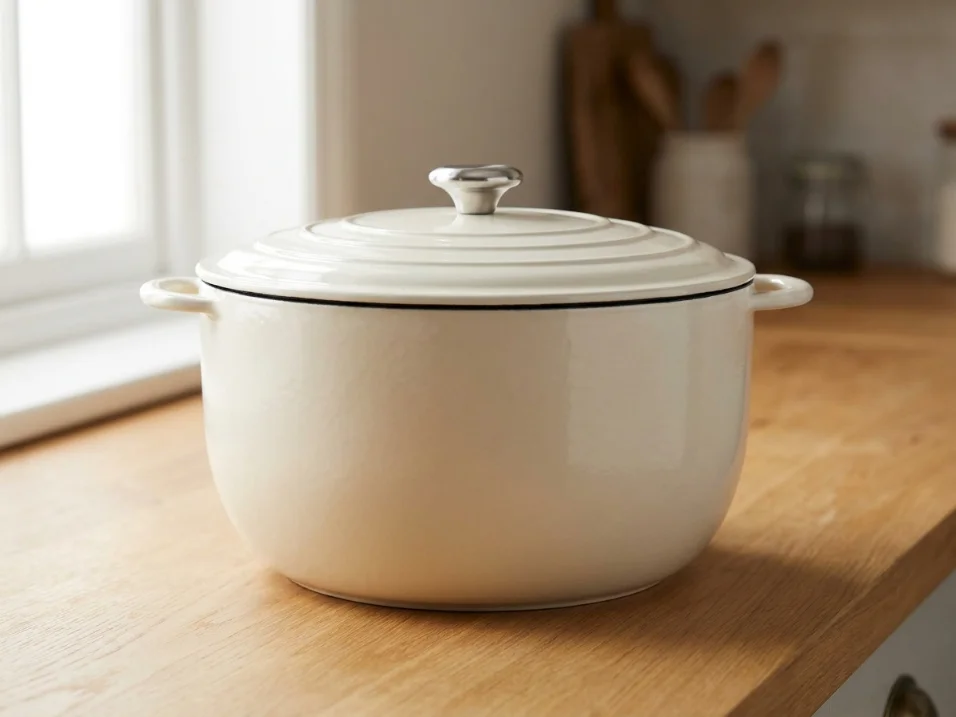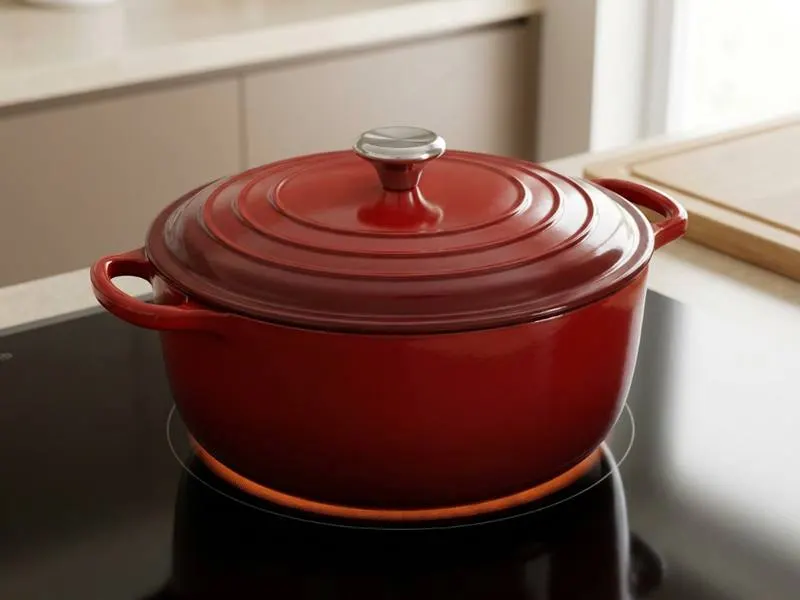
Your electric stove scorches sauces that should be simmering. Thin pans spike and dip with the element. A dutch oven solves this, and not just because it is heavy.
A dutch oven works on any electric stove type: coil, radiant glass-top, and induction. What makes it uniquely well-matched to electric is that a dutch oven's 13 lbs of cast iron absorbs the power cycling that thin pans transmit directly to food. Most competitors describe dutch ovens as "compatible" with electric stoves. None explain why they are actually better suited to them than to gas.
Why a Dutch Oven on Electric Stove Works Better Than You Think#
Electric radiant elements do not run continuously. JennAir's product docs confirm that radiant elements cycle fully on and off, even at the highest setting, to protect the ceramic surface.
The element holds enough heat during the off phase to stay at temperature. A thin stainless or aluminum pan feels every cycle. You get micro-scorching when it fires and slight cooling when it cuts out.
A dutch oven absorbs this entirely. The cast iron stores energy during the on phase and bleeds it steadily during the off phase. Your food sees steady heat. The element below it could be cycling every 30 seconds and you would never taste it.
How to Use It Safely on a Glass Top Stove#
On a glass-top stove, three things matter for heavy enameled cookware:
- Lift, do not slide. Le Creuset's care guide explicitly prohibits sliding on glass surfaces. A dutch oven's weight amplifies any debris caught underneath. A single grain of salt trapped between pot and glass acts as a grinding medium under the full load.
- Match the burner size. Le Creuset's care guide specifies matching the pot base to the cooktop heat zone. If the base significantly overhangs the element, the edges receive no direct heat while the center does, stressing the enamel unevenly. Use the largest burner that fits under the pot's base diameter.
- Start low. Lodge's care guide calls for gradual preheating with oil, and both Lodge and Le Creuset specify low to medium heat for enameled cast iron on all heat sources. The thermal mass holds temperature so efficiently that high settings cause overshooting rather than faster cooking.
What feels like a slow start becomes a stable, even temperature by the time you add food.
GE confirms that all cooktop surfaces, including radiant glass-top, induction, and electric coil, are rated to 50 lbs. A standard 6-quart dutch oven filled with a full braise stays well within that limit. We have not found a mainstream dutch oven that comes close to the weight threshold under normal cooking loads.
Electric Coil Burners#

Coil burners are the most forgiving surface for a dutch oven. The metal coils cannot be scratched by cast iron, so the lift-versus-slide rule matters only for the stove housing, not the cooking surface itself. If you have been considering a heat diffuser for electric stove use, a dutch oven makes that unnecessary.
Coil elements use the same temperature-limiting cycling behavior. Whirlpool's product docs confirm coil elements on new ranges changed starting from June 2018 and now use a limiter to hold the selected setting. A dutch oven's thermal mass handles this the same way it does on a radiant glass-top.
The main consideration on coils is burner size matching. A standard 6-quart dutch oven has a wider base than a small 6-inch coil element. If the pot significantly overhangs the coil, the outer edges receive no direct heat.
The cast iron's thermal mass eventually distributes the heat, but the preheat takes longer than on a matched burner. Use the largest coil that fits under the pot base without extending beyond it.
One practical advantage of coil burners: residual heat dissipates faster once you turn the element off. A radiant glass-top element stays hot and glowing for several minutes after cycling off, making it easy to accidentally brush a hand against a surface that looks off. Coil elements give you that visual feedback immediately.
Induction Cooktops#
Cast iron is strongly magnetic and triggers induction cooktops immediately. Enameled cast iron behaves the same way because the iron body underneath the glass enamel is what the magnetic field interacts with. If you want to verify your specific model, our induction compatibility checker confirms compatibility by brand.
The precaution specific to induction is heat ramp speed. Induction heats the iron faster than a radiant element can. If you start on a high setting, the cast iron expands before the enamel can follow.
Le Creuset's care guide names the result: rapid surface temperature changes cause thermal shock, which damages the enamel as crazing, cracks, and chipping.
Start on a low setting. Increase one or two levels at a time, with a brief pause between each step. By the time you reach medium, the pot is fully and evenly heated with no enamel risk. This process takes a few minutes, roughly the same wall-clock time as preheating on a standard radiant element, so nothing is lost.
If you want the full picture of how cast iron behaves on induction specifically, that article covers the magnet test and edge cases for bare cast iron.
What to Watch For Over Time#
If you use a dutch oven on glass regularly, check these periodically.
Enamel crazing shows as a fine network of hairline cracks visible in bright angled light. Run a fingernail lightly across the interior surface. Ridges that were not there before indicate stress fractures beginning in the enamel.
The cause is repeated rapid temperature changes: cold food into a hot dry pot, or high heat applied from cold. Slowing down preheat reduces further progression.
Glass-top marks that look like scratches are often deposits, not damage. A white or brown line on the glass after dutch oven use is usually carbonized residue from the pot bottom. Run a flat razor scraper at a shallow angle.
If the mark lifts, it was a deposit. An actual scratch has a visible groove and does not lift.
Exterior darkening on the enamel is normal. The outside of an enameled dutch oven gradually deepens in color from heat cycling. This is cosmetic and does not affect cooking performance or food safety.
The Lodge Essential Enamel 6-Quart#
This pot checks every box for electric stove use. The base is flat and smooth, which is critical for glass-top contact and even coil heating. The 6-quart size has a base that matches most standard large burners.
At 13 lbs empty (Consumer Reports' verified weight), it has enough thermal mass to buffer element cycling. It stays well within cooktop weight limits even when full. The porcelain enamel means no seasoning maintenance and no reactivity with acidic foods. It is oven-safe to 500°F, so a stovetop braise can go straight into the oven without switching pots.
The tradeoff to know: owner reports we reviewed across multiple platforms show that Lodge's enamel chips at the rim within about a year for some owners, faster than comparable Le Creuset enameled pieces. The chipping appears in three or more independent owner accounts reviewed, typically at the rim where the lid seats repeatedly. Lodge's Made Right warranty covers enamel damage during normal cooking, so a chip is not a financial loss, but it is a realistic expectation.
For a pot spending most of its time on a simmering electric stove, that is an acceptable trade.
For electric stove use, the Lodge Essential Enamel 6-Quart is the dutch oven we would reach for first.