A lot of people still believe a drop of dish soap is enough to ruin a cast iron skillet. That belief is decades out of date. It is also exactly why so many owners who ask can you put cast iron in the dishwasher assume the answer must be an even bigger no, for the same reason.
Bare cast iron should never go in the dishwasher, but the reason has nothing to do with soap. Dishwasher detergent is built to be far more aggressive than dish soap, and a full wash cycle exposes the pan to that chemistry for much longer than a quick rinse ever would.
Our cast iron cookware guide covers the rest of the ownership habit, seasoning included, once the dishwasher question is settled.
Automatic dishwasher detergent dissolves the polymerized oil seasoning that protects the pan. Once seasoning is gone, bare iron rusts fast.
If yours already went through a cycle, the pan almost certainly survived. What did not survive, and exactly how to get it back, is below.
Why Dishwasher Detergent Isn't Dish Soap#
Hand dish soap and automatic dishwasher detergent solve the same basic problem: breaking down grease. Their chemistry, though, is completely different. When we checked Lodge's own care pages against Consumer Reports and a university chemistry explainer, the same answer kept coming up: it is not the soap.
Allen Clauss is a University of Wisconsin-Madison chemistry lecturer who previously worked at Procter & Gamble. He describes automatic dishwasher detergent as a "brute force" formulation: high pH plus chlorine bleach, built to strip stains and baked-on food across a full wash cycle. Hand dishwashing detergent skips the bleach entirely. It works at a near-neutral pH, gentle enough for skin contact.
That gap in chemistry is the whole story. Seasoning is a thin layer of cooking oil, heated until it oxidizes and cross-links into a hard polymerized oil layer bonded to the iron underneath (the process is called polymerization).
A near-neutral surfactant, rinsed off by hand in under a minute, barely touches that bonded layer. A high-pH, bleach-based detergent works differently. Applied across a full cycle instead of a quick rinse, it breaks the oil down the same way it breaks down grease on a dinner plate.
Consumer Reports lists cast iron directly among the cookware that should stay out of a dishwasher. A cycle, in the outlet's words, "risks removing the seasoning...which can cause the pan to rust." Modern dish soap, meanwhile, is fine by hand. Lodge's own washing instructions say plainly: "you can use a small amount of soap."
So Can You Put Cast Iron in the Dishwasher and Get Away With It?#
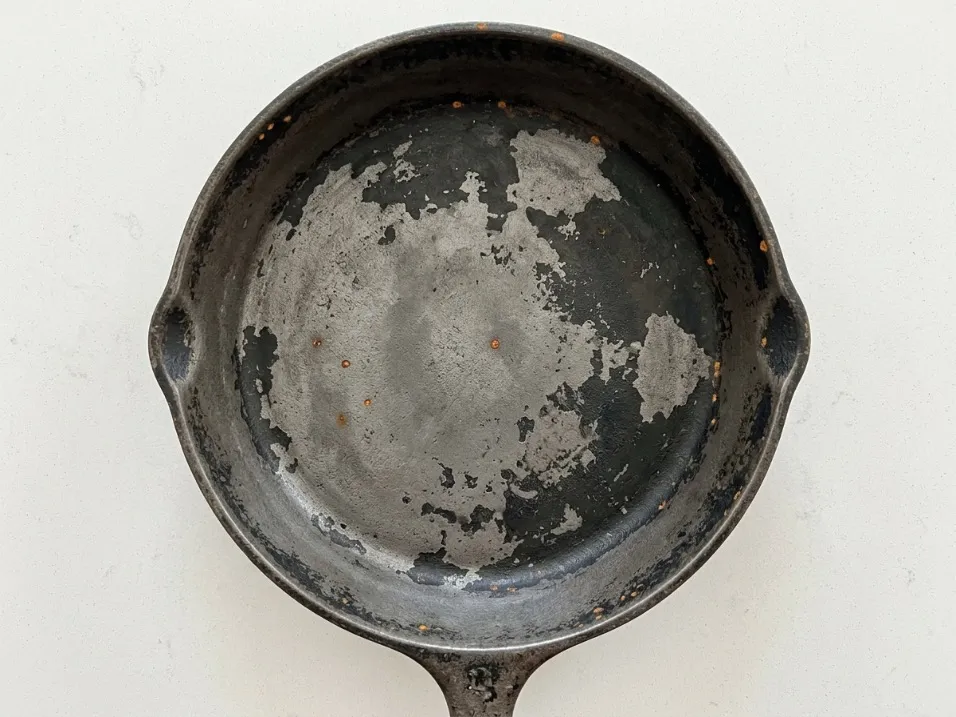
Lodge's own troubleshooting guide names the dishwasher directly as one of several rust triggers. Cast iron "left in the sink to soak, put in the dishwasher, allowed to air dry, or left in moisture-prone environments" can rust, the guide states.
Carbon steel gets the identical warning. Lodge says "just like cast iron, you don't want to soak carbon steel or wash it in a dishwasher." The brand's own carbon steel FAQ is blunt: "a dishwasher will remove the seasoning and likely cause rust." Everything here applies to seasoned carbon steel skillets and woks too. Across the guides we compared while researching this piece, none of them actually explained why dishwasher detergent is different from dish soap at the chemistry level; they asserted "harsh detergent" and moved on. If you are still weighing bare cast iron against carbon steel or an enameled piece for your next pan, the material selector quiz walks through which fits your cooking style.
Once the seasoning thins, the pan is bare iron sitting in a wet, heated environment for a full cycle, not a few seconds under a tap. Modern rough-cast surfaces compound the problem, which is one reason the drying step below is not optional.
None of this means the pan itself is ruined. Cast iron is a solid piece of metal, roughly 7.9 lbs for a 12-inch skillet, and it does not weaken from a run through a dishwasher. What takes the hit is the seasoning surface, and a seasoning surface is always rebuildable.
What About Enameled Cast Iron?#
If your piece has a glossy colored coating on the outside, such as Lodge's Essential Enamel line, Le Creuset, or Staub, it is enameled, and the rules flip entirely. Enameled cast iron is dishwasher safe. Lodge's own enameled care page says it plainly: "Technically, enameled cast iron is dishwasher safe, but we prefer hand washing to preserve the piece's finish." The vitreous glass coating does not rely on oil-based seasoning. The detergent chemistry that strips bare iron has nothing to attack here.
There is one nuance worth knowing before you toss it in every week, though. Lodge's own guidance warns that "leaving pans on a draining board to drip dry or cleaning in the dishwasher can cause a rust deposit" at an exposed rim, if it is not dried thoroughly. The rim is where a hairline gap in the coating is most likely to expose bare metal. Standing water finds it fast.
We covered the full enameled versus bare cast iron tradeoff if you are still deciding which one belongs in your kitchen.
How to Recover a Cast Iron Pan After the Dishwasher#
Start by inspecting the pan. Orange or brown surface rust is completely fixable. A wobble on a flat surface or a visible crack is a pre-existing issue from impact or thermal shock, not something the dishwasher caused.
- Scrub the rusted areas with a chain mail scrubber or steel wool under hot water until you are back down to clean gray iron.
- Dry the pan completely on a burner over low heat until every trace of moisture is gone.
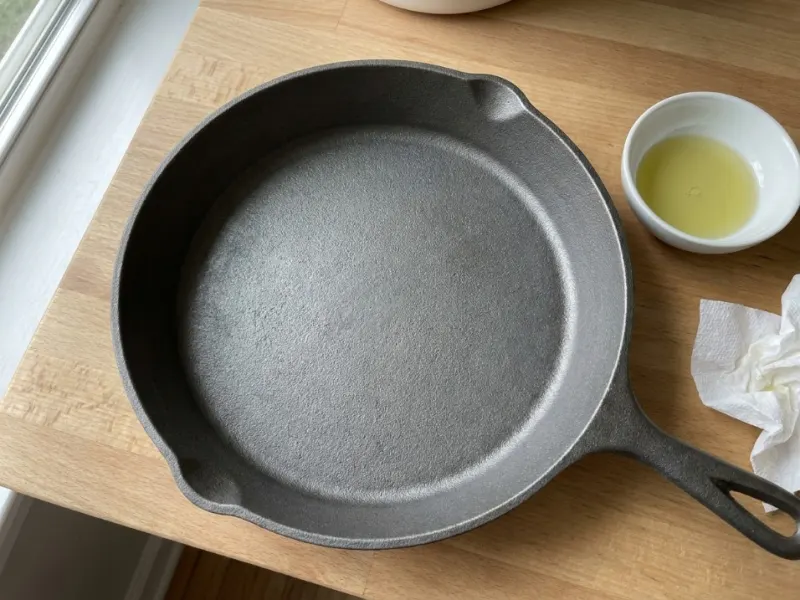
- Apply a thin, even coat of cooking oil across the entire surface, inside and out, then wipe off the excess until it looks matte rather than shiny.
- Bake the pan upside down at 450 to 500°F for one hour, then let it cool in the oven.

That one oven cycle rebuilds the rust-protection barrier. The pan will not feel as slick right away, though. That comes back gradually, over the following months of regular cooking, building working layers of seasoning on top of the base coat the oven just restored.
We wrote a full breakdown of which oils actually hold up for seasoning if you want that step right. A dedicated guide to heavier rust cases covers it if a single scrub-and-oil pass does not fully clear it.
If the Lodge 12-inch pre-seasoned cast iron skillet is the pan that ended up in the dishwasher, the fix above is the same regardless of which brand you own.
The Two-Minute Habit That Makes the Dishwasher a Non-Issue#
Cast iron ends up in the dishwasher almost always for the same reason: it sits dirty in the sink and gets treated like everything else piling up next to it. Hand washing it immediately, while it is still warm from cooking, removes the temptation entirely.
Run hot water over the pan. Work stuck food loose with a stiff brush or chain mail scrubber. A small amount of soap is fine for anything stubborn, as Lodge's own instructions confirm.
Rinse, then set the pan on a low burner until every trace of water evaporates. Wipe on a thin film of oil while it is still warm. That is the entire routine, and it takes less time than loading the dishwasher rack.
A pan that is already clean, dry, and put away cannot end up in someone else's dishwasher load by accident. If a dishwasher mishap sent you looking for a replacement, the Lodge 12-inch pre-seasoned cast iron skillet ships ready to cook straight out of the box. Want to skip this question entirely going forward? Enameled cast iron genuinely can go in the dishwasher.