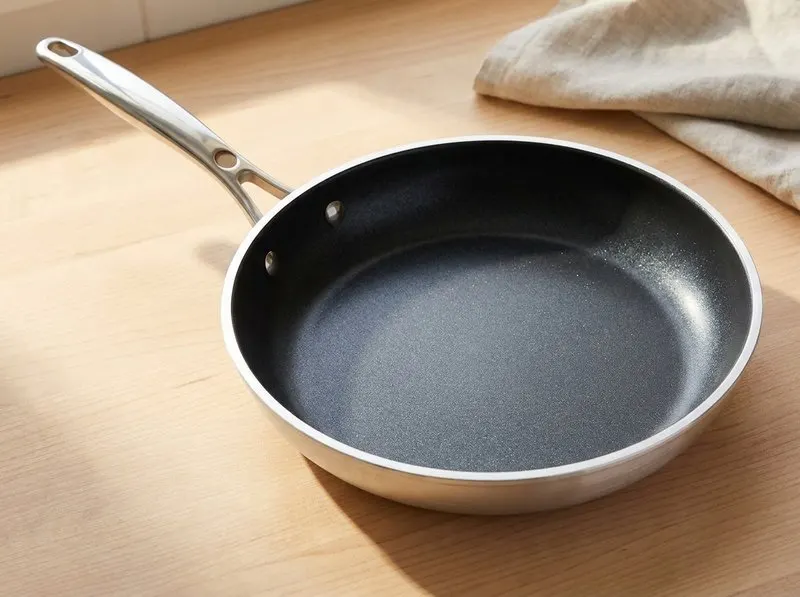
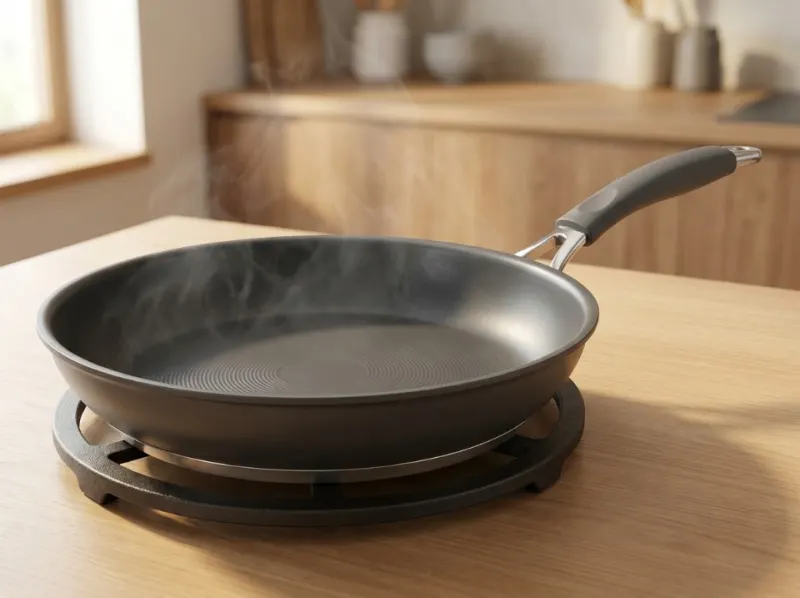
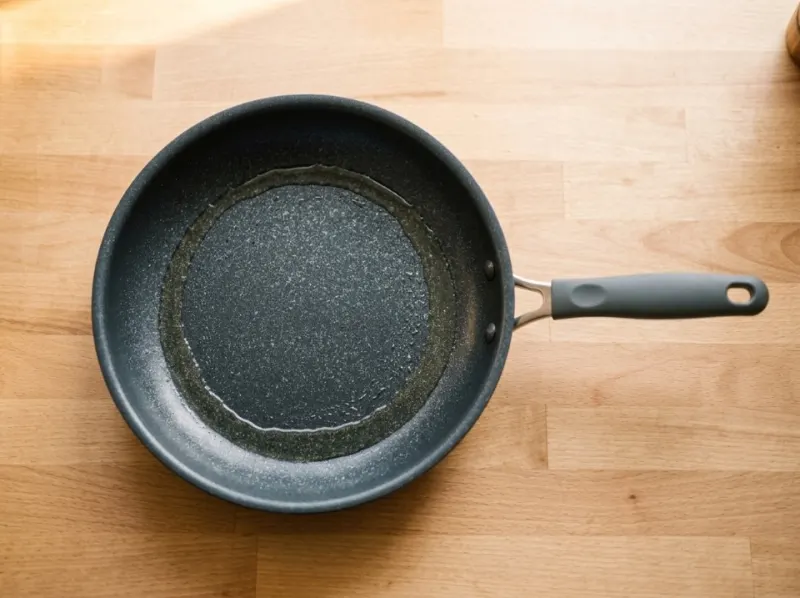
Two Calphalon skillets bought the same year can have two different oven ceilings. One tops out at 400°F. The other runs fifty degrees higher, to 450°F.
Yes, Calphalon pans can go in the oven, and most lines are rated to 450°F. Stainless-handled lines like Classic and Premier hit that ceiling. Select by Calphalon's silicone-handled line stops fifty degrees lower, at 400°F. Broiler use is a separate question that isn't decided by the coating, so check your specific line before you broil.
The number printed on your box matters less than one detail already sitting in your hand.
We dug through Calphalon's own spec pages, warranty documentation, and care instructions to sort out where each line's real ceiling sits, because the box rarely spells it out this clearly. Our nonstick cookware guide covers the same oven-safe question across every brand, not just this one.
Check the Handle First#
You don't need to remember which collection name is stamped on the bottom. You don't need the original receipt either.
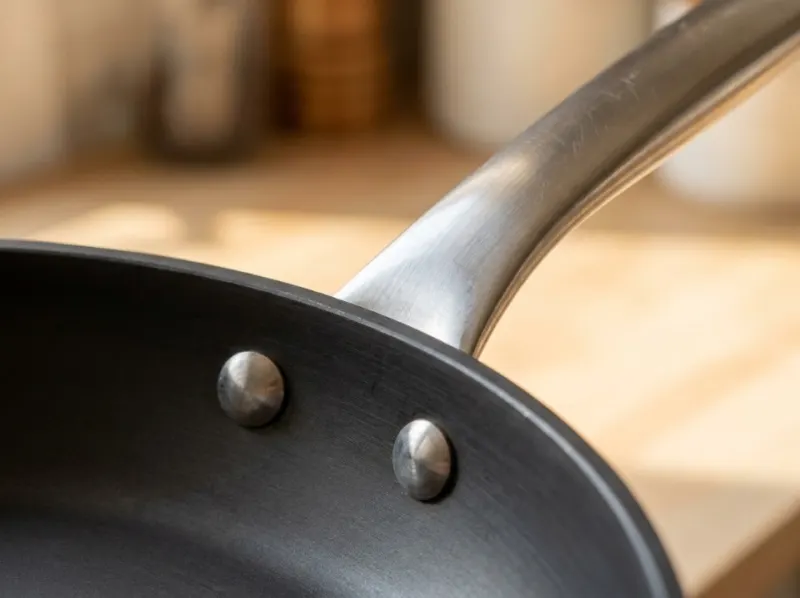
A stainless steel handle means you're holding a Classic, Premier, or another hard-anodized nonstick line, like the Calphalon Classic Hard-Anodized Nonstick Skillet. That handle means a 450°F ceiling. A silicone handle means Select by Calphalon, the budget line sold through Target. That handle caps you at 400°F.
That fifty-degree gap is not a rounding difference. Think about what you actually cook. A seared chop finished in the oven, a skillet cornbread, a frittata set under moderate heat. Most everyday recipes like these stay comfortably under either ceiling.
A high-heat roast is a different story. A recipe asking for a hard 450°F finish pushes a Select skillet right up against its printed limit, with no room for an oven that runs a little hot. Our read: if you already own the silicone-handled line, that's the recipe to double-check before you preheat, not every recipe you own.
Pushing past a rated ceiling again and again is exactly the kind of overheating that shows up on a hard-anodized nonstick coating as premature wear, long before the pan should have worn out.
Why the Broiler Is Different#
Broiler use isn't decided by whether a pan has a nonstick coating. Calphalon's Premier Space-Saving and Select by Calphalon lines, both PTFE hard-anodized nonstick, are broiler-banned on their own spec sheets. Calphalon's current plain Hard-Anodized Nonstick collection, the same PTFE coating, is rated broiler-safe on its own spec sheet.
Same coating, opposite rating. Calphalon's stainless lines clear the broiler too, with no coating at all to worry about.
PTFE, the coating on Calphalon's hard-anodized nonstick lines, begins releasing fumes at temperatures as low as 500°F according to NCBI's clinical overview of polymer fume fever, though the same overview notes human symptoms from those fumes generally don't start until 662°F. That's one real reason some Calphalon lines draw a hard line at the broiler. It doesn't explain why an identically coated line elsewhere in Calphalon's own catalog clears it. If you want to know exactly what is in a given coating, our PFAS safety checker gives a sourced verdict by brand and line.
A broiler works differently from an oven anyway. Its element sits just a few inches above the pan and runs far hotter at the surface than the dial number suggests, closer to direct flame than to convection heat, in a way that's hard to pin to one exact reading.
Classic Nonstick, the line reviewed here, doesn't publish a broiler rating either way. Calphalon's own use-and-care page for it never mentions the broiler at all. Our call, until Calphalon says otherwise: leave it off the table. A broiler element runs well above this pan's verified 450°F oven ceiling, into range where PTFE fume release becomes a real factor, so treating Classic Nonstick as broiler-off is the conservative read on the two numbers we do have, not a rule Calphalon states.
The Lid and the No-Boil-Over Insert#
An oven-safe skillet doesn't automatically mean every piece in the box is oven-safe. For the exact oven limits, including the handle and lid, look the pan up in our oven-safe temperature tool.
Calphalon's tempered glass lids ship rated to match the pan they arrived with, so a lid follows whatever ceiling its own skillet carries. The silicone No-Boil-Over insert bundled with some pasta and rice pots is a different story entirely.
Calphalon's own care instructions say that insert should never touch the oven, the stovetop, or any other hot surface. It has one job only, sitting inside a pot of water that's already boiling, to keep starchy water from spilling over the rim. If your pot came with one, pull it out before the pot goes anywhere near heat outside a normal stovetop simmer.
The fix takes ten seconds. Before any pot goes into the oven, lift the lid and check whether the insert is still sitting inside. It's an easy thing to forget once dinner is on the table and the oven door is already open.
What Voids the Warranty#
Calphalon's warranty page lists unapproved oven or broiler use right next to overheating as one of the most common ways owners lose coverage. The page shows photographed examples of pans pushed past their rated heat.
That's a real, recurring pattern the manufacturer tracks, not a hypothetical worst case dreamed up for a fine-print clause.
Here's the part that costs you twice. The same overheating that voids a warranty is frequently the same heat that breaks down a nonstick coating years before it should have worn out. A pan that quietly loses its release a year early, and its lifetime warranty right along with it, was never a bargain in the first place.
We'd rather you catch this before the receipt is long gone, not after. If you're not sure whether your pan has already been pushed past its ceiling, look for warping on the base or a nonstick surface that has gone dull and patchy faster than you'd expect. Either sign is worth a look at Calphalon's warranty page before you buy a replacement.
The Calphalon Oven-Safe Skillet We'd Point You To#
If you want the simplest answer and don't want to think about handle material every time you preheat, the Calphalon Classic Hard-Anodized Nonstick Skillet is the easiest line to reason about. Stainless handle. 450°F ceiling.
Hand wash only, which is the one habit that actually protects the lifetime warranty that comes with it. Budget for a replacement anywhere from about a year on the short end to four to five years with careful use, the same range owners report across this coating, not a one-time purchase.

Skip it if you already own a Select by Calphalon set and you're happy with it. A 400°F ceiling covers the overwhelming majority of stovetop-to-oven recipes, and buying a second skillet just to gain fifty degrees rarely earns its keep for most kitchens. But if you're shopping new and want the widest margin for high-heat finishes, or you share a kitchen where nobody remembers which skillet belongs to which set, the stainless-handle line removes the guesswork completely.
Either way, check your line's own spec sheet before you broil anything, including this one. Classic Nonstick doesn't publish a rating, which is exactly why we're treating it as broiler-off. If your kitchen mixes stainless steel and nonstick pieces from Calphalon, the handle still decides your oven ceiling, but the broiler question is its own separate check every time.