5x more strength. 10x longer. A sticky egg by month four.
The first two numbers come from Blue Diamond's own product page. The third comes from a Consumer Reports staff writer who cooked on the pan for months.
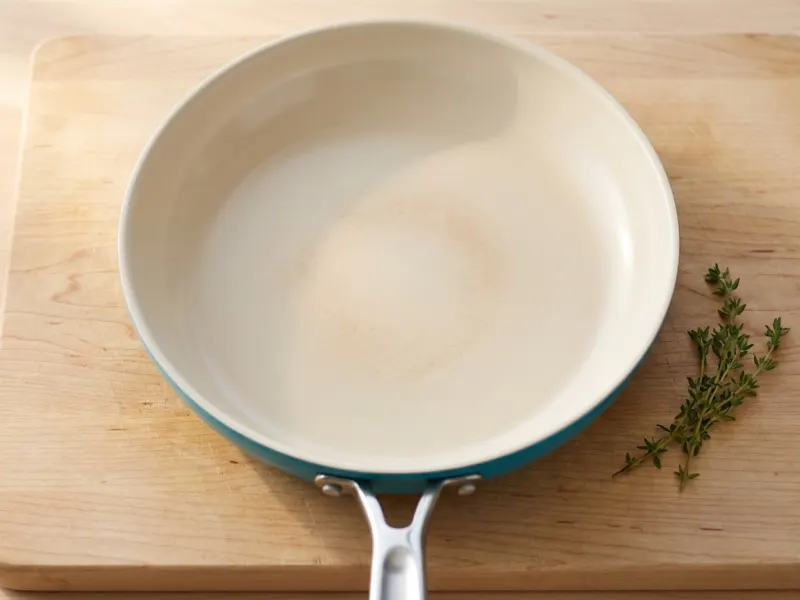
In Consumer Reports' lab, Blue Diamond's ceramic frypan released food cleanly and heated evenly right out of the box. Its 10-inch sibling is lighter than most nonstick pans Consumer Reports has tested, and the ceramic coating is PTFE-free. But a harder coating doesn't hold release longer, so expect to replace it sooner than the box suggests.
That gap between the marketing and the care sheet is the whole story here.
Blue Diamond's Claims: What the Brand Says Now#
The current product page promises a coating that "delivers 5x more strength and lasts 10x longer than conventional coatings." The separate Care and Use page adds a heat claim. The coating "conducts heat 4x faster than traditional coatings."
Both are the brand's own wording, not figures tested by an outside lab. Older marketing copy, captured on the brand's site in mid 2026, compared that heat transfer specifically to copper. That comparison no longer appears on the current product, care or FAQ pages.
The 4x figure survives. The copper line it used to ride on does not.
Under the "diamond" name, the coating is a diamond-infused sol-gel ceramic: a silica-based solution with microscopic diamond particles mixed in. It's sprayed onto an aluminum body, then cured in an oven at what Blue Diamond itself calls a relatively low temperature.
So that's three claims to separate: a strength number, a durability number, and a heat number, and all three come from the brand. The next section tests the strength claim against something real.

Why 5x Harder Doesn't Mean It Releases Food Longer#
"5x more strength" sounds like it should mean "lasts longer." It doesn't, and two separate pieces of evidence show why.
Start with hardness. Fluorocarbon Group, an industrial applicator that coats surfaces in both ceramic sol-gel and PTFE finishes, rates sol-gel surface hardness "Very high (9H)" on the pencil scale. PTFE rates "Low" on the same scale.
That's a supplier's own comparison table, not an independent lab measurement, and it isn't a test of Blue Diamond's coating specifically. On hardness alone, then, the direction of Blue Diamond's claim has outside support.
Hardness is not the same property as release. A 2025 peer-reviewed study from the University of Cordoba, published in Results in Engineering, ran 90 pancake cooking cycles on six coatings: five commercial sol-gel ceramics and one PTFE. Researchers measured how much force it took to peel food off the surface after every cycle.
PTFE kept a low, consistent peel force the whole way through. Food released from the PTFE pan with up to a third of the force the best ceramic coating needed. PTFE also held up best against abrasive wear in the same test.
Two things that study did not do: it never touched a Blue Diamond pan, and it never measured hardness. Read the hardness rating and the release data as two separate findings. Together they show that scratch resistance and slickness are different properties, and the harder coating family lost on slickness.
What explains the release gap, if not hardness? The sourced drivers are heat, wear, and age. Blue Diamond's own care sheet, quoted by Consumer Reports, warns buyers to expect "a natural reduction of non-stick properties" over time, and that prolonged high heat speeds that decline up.
GreenPan and Zwilling say the same thing about their own ceramic lines in their own manufacturer documentation. Overheating and ordinary wear erode release gradually, no matter how hard the surface tests on a pencil scale.
Heat and Handle: What Consumer Reports Found in the Lab and at Home#
Consumer Reports ran two kinds of testing on this 12-inch Blue Diamond frypan: a formal lab evaluation and a staff writer's own months of home cooking.
In the lab, food release and cooking evenness both rated excellent, and the coating held up well under repeated abrasion testing. The handle stayed cool on the stovetop, but it scored only "so-so" for sturdiness.
Consumer Reports weighed the 10-inch size. At 1.7 pounds, it sits at the light end of the 1 to 2.5 pound range Consumer Reports found across the nonstick pans it tested. Blue Diamond rates the pan oven and broiler safe up to 600°F, well above the 500°F ceiling most nonstick pans carry. Our oven-safe temperature lookup shows each maker's stated oven limit, quoted from its own documentation.
Consumer Reports did not independently test that specific oven claim. It's a manufacturer number worth knowing, not a lab-confirmed one.
The home-use result matters more for buying expectations. The staff writer's own 12-inch pan performed well at first, then stuck badly four months in: a dry-pan fried egg turned into a sticky mess.
A little oil fixed the immediate problem. That's the same gap this review opened with, confirmed on an actual pan rather than a lab bench.
Care and Safety: Hand Wash, Soft Utensils, and the PFAS Question#
Blue Diamond's own product label lists the pan as dishwasher safe and metal utensil safe. Its Care and Use page narrows both claims right away.
It recommends hand washing, plus plastic, silicone, or wooden utensils to prolong the coating's life. It warns against sharp objects or striking the rim or surface with anything.
Consumer Reports' own recommendation lines up with that narrower advice: hand wash it, even though the label says the dishwasher is fine.
On safety, two separate claims are worth untangling. Consumer Reports lists the coating as made without PTFE, matching Blue Diamond's own description exactly.
Separately, Blue Diamond states the coating is free of PFAS, PFOA, lead, and cadmium. That broader claim is the manufacturer's own statement, not an independently lab-verified one the way this site tracks for GreenPan and Caraway. Both of those brands publish third-party test results or a disclosed composition behind their own PFAS-free claims.
That doesn't make Blue Diamond's claim false. The PTFE-free part also appears in Consumer Reports' writeup, while the wider PFAS-free part currently rests on the brand's word alone.
Our guide to ceramic cookware safety walks through why that distinction matters. The cookware safety checker tracks which specific brands have published proof behind their own PFAS claims.

Does the Blue Diamond Pan Warp?#
Blue Diamond markets a Warp Control Base: a heavy-duty forged base that resists "warping, wobbling, or degrading over time." That's the brand's own qualitative description.
Blue Diamond doesn't publish a base thickness or gauge figure to back it up.
The brand's own Care and Use page gives the real risk factor directly. Rinsing a hot pan while it's still hot risks thermal shock, which can warp pans.
That lines up with the general reason pans warp at all. Thin, lightweight nonstick pans are the construction class most vulnerable to cold-shock and uneven-heating warp, because the center and edges expand at different rates when the temperature swings fast.
Letting the pan cool before it touches water is the one habit that keeps this from starting. See our full breakdown of why pans warp for the mechanism in more depth.
Collections: Which Blue Diamond Line Fits Your Stovetop#
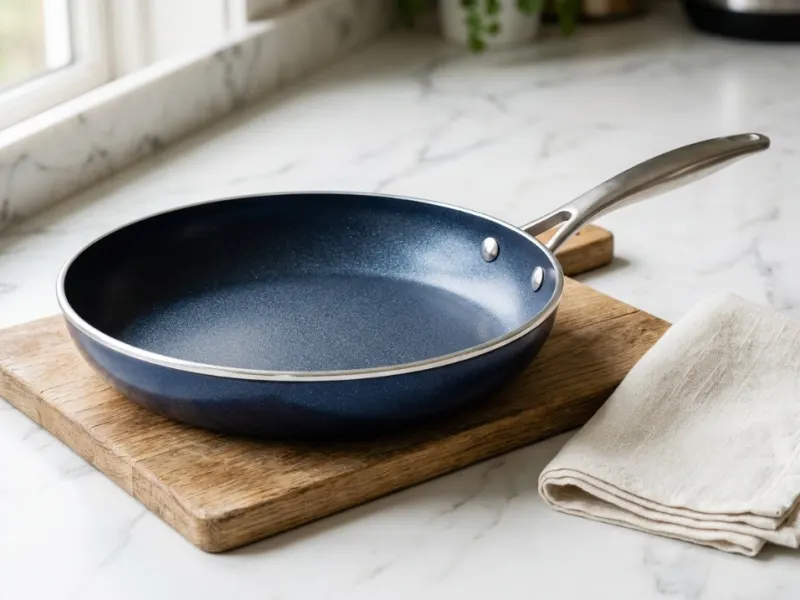
The pan this review covers is the Classic 12-inch Frypan, Blue Diamond's current official name for the model older listings called the Enhanced Ceramic Nonstick Fry Pan. It's the same physical pan under a new name.
The Classic line, including this frypan, works on every stovetop except induction. If induction matters to you, three other lines cover it.
Gold, Diamond Bond, and White Diamond are all confirmed induction-ready on their own product pages. Diamond Bond is the standout construction change among them, since it swaps the standard aluminum body for a 3-ply stainless steel body.
Blue Diamond's warranty backs the coating specifically for two years, plus a lifetime warranty on other defects in materials and workmanship.
Both exclude normal wear and tear and failure to follow the care instructions, which matters given everything above about heat and hand washing.
Ceramic coatings as a category run on an owner-reported window: a few months up to about a year and a half before release noticeably fades.
Our guide to how long ceramic coating lasts breaks that range down further.
For how either brand's coating stacks up against plain PTFE on safety and lifespan generally, see our nonstick cookware buying guide and our ceramic versus Teflon comparison.
Verdict: Who Should Buy the Blue Diamond Pan#
Buy this pan if you want a PTFE-free ceramic coating with strong release and even heat right out of the box.
The light weight and the stay-cool handle are genuine advantages too, confirmed in Consumer Reports' own lab testing rather than taken from the box.
Skip it if you're buying on the "10x longer lasting" line specifically, or if you need induction compatibility and haven't checked that the Classic line doesn't offer it.
Skip it as well if you'd rather buy once and replace rarely.
Set the expectation correctly going in. The Blue Diamond 12-Inch Ceramic Nonstick Frying Pan delivers a strong first impression, a normal ceramic lifespan, and a coating that rewards hand washing and medium heat the same way every sol-gel ceramic pan does.