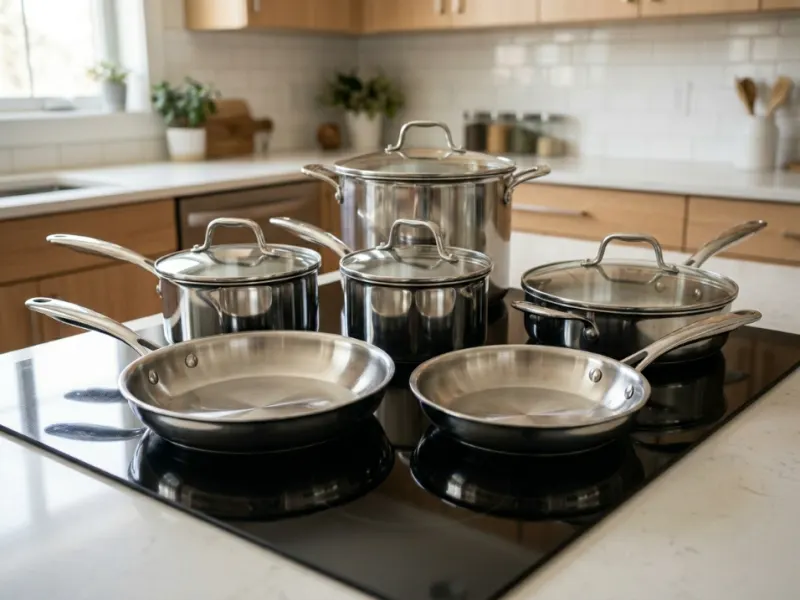
A fully clad tri-ply skillet, the exact construction every glass-top buying guide tells you to buy, still developed a warped bottom within 3 months. Multiple owner reports on Amazon describe the same failure on the same well-reviewed line.
Our pick for a glass top stove is Heritage Steel's EATER Series: 5-ply fully clad stainless steel, made in the USA, with no PTFE or ceramic coatings to eventually replace.
Fully clad construction lowers your odds of warping by a lot. It just doesn't erase them completely. We dug through manufacturer support pages and owner reports on Amazon to find out why, and understanding that gets you further than any single product pick.
The Cycling You're Probably Blaming on a Broken Stove#
Does your glass top stove boil slowly? Refuse to hold a simmer? Ignore the dial when you turn the heat down?
The appliance is usually not broken. Three manufacturers say so directly.
JennAir's own support page states that radiant elements cycle "ON and OFF, even at the HI setting, to prevent damage to the ceramic cooktop." It calls this "normal operation." KitchenAid describes the same behavior: elements "cycle on and off to reach the right temperature." LG confirms it a third time, adding that cycling happens "more frequently if cooking on a lower temperature setting."
None of those three pages ties the cycling rate to which pan sits on the burner. They describe it as how the appliance works, full stop.
What actually varies by pan is how evenly it carries that heat away. Whirlpool's own maintenance guidance is specific here: a flat-bottom pan gives "the best heat conduction and energy efficiency." A pan with a "rounded, warped, ribbed or dented" bottom "could cause uneven heating and poor cooking results."
Put the two facts together and the real picture comes into focus. Cycling on and off is normal by design. A pan that can't sit flat against the glass just makes that normal cycling produce worse, less even results. To you, at the stove, that reads as a malfunction.
Disc-Bottom vs Fully Clad: What Actually Warps#
Disc-bottom construction bonds an aluminum plate to the base of a stainless pan and stops there. The sidewalls stay pure stainless. Under a concentrated radiant element, the disc and the surrounding steel expand at different rates every time you cook. Do that often enough, and the bond line develops stress until the center sets slightly concave.

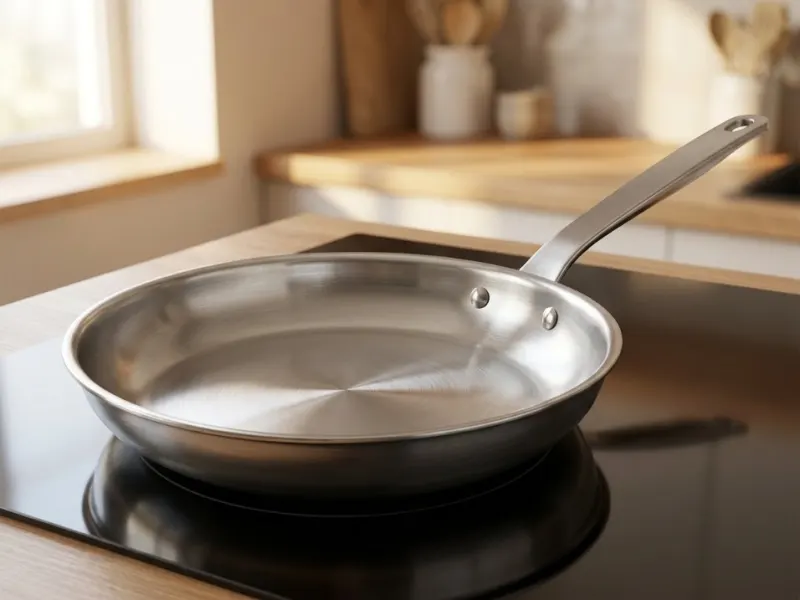
Fully clad construction avoids that stress point entirely. The aluminum core runs all the way up the sidewalls instead of stopping at the base.
Some brands make the two constructions genuinely hard to tell apart by name. Tramontina sells a "Tri-Ply Base" line, aluminum bonded only at the base, right alongside a "Tri-Ply Clad" line where the core runs base to rim, per the brand's own product pages. Both lines use nearly identical marketing language about even heat.
The fix is to read past the word "tri-ply" itself. Look for "clad," "fully clad," or "base to rim" in the actual description. If a listing only mentions an aluminum core with no cladding detail at all, budget for the same warping timeline as any other disc-bottom pan.
Even "Fully Clad" Isn't a Guarantee#
Here's the part most glass-top buying guides skip. A "fully clad" label lowers your odds of warping. It does not zero them out.
Amazon owner reports describe a Cuisinart MultiClad Pro skillet, a well-known and well-reviewed fully clad tri-ply line, developing "convex warpage on the bottom" after one owner's "first pan." A second, independent owner reported the "bottom warped within 3 months" on that same line. A separate report describes a Cook's Standard Multi-Ply Clad skillet, also fully clad, warping after "over a year" of use.
Both product listings carry consistently high overall ratings. These are minority complaints on generally well-reviewed cookware, not proof that fully clad construction is unreliable.
What they do prove, and what we think matters more than either report on its own, is that construction is a strong predictor, not an absolute one. Rapid temperature swings, like cold water hitting a hot pan, stress any metal regardless of layer count. So does running a pan much larger than its burner. The 3-ply vs 5-ply article goes deeper on what extra layers actually buy you, but the headline nuance is simple: buy for construction, then still handle the pan like something you want to keep flat.
What Works on a Glass Top Stove#
Fully clad stainless steel, tri-ply or 5-ply, is the most reliable long-term choice for a glass top. It doesn't scratch the glass and carries no coating to eventually replace. The flatness argument above applies directly.
It does ask more of you at the stove. Proper preheating and the water-drop test replace a nonstick shortcut. Understanding why everything sticks to a cold stainless pan makes that technique click faster.
Hard-anodized aluminum is solid too, when you want a nonstick surface on a glass top. The electrochemically hardened surface holds up well on glass tops without the fully clad construction stainless relies on.
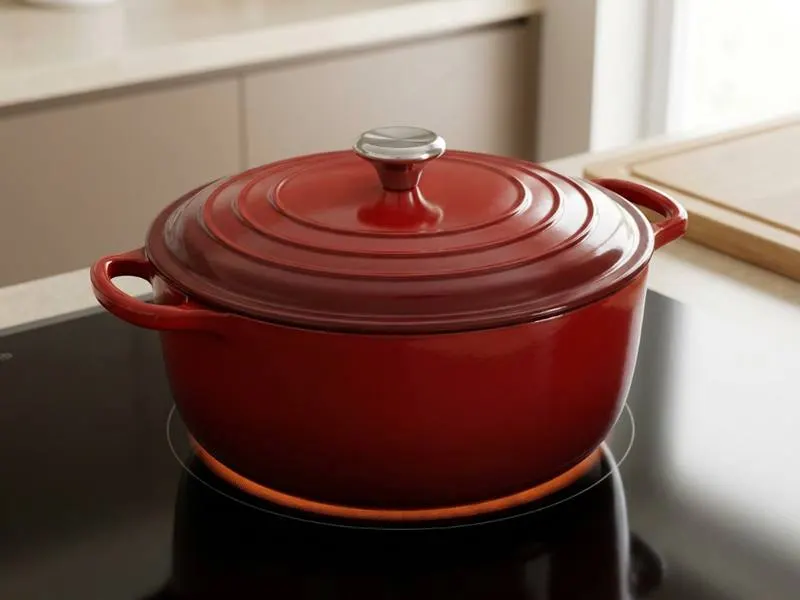
Enameled cast iron handles glass tops well, with one caveat. The smooth enamel itself resists scratching, but dragging it across the glass can still chip the enamel and scratch the surface, the same lift-don't-slide habit that protects bare cast iron. Sheer weight keeps the pan sitting flat by default. The tradeoff is slow temperature response, a property of cast iron generally, not something specific to glass tops.
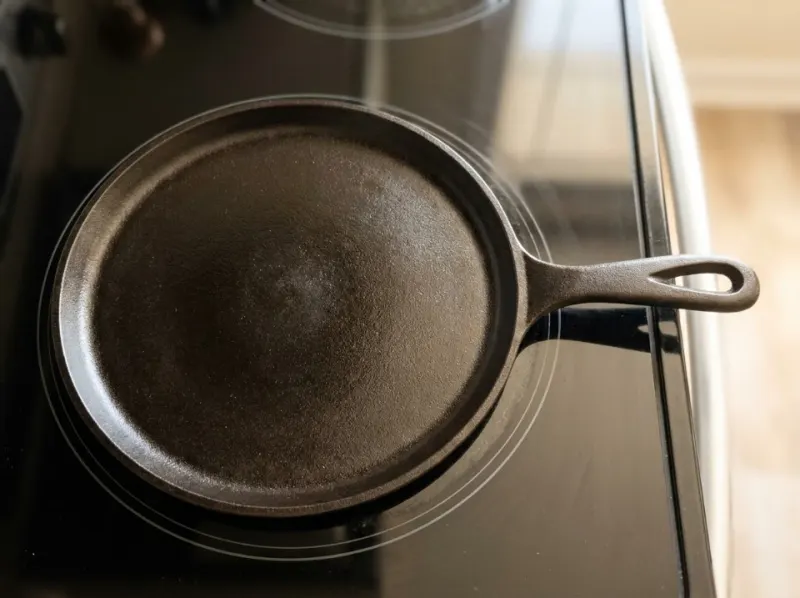
Bare cast iron works too, as long as you never drag it. The cast iron for glass top stoves guide covers the lift-don't-slide habit in more depth, including a sanding option if you want extra scratch margin.
The Cookware We'd Point You Toward#
For anyone building a glass-top kitchen from scratch, Heritage Steel's EATER Series is the clearest upgrade over a standard disc-bottom set. It's a 5-ply fully clad line, 2 layers of stainless plus a 3-layer aluminum core running the full height of each piece, with a 400-series ferritic exterior layer for induction compatibility, manufactured in Clarksville, Tennessee.
There's no PTFE, no ceramic sol-gel, and nothing else to eventually replace. The whole set is rated oven-safe to 800°F and broiler-safe, which covers nearly anything a home kitchen throws at it. Checking a different brand's oven limit first? The oven-safe temperature lookup tool covers a range of brands in one place.
The ten-piece set is more cookware than a lot of kitchens have room for. Heritage Steel also sells a smaller 5-piece Essentials Set and an 8-piece Core Set if storage is tight. Or start with just a skillet and a saucepan, and build out once you know which sizes you actually reach for.
One tradeoff worth naming honestly: the handles are riveted by hand rather than welded, per the brand's own manufacturing page. That leaves a small interior attachment point at the handle base. It's not a defect, it's simply what riveting looks like, but it does mean an extra spot to scrub after a sticky sauce reduces down near the handle. In exchange, the brand backs the set with a lifetime warranty it says is still honoring cookware bought over 30 years ago, a longer track record than most cookware brands put a number on.
Where This Leaves You#
Element cycling on your glass top is normal, by three separate manufacturers' own account. Stop troubleshooting the appliance first. Start with the pan.
The construction words on the listing, not the word "stainless" alone, tell you which side of that distinction you're buying. Heritage Steel's EATER Series sits on the safer side of it. That single check, done before you buy, does more for long-term performance than any other spec on the page.
Fully clad construction is not a hard guarantee against warping, but it's the single biggest lever you control at purchase time. Pairing it with basic care, no thermal shock, no wildly oversized pan on a small burner, closes most of the remaining gap. Weighing whether the investment beats replacing a cheaper set every couple of years? The cookware cost calculator can run that math against your own kitchen habits.